🪸 Reef Tank Calcium Calculator
Calculate daily calcium dosing for your reef aquarium — kalkwasser, calcium chloride, or 2-part solutions
| Tank Name | Dimensions (L"xW"xH") | Volume (gal) | Volume (L) | Low Demand (mg/day) | High Demand (mg/day) |
|---|---|---|---|---|---|
| Nano Reef | 12x8x10 | ~4 | ~15 | 120 | 300 |
| 10 Gal Reef | 20x10x12 | 10 | 38 | 300 | 750 |
| 20 Gal Long | 30x12x12 | 20 | 76 | 600 | 1,500 |
| 29 Gallon | 30x12x18 | 29 | 110 | 870 | 2,175 |
| 40 Gal Breeder | 36x18x16 | 40 | 151 | 1,200 | 3,000 |
| 55 Gallon | 48x13x21 | 55 | 208 | 1,650 | 4,125 |
| 75 Gallon | 48x18x21 | 75 | 284 | 2,250 | 5,625 |
| 90 Gallon | 48x18x24 | 90 | 341 | 2,700 | 6,750 |
| 125 Gallon | 72x18x22 | 125 | 473 | 3,750 | 9,375 |
| 180 Gallon | 72x24x24 | 180 | 681 | 5,400 | 13,500 |
| 220 Gallon | 72x24x30 | 220 | 833 | 6,600 | 16,500 |
| Method | Ca per dose | Raises 10 gal by 10 ppm | Alk Effect | Best For |
|---|---|---|---|---|
| Calcium Chloride (dry) | 1.85g Ca per tsp | ~1.4 tsp dry | None (raises Cl⁻) | Correction doses, small tanks |
| Calcium Chloride (liquid) | ~100 ppm per 15ml/10gal | ~15 ml | None | Easy liquid dosing |
| Kalkwasser (saturated) | ~2 g/L Ca(OH)₂ | ~200 ml sat. solution | Raises pH & Alk | Evaporation topoff, all sizes |
| Two-Part (Part A) | Varies by brand ~40 g/L Ca | ~25 ml Part A | Raises Alk (Part B) | Consistent SPS reefs |
| Calcium Reactor | Continuous via CO₂ | N/A (flow rate tuned) | Raises Alk & Ca together | Large SPS dominated systems |
| All-in-One Nano Blend | Varies ~20 g/L Ca | ~50 ml | Balanced blend | Nano reefs, beginners |
| Natural Seawater (NSW) | ~420 ppm baseline | Water change dependent | Natural balance | Large systems near ocean |
| Desired Raise | CaCl₂ Dry (tsp) | CaCl₂ Dry (grams) | Kalk Sat. Solution (ml) | 2-Part Part A (ml) |
|---|---|---|---|---|
| +10 ppm | ~1.4 tsp | ~6.4g | ~200 ml | ~25 ml |
| +20 ppm | ~2.8 tsp | ~12.8g | ~400 ml | ~50 ml |
| +30 ppm | ~4.2 tsp | ~19.2g | ~600 ml | ~75 ml |
| +40 ppm | ~5.6 tsp | ~25.6g | ~800 ml | ~100 ml |
| +50 ppm | ~7.0 tsp | ~32g | ~1,000 ml | ~125 ml |
One of the most important things in Reef Tank aquariums is Calcium, that you simply can not ignore. Corals and other animals use it to build their skeletons and structures from Calcium carbonate. Problem is that the water in Reef Tank systems has less Calcium than in the ocean, so levels of Calcium can drop very easily and need constant attention.
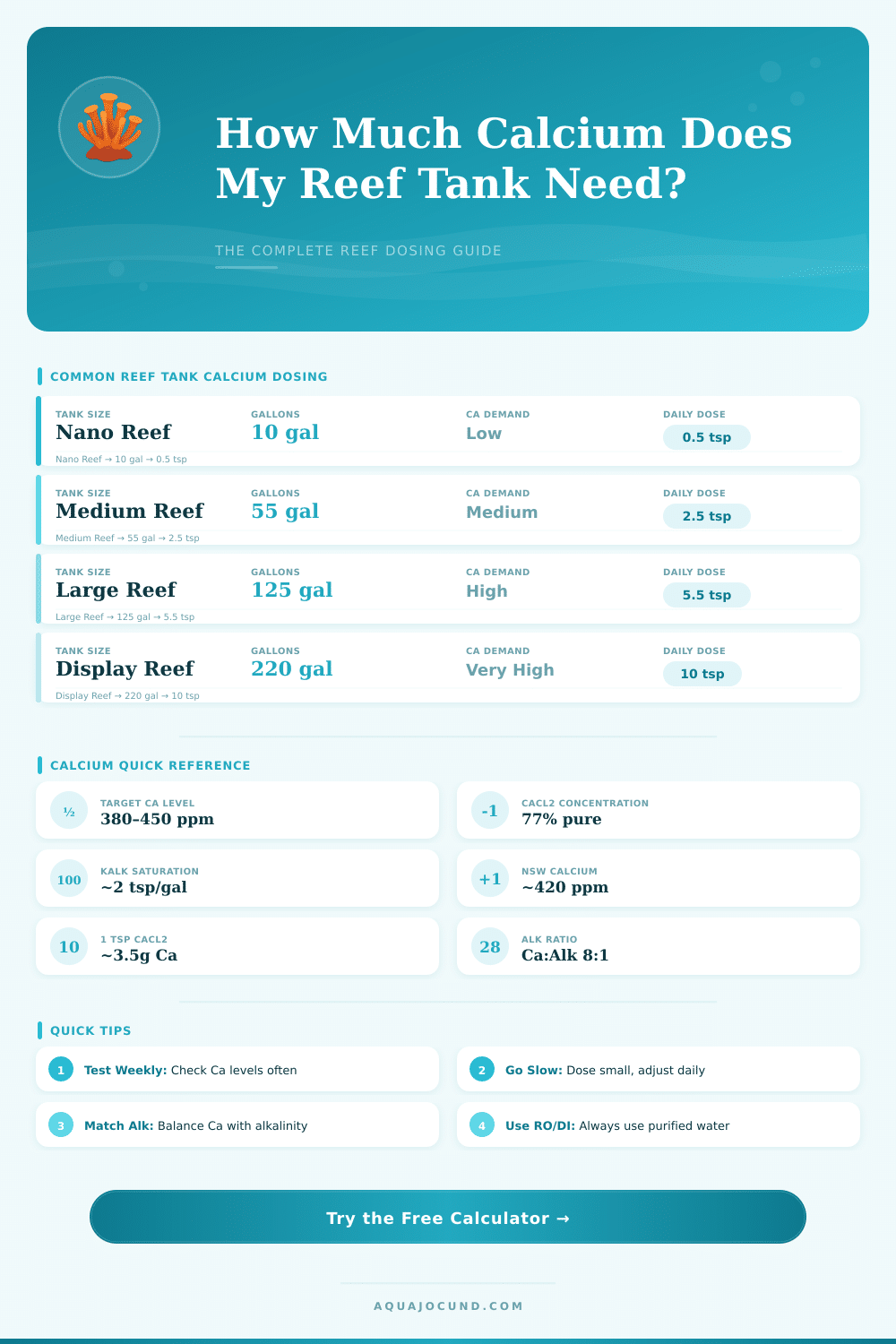
You want levels between 380 and 450 ppm to stop everything going wrong. I found, that for good growth of coral skeleton, stay around 400 to 450 mg/l works best, while the carbonate hardness stays between 7 and 9 degrees.
Keep Calcium, Alkalinity and Magnesium Stable in Your Reef Tank
If it falls under 320 ppm, you certainly have low Calcium. When it slips down to around 280 or 300 ppm, the natural processes in the tank simply can not bring it back to the needed level without your help. Even so, unless you care about a tank fully loaded with difficult corals, reaching exactly 450 always is not entirely needed.
The main goal is to keep stabliity in the tank.
Now look at the other extreme: Calcium above 500 can create real problems. Most folks do not keep their tanks that high, and honestly, it rarely goes past 500 mg/l. If the alkalinity also rises, it could happen without big drama.
Real troubles come, when Calcium and alkalinity get out of balance one with the other. Reef Tank aquariums usually have higher alkalinity and Calcium than natural seawater, which makes them oversaturated. Fishes do not care about big changes in Calcium, but crustaceans?
They are much more sensitive too such changes.
The simplest way to control Calcium and alkalinity is to use a good two-part supplement. Products that carry both, really simplify your life. Calcium chloride also helps to specifically boost Calcium.
For small systems or tanks with low needs, limewater is a more cheap method, that also helps the pH. Even so, reefs need more care than freshwater aquariums, when you try to save time.
Another thing that you must not ignore is magnesium. Without magnesium above 1290, you can not effectively boost Calcium. Some salt mixes…
Say, something like Reef Crystals, only reach around 300 ppm when you mix them. So only water changes do not always solve the problem. Another option is a Calcium reactor, that can save money on a long-term basis compared to constant dosing of supplements, especially for big systems.
If Calcium drops on its own without your dosing, maybe your salt mix is the cause. Regular water changes help bring everything back to normal. It is good to split big water changes into smaller ones over some days, instead of doing one big one.
When Calcium, alkalinity and magnesium all get fixed and stay stable, corals really benefit. In the early 80s, nobody really understood how important those elements and their stability is for the health ofReef Tank systems. Aim for alkalinity around 7 to 8 dKH, Calcium at 420, pH at 8.2 and magnesium at 1350 for good targets.