🐟 Rectangular Aquarium Volume Calculator
Calculate exact water volume for any tank shape — in gallons and liters instantly
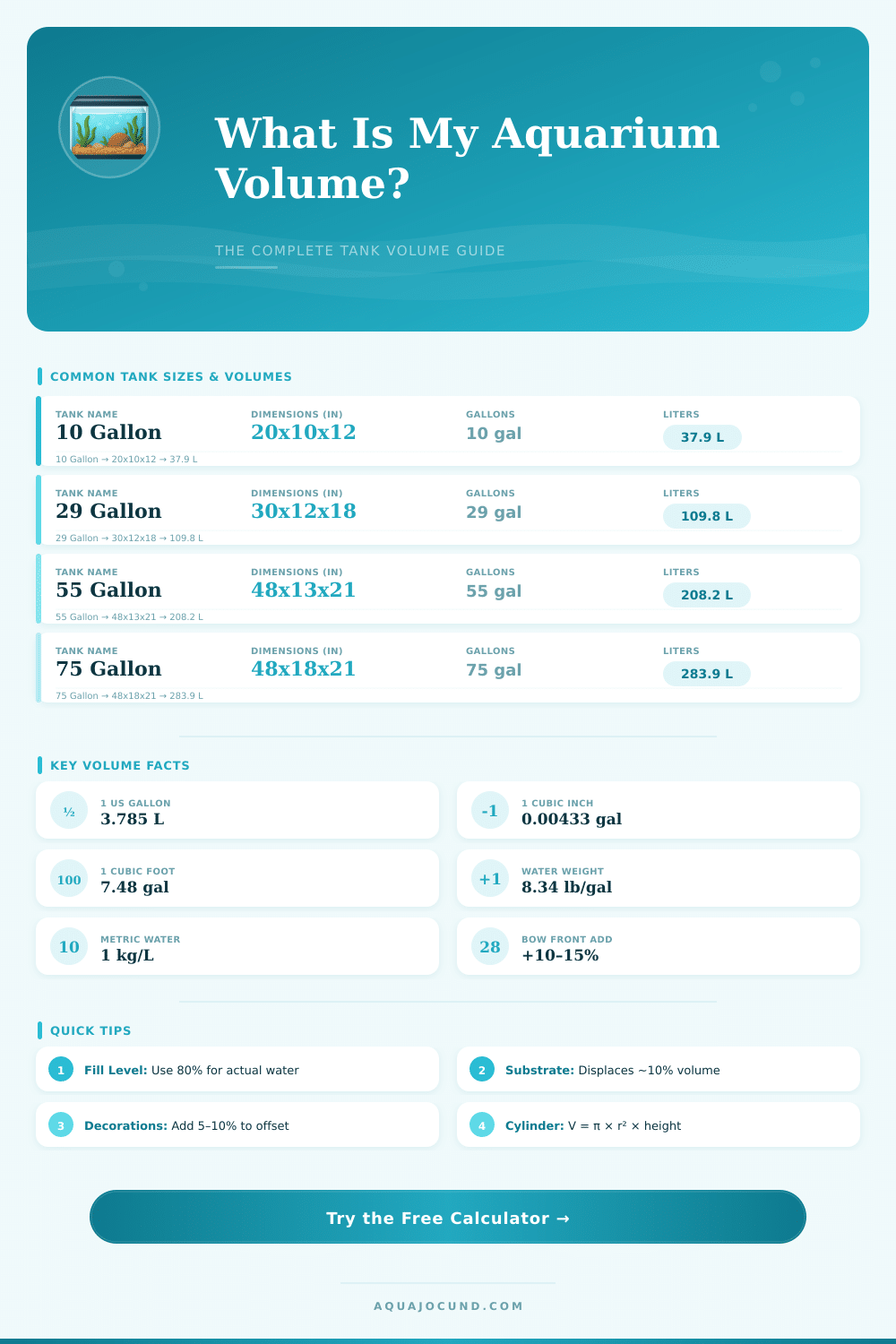
| Tank Name | Dimensions (L x W x H in) | Volume (gal) | Volume (L) | Weight Full (lbs) |
|---|---|---|---|---|
| 2.5 Gallon Nano | 12 x 6 x 8 | 2.5 gal | 9.5 L | 27 lbs |
| 5 Gallon Nano | 16 x 8 x 10 | 5 gal | 18.9 L | 62 lbs |
| 10 Gallon Standard | 20 x 10 x 12 | 10 gal | 37.9 L | 111 lbs |
| 15 Gallon | 24 x 12 x 12 | 15 gal | 56.8 L | 170 lbs |
| 20 Gallon High | 24 x 12 x 16 | 20 gal | 75.7 L | 225 lbs |
| 20 Gallon Long | 30 x 12 x 12 | 20 gal | 75.7 L | 225 lbs |
| 29 Gallon | 30 x 12 x 18 | 29 gal | 109.8 L | 330 lbs |
| 40 Gallon Breeder | 36 x 18 x 16 | 40 gal | 151.4 L | 458 lbs |
| 55 Gallon | 48 x 13 x 21 | 55 gal | 208.2 L | 625 lbs |
| 75 Gallon | 48 x 18 x 21 | 75 gal | 283.9 L | 850 lbs |
| 90 Gallon | 48 x 18 x 24 | 90 gal | 340.7 L | 1050 lbs |
| 125 Gallon | 72 x 18 x 22 | 125 gal | 473.2 L | 1400 lbs |
| 180 Gallon | 72 x 24 x 25 | 180 gal | 681.4 L | 2000 lbs |
| Tank Type | Recommended Fill % | Substrate Displacement | Decor Displacement | Net Usable Volume |
|---|---|---|---|---|
| Freshwater Community | 80% | ~10% | ~5% | ~65% of total |
| Planted Freshwater | 85% | ~15% | ~5% | ~65% of total |
| Cichlid / African Rift | 80% | ~5% | ~20% | ~55% of total |
| Saltwater Reef | 80% | ~5% | ~25% | ~50% of total |
| Coldwater / Goldfish | 75% | ~10% | ~5% | ~60% of total |
| Paludarium | 50% | ~15% | ~10% | ~25% of total |
| Brackish | 80% | ~10% | ~10% | ~60% of total |
| Volume | Water Weight (lbs) | Water Weight (kg) | Plus Tank & Stand Est. |
|---|---|---|---|
| 10 gallons (37.9 L) | 83.4 lbs | 37.9 kg | ~111 lbs total |
| 20 gallons (75.7 L) | 166.8 lbs | 75.7 kg | ~225 lbs total |
| 29 gallons (109.8 L) | 241.8 lbs | 109.8 kg | ~330 lbs total |
| 40 gallons (151.4 L) | 333.6 lbs | 151.4 kg | ~458 lbs total |
| 55 gallons (208.2 L) | 458.7 lbs | 208.2 kg | ~625 lbs total |
| 75 gallons (283.9 L) | 625.5 lbs | 283.9 kg | ~850 lbs total |
| 125 gallons (473.2 L) | 1042.5 lbs | 473.2 kg | ~1400 lbs total |
Each Aquarium owner will find himself counting the real amount of water that their Aquarium can store. This number matters a lot. It helps to estimate how many fish can live here without hurting the water quality, and it shows the limit of biological load that one works with.
Also the actual size of the Aquarium has its role, though for other reasons. They help species feel well in this space.
Find Your Aquarium’s Real Water Volume
For simple rectangular Aquariums the math is not a hard task. Simply take a ruler and measure the length, width and height. Multiply those three values together, and you have the cubic units.
If you work with inches, divide the result by 231 to get American gallons. With centimeters do otherwise: multiply length by width and height, then divide by 1000 for liters. For instance for an Aquarium of 50 cm by 60 cm by 70 cm (multiply them), and you find 210 000 milliliters, so 210 liters.
Of course, not all Aquariums come from the plant as a perfect rectangle. Some have curved sides, triangle patterns or oval forms, that makes the math harder. For Aquariums in the form of triangles, one must count the surface of the base, length times height divided by two, and then multiply by the whole height for cubic inches.
For oval Aquariums one uses an entirely different formula, that takes the almost-circular area of the base tiems the length. Even so, many online tools for Aquariums care about all those odd forms on their own. Choose the type of your Aquarium, enter the size, and done.
Other practical numbers to recall are 7.48 American gallons per cubic foot. You will use it soon.
Here everything starts too go hard however. The Volume that one wrote on the box, and the present water in the Aquarium? They commonly do not match.
One Aquarium, marked as 230 liters, had size 120 cm by 40 cm by 60 cm, but the math did not click. Another, sold for 100 liters, carried 120 liters, when one checked the measures. An Aquarium sold as 100 cm by 50 cm by 50 cm does not have almost that, what the specs promise, because the substrate takes space below and some centimeters stay empty up.
Add a heater, filter and decorations, and the real Volume drops even more.
Some tools go further and estimate the needed watts for a heater or the flow of a pump based on the Volume. Different websites for math sometimes give different results even so, so it helps to check several. Some testing the same Aquarium found two tools saying 55 gallons, while the third stuck on 58 gallons.
For info, fresh water with specific weight of 1.000 weighs around 8.34 pounds per gallon… Thatis useful for guessing the whole weight of the Aquarium down the way.