🌊 Pond Volume Calculator
Calculate your pond volume in gallons or liters — for stocking, filtration & treatment planning
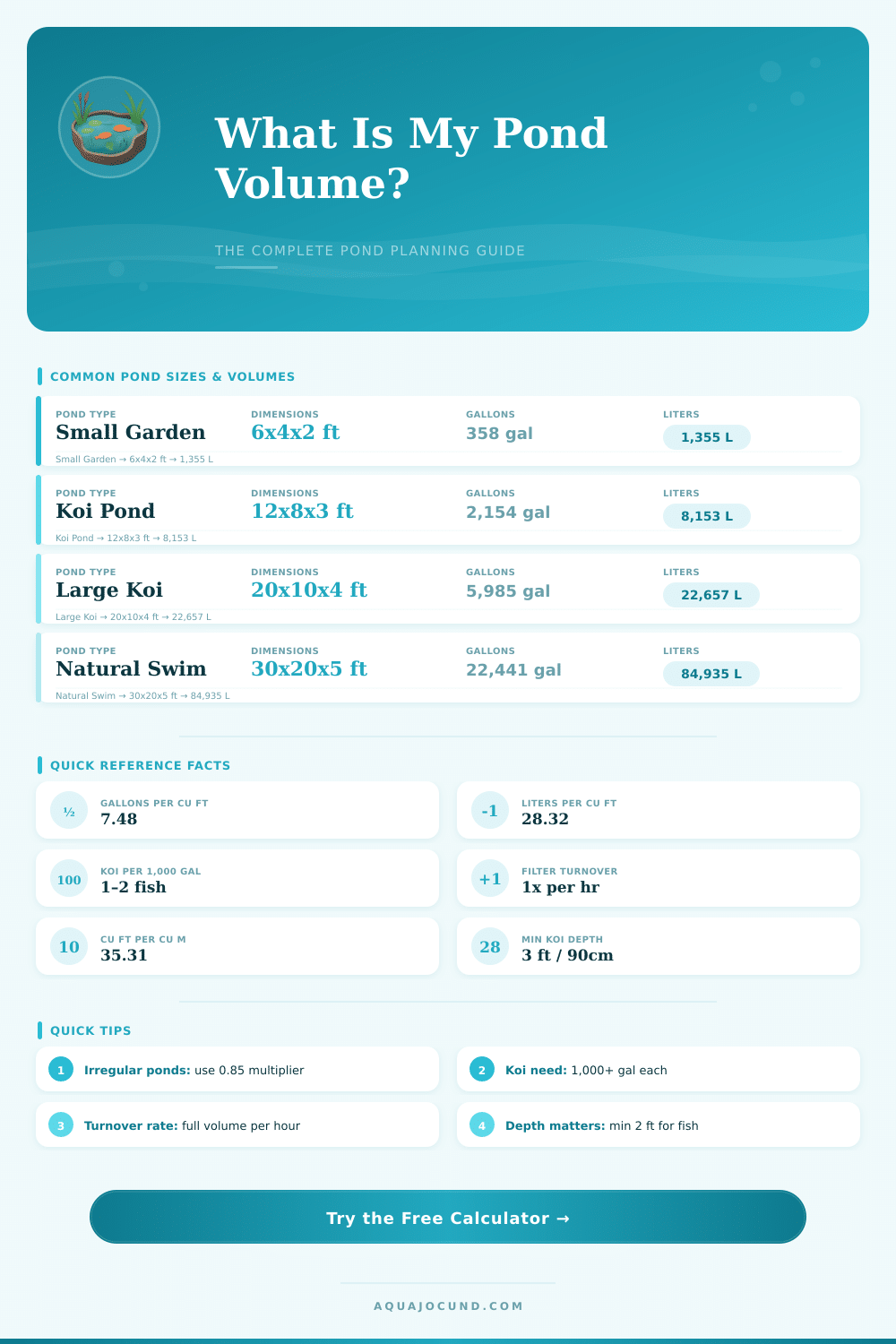
| Pond Type | Dimensions (ft) | Gallons (US) | Liters | Recommended Use |
|---|---|---|---|---|
| Patio / Tub | 3 x 3 x 1.5 | ~101 | ~382 | Container / Patio |
| Small Garden | 6 x 4 x 2 | ~358 | ~1,355 | Goldfish / Plants |
| Medium Garden | 8 x 6 x 2 | ~717 | ~2,714 | Goldfish / Small Koi |
| Starter Koi | 10 x 8 x 3 | ~1,795 | ~6,795 | 3–5 Koi |
| Standard Koi | 12 x 8 x 3 | ~2,154 | ~8,153 | 4–6 Koi |
| Large Koi | 16 x 10 x 4 | ~4,788 | ~18,126 | 8–12 Koi |
| Estate Koi | 20 x 12 x 4 | ~7,181 | ~27,186 | 12–20 Koi |
| Natural Swim | 30 x 20 x 5 | ~22,441 | ~84,935 | Swimming / Recreation |
| Pond Volume | Min Pump Flow (GPH) | Min Filter Size | UV Clarifier | Koi Capacity |
|---|---|---|---|---|
| Up to 500 gal | 500 GPH | 500 gal rated | 9W | 3–5 small |
| 500–1,000 gal | 1,000 GPH | 1,000 gal rated | 13W | 3–5 koi |
| 1,000–2,000 gal | 2,000 GPH | 2,000 gal rated | 18W | 5–8 koi |
| 2,000–4,000 gal | 4,000 GPH | 4,000 gal rated | 25W | 8–12 koi |
| 4,000–8,000 gal | 8,000 GPH | 8,000 gal rated | 36W | 12–20 koi |
| 8,000+ gal | 8,000+ GPH | Commercial rated | 55W+ | 20+ koi |
| Shape | Formula (cu ft) | To Gallons | Accuracy |
|---|---|---|---|
| Rectangle / Square | L x W x D | cu ft x 7.48 | Very High |
| Circular / Round | π x r² x D | cu ft x 7.48 | Very High |
| Oval / Elliptical | π x (L/2) x (W/2) x D | cu ft x 7.48 | High |
| Kidney Shape | L x W x D x 0.85 | cu ft x 7.48 | Good Estimate |
| Irregular | L x W x D x 0.75–0.85 | cu ft x 7.48 | Estimate |
Knowing how many water a Pond stores is really important. Whether one stores fish or picks the right pump, the right rating of the Volume does big difference. Volume calculator for Pond helps to guess how many gallons of water it carries, what is its size and even how many fish one can add in it.
For basic square or square Pond the math simply is. One measures the length width and depth, later times them together. If the measures happen in metres, that rise of the three numbers gives cubic metres.
How to Find How Much Water Is in a Pond
Each cubic metre match to 1,000 liters or around 220 gallons, what eases the change, when the basic Volume already is counted.
Round Pond require a bit other formula. One mode is times 0.8 by the length, width and depth. Other way works with the radius: one tiems the radius by itself, later by 3.142, then by the depth and last by 6.23 to get the Volume in gallons.
In round Pond terms as radius, diameter and ring enters in the game, together with height for the cubic part.
Pond with curved or uneven edges require a bit of rating by eye. One measures the width, length and depth at the surface, later the same at the bottom. The average of those surface and bottom measures give more precise number.
The average depth of Pond presents by several deep measures, that one averages all.
For big Pond, that one measures in acres, one times the area in acres by the average depth in feet to get acre-feet. Won acre-foot of water matches 325,851 gallons. So half-acre Pond with average depth of four feet results in two acre-feet, what gives around 651,702 gallons.
Brooks, that is connected to Pond, also add to the Volume. The Volume of the brook plus the Volume of the basin matches the whole amount of gallons in the water system. The average depth of most brooks are around 0.17 feet, what roughly means two inches.
Wrong rating of the Volume can cause real troubles. One folk used calculator for Pond, that pointed, that 9 x 5 x 3 Pond stores 505 gallons, but two other calculators said, that it has only more than 1,000 gallons. Such mistakes happen, when one orders gear.
Double check by more than one method is wise step.
There is even a smart mode using salt. One adds known amount of salt in the Pond, measure the salt level before and later, later put those numbers in formula. One times 120 by the added salt in pounds, later share by the difference between the readings.
That result gives exact Volume. Deep Pond are useful for other reasons also: going past four feet help fish survive cool winters, anddig more deep adds water Volume too.