🐡 Pleco Fish Water Temperature Checker
Check if your tank temperature is ideal for your pleco species & get heater sizing recommendations
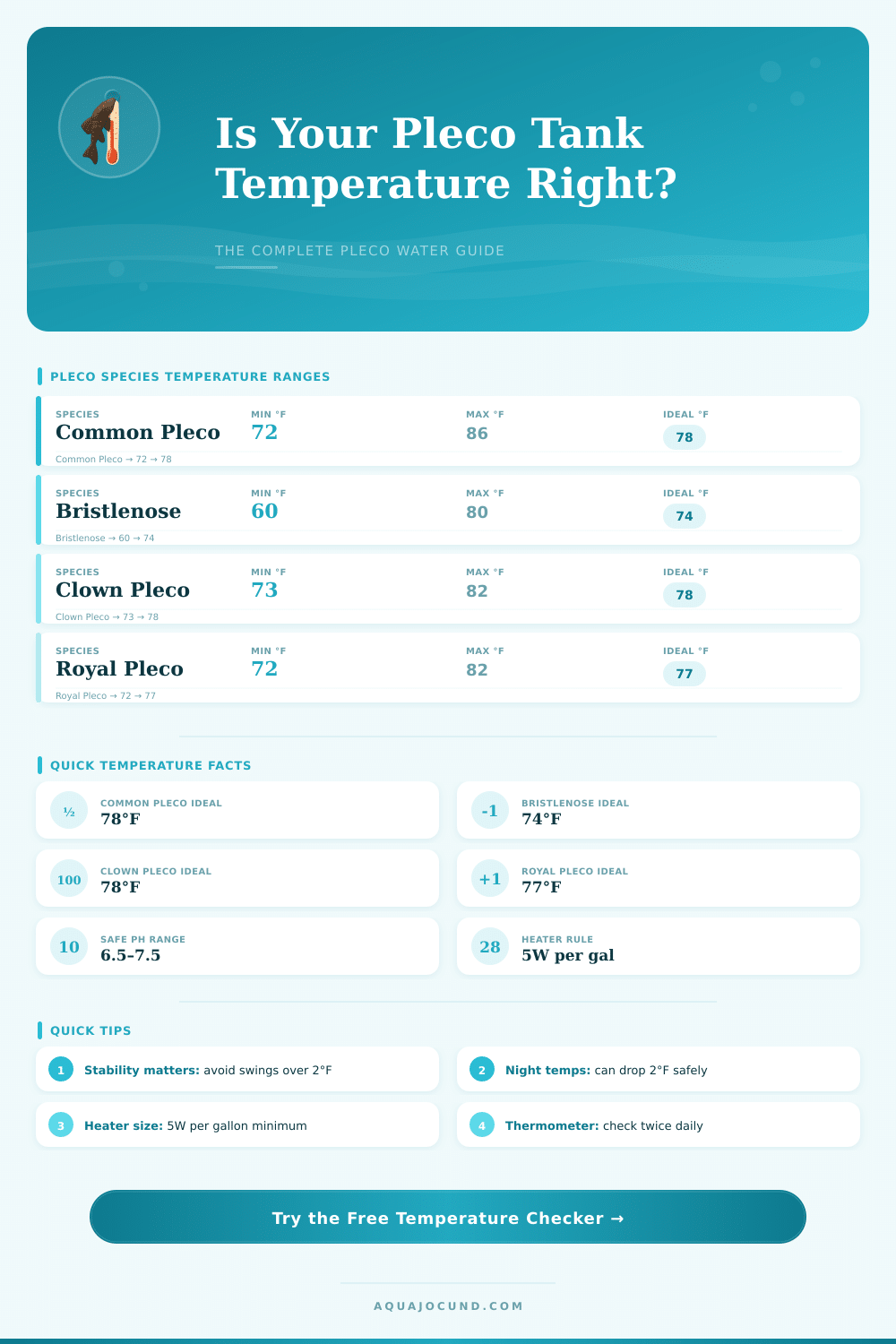
| Species | Temp Range (°F) | Temp Range (°C) | Ideal Temp (°F) | Ideal Temp (°C) | pH Range |
|---|---|---|---|---|---|
| Common Pleco | 72–86°F | 22–30°C | 78°F | 25.6°C | 6.5–7.5 |
| Bristlenose Pleco | 60–80°F | 15–27°C | 74°F | 23.3°C | 6.5–7.5 |
| Clown Pleco | 73–82°F | 23–28°C | 78°F | 25.6°C | 6.8–7.6 |
| Royal Pleco | 72–82°F | 22–28°C | 77°F | 25°C | 6.6–7.4 |
| Rubber Lip Pleco | 71–78°F | 22–26°C | 75°F | 24°C | 6.5–8.0 |
| Sailfin Pleco | 73–86°F | 23–30°C | 80°F | 26.7°C | 6.5–7.5 |
| Zebra Pleco (L046) | 79–88°F | 26–31°C | 84°F | 28.9°C | 6.0–7.0 |
| Gold Spot Pleco | 72–82°F | 22–28°C | 77°F | 25°C | 6.5–7.5 |
| Tank Size | Volume (gal) | Volume (L) | Heater Watts (5°F rise) | Heater Watts (10°F rise) | Heater Type Rec. |
|---|---|---|---|---|---|
| Nano / Pico | 1–5 gal | 4–19 L | 10–25W | 25–50W | Mini Submersible |
| Small | 10–20 gal | 38–76 L | 50–100W | 100–150W | Submersible |
| Medium | 29–55 gal | 110–208 L | 100–200W | 200–300W | Submersible |
| Large | 75–100 gal | 284–379 L | 200–300W | 300–400W | Titanium / Inline |
| Extra Large | 125+ gal | 473+ L | 300–500W | 500W+ | Sump / Titanium |
| Tank Name | Dimensions (in) | Volume (gal) | Volume (L) | Pleco Suitability |
|---|---|---|---|---|
| 5 Gallon Nano | 16 x 8 x 10 | 5 | 19 | Bristlenose only (juvenile) |
| 10 Gallon Standard | 20 x 10 x 12 | 10 | 38 | Bristlenose (juvenile) |
| 20 Gallon Long | 30 x 12 x 12 | 20 | 76 | Bristlenose, Rubber Lip |
| 29 Gallon | 30 x 12 x 18 | 29 | 110 | Clown, Bristlenose |
| 40 Gallon Breeder | 36 x 18 x 16 | 40 | 151 | Most smaller species |
| 55 Gallon | 48 x 13 x 21 | 55 | 208 | Royal, Common (young) |
| 75 Gallon | 48 x 18 x 21 | 75 | 284 | Common, Royal, Sailfin |
| 125 Gallon | 72 x 18 x 22 | 125 | 473 | Common, Sailfin (adult) |
Getting the water temperature right in a tank for fish is much more important than most folks think. Most tropical fish like around 75 to 80 degrees Fahrenheit, which comes to about 24 to 27 degrees Celsius. The best tropical setups do well at around 76 to 80 degrees but here is the spot: not all fish want the same conditions.
Mollies like feeling well in 74 to 80 degrees. What about discus fish? They enjoy heat, commonly reaching the middle to top of the 80s degrees.
Keeping the Right Water Temperature for Your Fish
Betta fish like water at about 78 to 80 degrees, and they clearly droop when it drops, because they start saving energy. For betta fish 74 degrees feels too cold. Ideally you keep them no under 76 degrees, but really they do best at 78 to 80.
Goldfish follow totally different rules. They belong to cold-water fish and commonly do not need a heater. Normal goldfish do well around 60 to 70 degrees, while fancier types stay well in 68 to 74 degrees.
A goldfish tank can just sit at room temperature… Roughly around 68 to 72 degrees, and the fish can live just fine.
When you set up a tank, the main challenge comes from picking species whose heat needs truly match. Problems come when one type wants the warmer part and another the cooler of the same range. What does that average compromise do?
It leaves both fish suffer a bit; one’s always a bit cool, the other a bit too warm. Never mix tropical and cold-water fish, one group always will live in bad conditions, no matter what.
Temperature changes really cause problems. Small tanks quickly warm or cool according too the conditions in the room around them. The key is to keep the water steady in a range fit for your fish.
Steady conditions matter much more than hitting exact numbers. If you change the heat, do that slowly, about one degree a day is the good plan.
High temperatures quickly age fish. Their heart pumps faster, their body functions grow and they need more food just to run. Hot water also does not hold as much dissolved oxygen as cold water.
So you end with fish that need more oxygen, while the tank gives less. That is nota good place to be in.
Checking the tank temperature once a day is a smart habit. Heater fails can really cook your fish. Those stick-on thermometers are not very reliable, because they mostly read the air through the glass.
Digital tank thermometers cost little and are easy to find. Without a working heater the tank will just follow the room temperature naturally. Putting your hand in should feel a bit cool or about right.