🌡️ Platy Fish Water Temperature Checker
Check if your tank temperature is safe for platy fish — get instant results in °F and °C
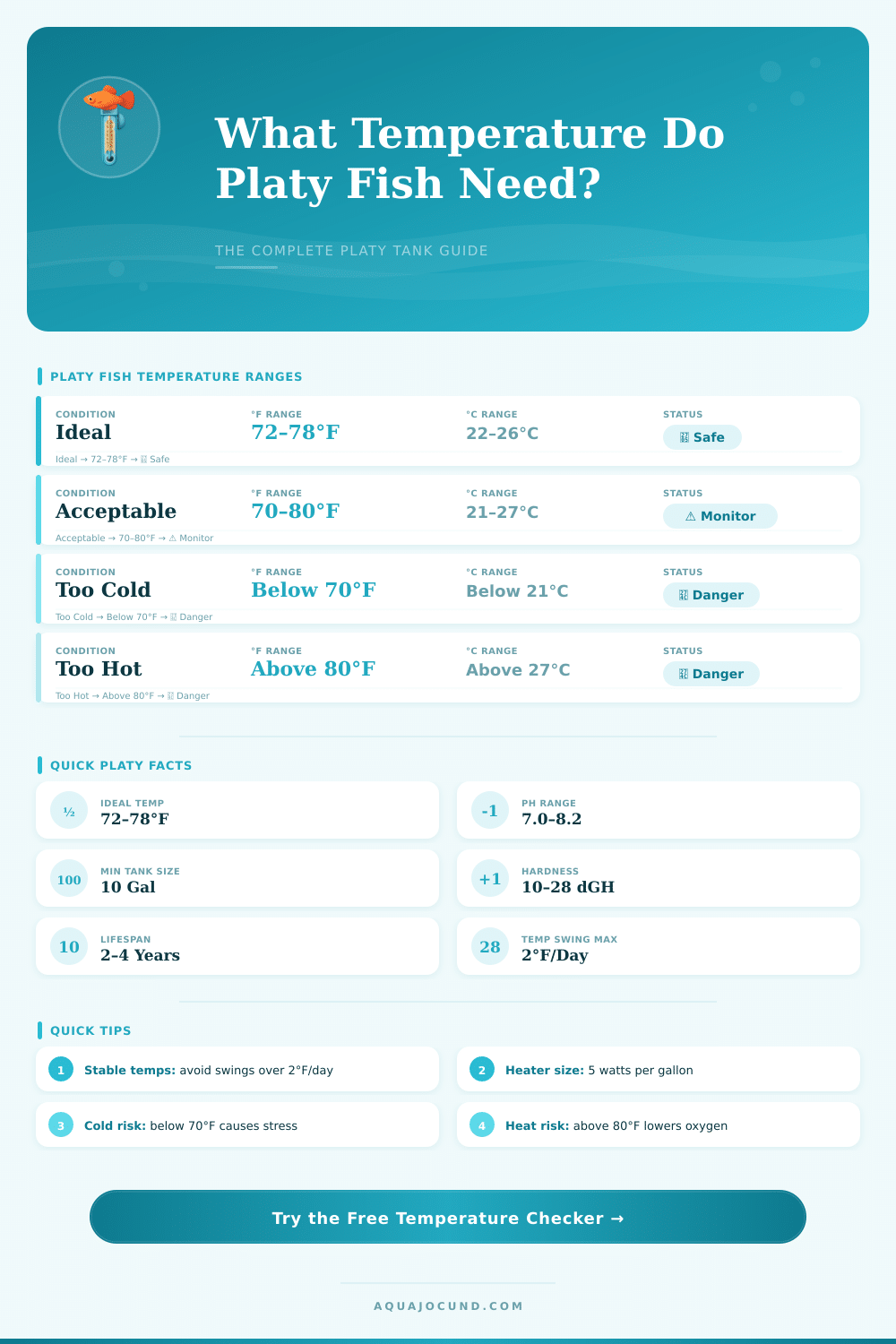
| Status | °F Range | °C Range | Platy Response | Action Required |
|---|---|---|---|---|
| ❌ Dangerously Cold | Below 65°F | Below 18°C | Lethargy, immune failure | Raise temp immediately |
| ⚠️ Too Cold | 65–70°F | 18–21°C | Sluggish, low appetite | Increase heater setting |
| ✅ Acceptable | 70–72°F | 21–22°C | Slightly subdued | Monitor closely |
| ✅ Ideal | 72–78°F | 22–26°C | Active, healthy, breeding | Maintain this range |
| ⚠️ Acceptable High | 78–80°F | 26–27°C | Active but oxygen drops | Increase aeration |
| ⚠️ Too Warm | 80–84°F | 27–29°C | Rapid breathing, stress | Cool tank, add airstone |
| ❌ Dangerously Hot | Above 84°F | Above 29°C | Organ stress, possible death | Emergency cooling needed |
| Tank Size | Volume (gal / L) | Recommended Watts | Temp Lift Capacity | Heater Type |
|---|---|---|---|---|
| Nano Tank | 2–5 gal / 8–19 L | 25–50 W | Up to +10°F | Nano Preset |
| Small Tank | 10 gal / 38 L | 50–75 W | Up to +15°F | Submersible |
| Medium Tank | 20–29 gal / 76–110 L | 100–150 W | Up to +15°F | Submersible |
| Large Tank | 40–55 gal / 151–208 L | 200–300 W | Up to +15°F | Submersible / Inline |
| Extra Large | 75–125 gal / 284–473 L | 300–500 W | Up to +15°F | Inline / Titanium |
| Tank Name | Dimensions (L x W x H in) | Gallons | Liters | Platy Capacity |
|---|---|---|---|---|
| 5 Gallon Nano | 16 x 8 x 10 | 5 gal | 19 L | 2–3 platies |
| 10 Gallon | 20 x 10 x 12 | 10 gal | 38 L | 4–6 platies |
| 20 Gallon Long | 30 x 12 x 12 | 20 gal | 76 L | 8–10 platies |
| 29 Gallon | 30 x 12 x 18 | 29 gal | 110 L | 12–15 platies |
| 40 Gallon Breeder | 36 x 18 x 16 | 40 gal | 151 L | 16–20 platies |
| 55 Gallon | 48 x 13 x 21 | 55 gal | 208 L | 20–25 platies |
| 75 Gallon | 48 x 18 x 21 | 75 gal | 284 L | 30–35 platies |
| Heater Type | Best For | Efficiency | Temp Stability | Typical Range |
|---|---|---|---|---|
| Submersible | 10–55 gal tanks | Good | ±1°F | 25–300 W |
| Inline | Large tanks with canister | Excellent | ±0.5°F | 100–500 W |
| Substrate Cable | Planted tanks | Good | ±1°F | 25–100 W |
| Hang-On-Back | Small tanks | Moderate | ±2°F | 25–150 W |
| Nano Preset | 2–10 gal nano tanks | Good | ±1°F | 10–50 W |
| Titanium | 75+ gal / saltwater | Excellent | ±0.5°F | 200–800 W |
Temperature is one of those things that can help or destroy your aquarium, frankly. Different species of fish have very different choices, and if you get it wrong the situation quickly gets bad. Tropical fish usually live well in ranges of 75 to 80 degrees, while species for cold water, like goldfish, prefer to be under 70 degrees.
Temperate fish find themselves somewhere in between, comfortable with conditions of any group.
How Water Temperature Affects Your Fish
For the most common aquarium fish that you will meet, reaching the zone of 24 to 28 degrees Celsius works well; that is around 75 to 82 degrees Fahrenheit. When you have a mix of species with different needs about Water Temperature, finding a compromise about the temperature is your best solution. Around 25 degrees Celsius mostly keeps the majority of shared fish residents happy.
The most common tropical aquariums do well at about 78 degrees Fahrenheit.
Goldfish are quite tolerant to cold and they will survive in normal room conditions, somewhere of 60 to 75 degrees. Here is the problem though… Mixing tropical and cold water fish together invites problems, because one group will inevitably be uncomfortable in water that is totally wrong for it.
For instance, mollies seem to do more well in 74 to 80 degrees, while discus fish want it much more warm. Neon tetras comfortably fall in the range of 70 to 78 degrees, even though 75 seems to be their best spot. Every species has a temperature range in which it can technically survive, but simply surviving and truly thriving are two totally different thnigs.
Here is where it gets interesting, quickly raising the Water Temperature raises the metabolism of the fish. Those faster processes can actually shorten the lifetime of them. The main point is not reaching exactly some ideal number.
Some degrees off will not cause death for your fish, despite what aquarium forums could leave you believe.
Every aquarium requires a reliable thermometer that you can truly trust. For tropical setups, a heater becomes basically needed, especially when the outside temperature starts to sink. You have two main types of heaters, submersible and hanging, and the submersible ones are clearly the most popular.
The most common come with thermostats that allow you to set the wanted temperature. Even a modest heater pays for itself, because many tropical species require at least 78 degrees to stay healthy.
Temperature swings are what truly stresses the fish. Sudden change of more than sum degrees can truly upset them and make them open to diseases. While you change the water, make sure that the new water matches the temperature of the aquarium.
Do the changes slowly, one or two degrees a day, to keep the fish calm and without stress. The opposite problem happens in summer entirely. Warmer water simply does not hold oxygen well, so use an air pump to give your fish good oxygen surroundings.
You can go to 84 degrees and the most common fish will adapt, but anything above 90 degrees starts to cause serious troubles.
Bettas require a stable range of 76 to 82 degrees to live. The absolute minimum for a betta is around 76, even though 78 to 80 is truly better for them. When the temperature goes out of the right zone too long, health problems follow.
Also fast changes bother them. Sudden cold shock and the most common fish simply stop eating entirely. Once the temperature falls under 4 degrees Celsius, coldwater fish quickly enter intoa dormant mode.