🌡️ Parrot Fish Water Temperature Checker
Enter your tank details and current temperature to check if conditions are ideal for your parrot fish
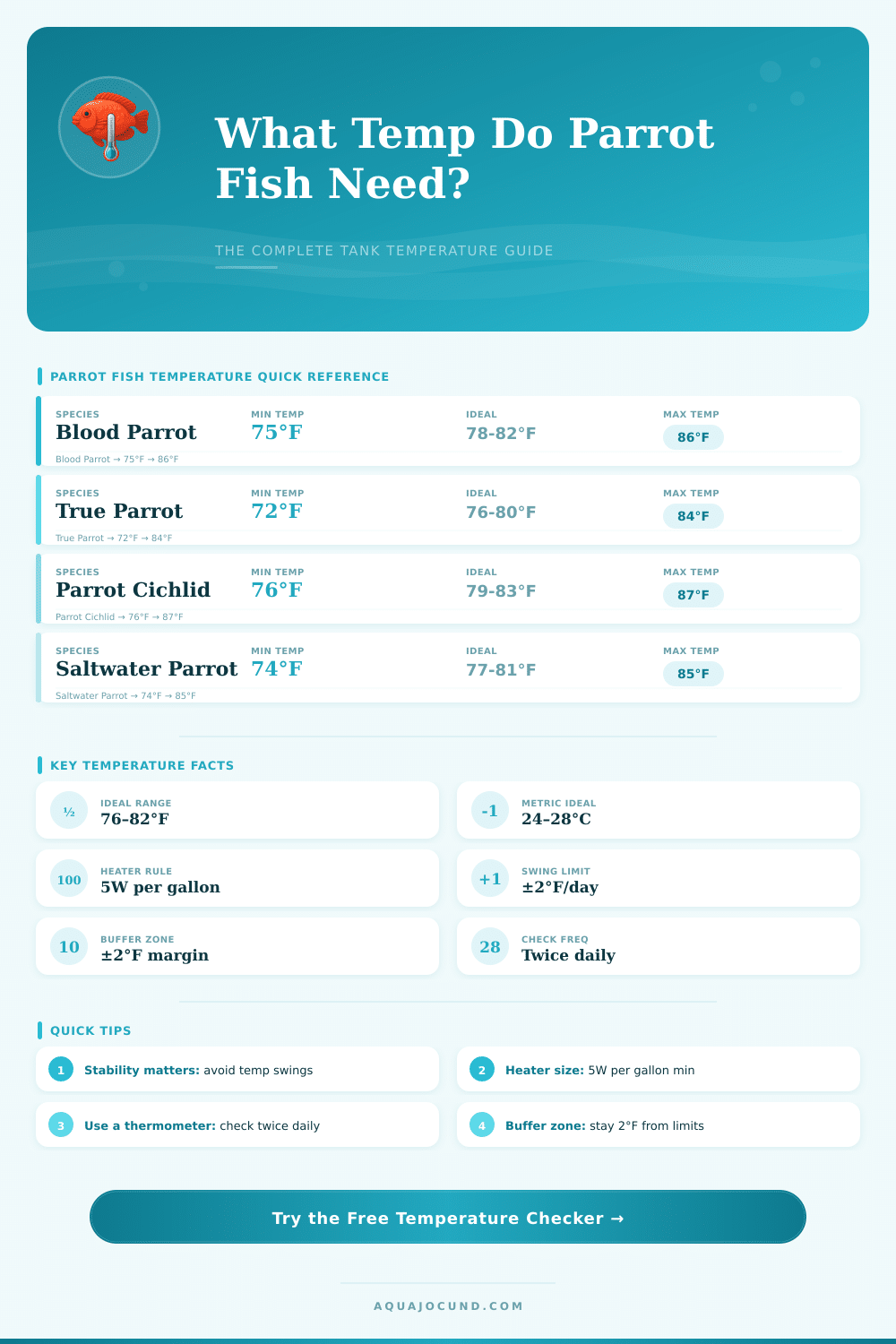
| Species | Min (°F) | Ideal Range (°F) | Max (°F) | Min (°C) | Ideal Range (°C) | Max (°C) | Water Type |
|---|---|---|---|---|---|---|---|
| Blood Parrot Cichlid | 75 | 76–82 | 86 | 24 | 24–28 | 30 | Freshwater |
| True Parrot Fish | 72 | 75–80 | 84 | 22 | 24–27 | 29 | Freshwater |
| Parrot Cichlid (Hoplarchus) | 76 | 79–83 | 88 | 24 | 26–28 | 31 | Freshwater |
| Saltwater Parrotfish | 72 | 75–82 | 86 | 22 | 24–28 | 30 | Saltwater |
| Jellybean Parrot | 74 | 76–81 | 85 | 23 | 24–27 | 29 | Freshwater |
| King Kong Parrot | 76 | 78–82 | 86 | 24 | 26–28 | 30 | Freshwater |
| Red Parrot Cichlid | 75 | 77–82 | 86 | 24 | 25–28 | 30 | Freshwater |
| Bumphead Parrotfish | 73 | 76–82 | 85 | 23 | 24–28 | 29 | Saltwater |
| Tank Size | Volume (Gal) | Volume (L) | Temp Diff <10°F | Temp Diff 10–20°F | Temp Diff >20°F | Recommended Wattage |
|---|---|---|---|---|---|---|
| Nano | 5–10 | 19–38 | 25W | 50W | 75W | 25–50W |
| Small | 10–20 | 38–76 | 50W | 75W | 100W | 50–100W |
| Medium | 20–40 | 76–151 | 75W | 100W | 150W | 100–150W |
| Standard | 40–75 | 151–284 | 150W | 200W | 300W | 200–300W |
| Large | 75–125 | 284–473 | 200W | 300W | 400W | 300–400W |
| Extra Large | 125–200 | 473–757 | 300W | 400W | 500W+ | 400–500W |
| Tank Name | Dimensions (in) | Gallons | Liters | Dimensions (cm) |
|---|---|---|---|---|
| 5 Gallon Nano | 16 x 8 x 10 | 5.5 | 20.8 | 41 x 20 x 25 |
| 10 Gallon Standard | 20 x 10 x 12 | 10.4 | 39.3 | 51 x 25 x 30 |
| 20 Gallon High | 24 x 12 x 16 | 20.0 | 75.7 | 61 x 30 x 41 |
| 29 Gallon | 30 x 12 x 18 | 27.0 | 102.2 | 76 x 30 x 46 |
| 40 Gallon Breeder | 36 x 18 x 16 | 40.0 | 151.4 | 91 x 46 x 41 |
| 55 Gallon | 48 x 13 x 21 | 55.0 | 208.2 | 122 x 33 x 53 |
| 75 Gallon | 48 x 18 x 21 | 75.0 | 283.9 | 122 x 46 x 53 |
| 125 Gallon | 72 x 18 x 22 | 125.0 | 473.2 | 183 x 46 x 56 |
| Heater Type | Efficiency | Accuracy | Best For | Wattage Multiplier |
|---|---|---|---|---|
| Submersible Glass | Good | ±1–2°F | Small/Medium tanks | 1.0x (baseline) |
| Titanium Submersible | Excellent | ±0.5°F | Large/Reef tanks | 0.9x (more efficient) |
| Inline Heater | Very Good | ±1°F | Sump setups | 0.95x |
| Substrate Heater | Moderate | ±2°F | Planted tanks | 1.2x (supplemental) |
| Canister In-Line | Very Good | ±0.5°F | Medium/Large tanks | 0.9x |
| Hang-On Back | Moderate | ±2°F | Budget/Small setups | 1.1x |
Parrot fish enjoy big popularity in freshwater aquariums and reaching the right water temperature is key for their health. Most of those fish handle temperatures of 76 to 86°F, so around 24 to 30°C. Even so, the best range seems to be 82 to 84°F for best conditions. They have similar needs about water compared with angelfish, that also like this warm range.
Specifically the bloody parrot fish last in water between about 75°F and 85°F. Even so, if you keep them in the low end of that range, they can become still and less likely to breed. For bloody parrots a target of around 78°F, or 26°C, works best. If the water temperature falls undre that, it can weaken their defence against diseases and even push them to lose the shine of their colours.
Best Water Temperature for Parrot Fish
Under 80°F the parrot fish commonly seem more lonely and colourless. So, raising slowly the water temperature a bit can help revive their colour and make them more active. When the fish looks shy or grim, slowly raising the temperature wood help.
For polar blue parrot fish the best range is 24 to 28°C, which is about 75 to 82°F. If you keep several fish or different species together, use at least a 50-gallon tank for comfort. King Kong parrots need a minimum of a 55-gallon tank and like temperatures between 76 and 86°F similarly.
Parrot fish need steady water temperature between 24 and 29°C. Many types come from warm South American regions, and even the bloody parrots, that folks breed in captivity, do best in warmer waters. A heater is key for this species, because they hate changes in the water temperature. The temperature should not change too much.
Also the setup of the tank plays a role. Parrot fish like things to hide in, like clay jars, caves, stones and driftwood. Enough pool space is needed besides those shelters.
Because this fish is a bit plump, it benefits from strong filtering in the tank. Tender plants should be avoided, because the fish can break them.
Bloody parrots eat eagerly pellet foods along with occasional bloodworms and fly larvae as treats. Smaller pellets work better because of the shape of their mouth. The wanted pH for those fish sits between 6.0 and 8.5, but a range of 7.0 to 8.0 is even more comfortable for them.
If parrot fish ever get sick, one way to help is slowly raising the water temperature to 87 to 90°F and keeping it there for a full ten days. Later, slowly bring it back to the usual level around 78°F. For that treatment you donot need medicines or salts. Only patience and close control of the temperature is enough.