🐟 Oscar Fish Tank Size Calculator
Calculate the ideal aquarium volume, floor space, and filtration for your Oscar fish
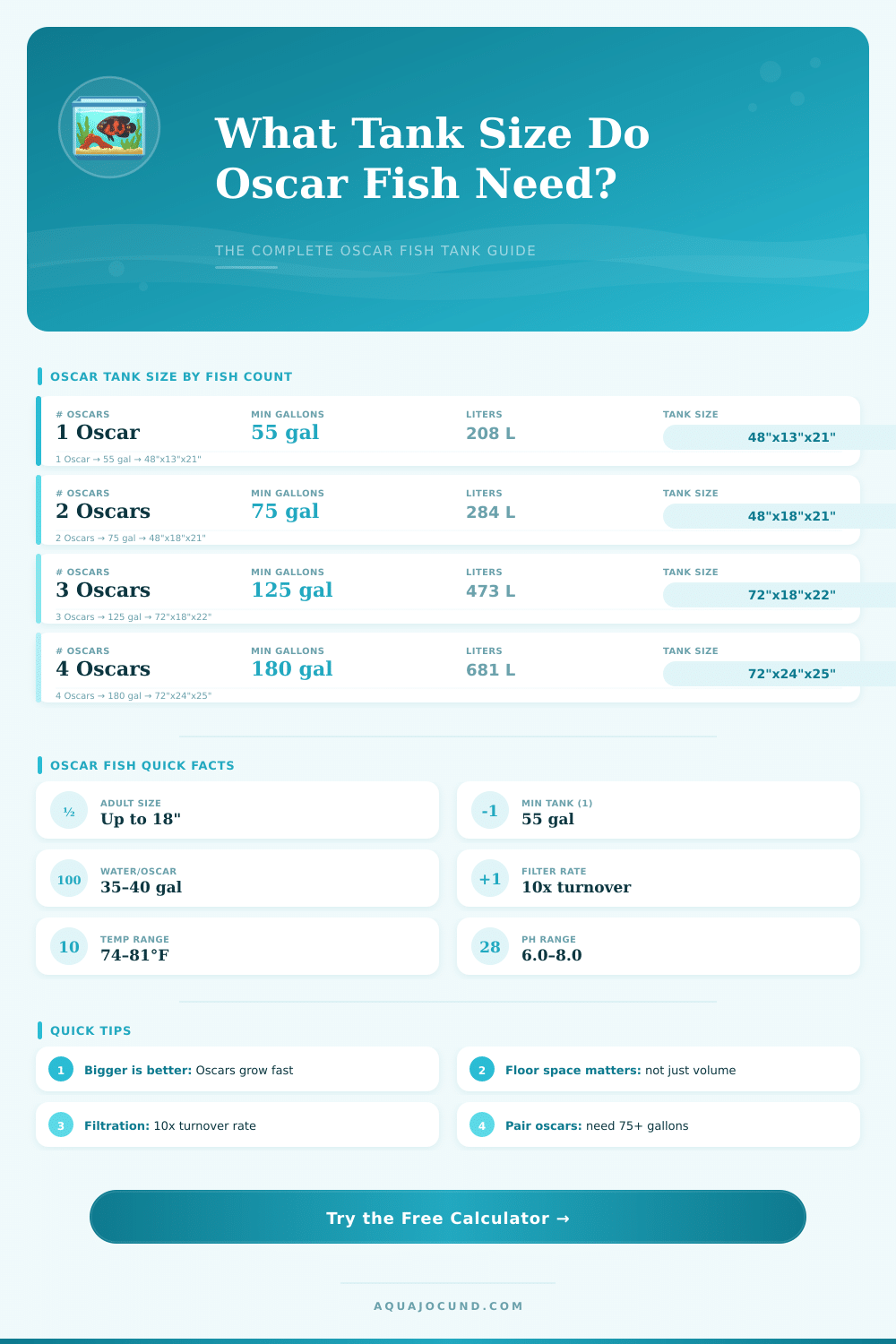
| Tank Name | Dimensions (L×W×H inches) | Volume (Gallons) | Volume (Liters) | Oscars Supported |
|---|---|---|---|---|
| 55 Gallon Standard | 48×13×21 | 55 gal | 208 L | 1 adult |
| 75 Gallon | 48×18×21 | 75 gal | 284 L | 1–2 adults |
| 90 Gallon | 48×18×24 | 90 gal | 341 L | 2 adults |
| 100 Gallon | 60×18×20 | 100 gal | 379 L | 2 adults |
| 125 Gallon | 72×18×22 | 125 gal | 473 L | 2–3 adults |
| 150 Gallon | 72×24×25 | 150 gal | 568 L | 3 adults |
| 180 Gallon | 72×24×28 | 180 gal | 681 L | 3–4 adults |
| 210 Gallon | 84×24×25 | 210 gal | 795 L | 4–5 adults |
| 240 Gallon | 96×24×25 | 240 gal | 908 L | 5–6 adults |
| 300 Gallon | 96×24×30 | 300 gal | 1136 L | 6–7 adults |
| Filter Type | Recommended Turnover | 55 gal (208 L) | 75 gal (284 L) | 125 gal (473 L) | Notes |
|---|---|---|---|---|---|
| Canister Filter | 8–10x/hr | 440–550 GPH | 600–750 GPH | 1000–1250 GPH | Best mechanical filtration |
| Sump / Wet-Dry | 6–8x/hr | 330–440 GPH | 450–600 GPH | 750–1000 GPH | Highest bio capacity |
| HOB Filter | 10–12x/hr | 550–660 GPH | 750–900 GPH | 1250–1500 GPH | Use multiple units |
| Fluidized Bed | 8–10x/hr | 440–550 GPH | 600–750 GPH | 1000–1250 GPH | Excellent bio filtration |
| Undergravel | 5–7x/hr | 275–385 GPH | 375–525 GPH | 625–875 GPH | Not recommended for oscars |
| Tank Volume | Heater Wattage | Ideal Temp | pH Range | Ammonia / Nitrite | Max Nitrate |
|---|---|---|---|---|---|
| 55 gal (208 L) | 200–250W | 74–81°F / 23–27°C | 6.0–8.0 | 0 ppm | <20 ppm |
| 75 gal (284 L) | 250–300W | 74–81°F / 23–27°C | 6.0–8.0 | 0 ppm | <20 ppm |
| 125 gal (473 L) | 400–500W | 74–81°F / 23–27°C | 6.0–8.0 | 0 ppm | <20 ppm |
| 150 gal (568 L) | 500–600W | 74–81°F / 23–27°C | 6.0–8.0 | 0 ppm | <20 ppm |
| 180 gal (681 L) | 600–800W | 74–81°F / 23–27°C | 6.0–8.0 | 0 ppm | <20 ppm |
| 240 gal (908 L) | 800–1000W | 74–81°F / 23–27°C | 6.0–8.0 | 0 ppm | <20 ppm |
| Setup Type | Gal per Oscar | Floor Space Focus | Filter Multiplier | Water Change Freq. |
|---|---|---|---|---|
| Standard Cichlid | 35–40 gal | High | 10x/hr | 25–30% weekly |
| Planted Oscar | 40–50 gal | High | 8–10x/hr | 20–25% weekly |
| South American Biotope | 40–55 gal | Very High | 10x/hr | 30% weekly |
| Oscar Community | 50–60 gal | Very High | 10–12x/hr | 30–40% weekly |
| Breeding Pair | 55–65 gal | Extremely High | 10x/hr | 30–40% weekly |
| Juvenile Grow-Out | 15–20 gal | Medium | 8–10x/hr | 30–50% weekly |
Choosing the right size for a fish tank is more important than many folks think. A common starting rule is that about one gallon for every inch of fish. So for every gallon of water one can fit around one inch of fish body.
Even so this rule not always counts. One ten-inch fish does not match by weight to eleven one-inch fishes. Think how many little fishes fit in the space of one big, and that gives a near idea about the actual need of tank volume.
How to Choose the Right Fish Tank Size
For newcomers a 20-gallon tank forms a good choice. It is not too big, so that the cleaning stays easy. Many beginners find difficult the issue about big tanks, so that helps them.
A full 20-gallon tank weighs around 225 pounds, what proves that it yet stays a practical size. Such a tank works well for a school of little fishes like tetras, rasboras or even tinier species. It is possible to also keep a pair of bigger territorial fishes, for instance common cichlids.
A 20-gallon model works even as a reliable first saltwater tank, because one can easily install light and filter without need of a sump or skimmer.
Going under 10 gallons is widely not suggested. A 10-gallon tank can serve for guppies or alike tiny fishes, but very little tanks under that limit do not work. One should not choose too tiny tanks.
Better aim for 20 gallons or more, so that it be safe and comfortable. During the choice of tank, one must decide between glass and acrylic.
An interesting fact is that the gallon numbers do not tell everything. A 50-gallon tank commonly is broader than a 55-gallon. Fishes sometimes like more depth instead of high but narrow area.
Widely one favours longer and broad models. Too high tanks can create problems with oxygen and lite at the bottom. A 20-gallon long and 30-gallon standard have identical base, but the 30-gallon stores around 50 percent more water, what allows more fishes.
Tanks of middle level in the range of 55 to 75 gallons offer a nice size for saltwater and freshwater setups. A 75-gallon tank works as a good first size for saltwater fishes. The usual 55-gallon model has only 12 inches of depth, what hampers the setup of reefs.
Sizes of tanks a bit vary by makers. It is good to bring a flexible tape to the store, especially if one mixes brands for hoods, covers or stands. When tanks reach average or bigger one must mind proper furniture because of the increasing weight.
Always consider the adult size of fishes, not only their tiny look in the store. A 50-gallon tank is a good size, not too heavy for a normal floor, even socheck the strength of the floor stays wise.