🐠 Glass Aquarium Thickness Calculator
Calculate the minimum glass thickness needed for a safe, leak-free aquarium — rectangle, cube, cylinder & bow front tanks
Tensile Str. (psi)
Tensile Str. (psi)
Tensile Str. (psi)
Tensile Str. (psi)
Tensile Str. (psi)
Tensile Str. (psi)
psi per inch depth
Safety Factor
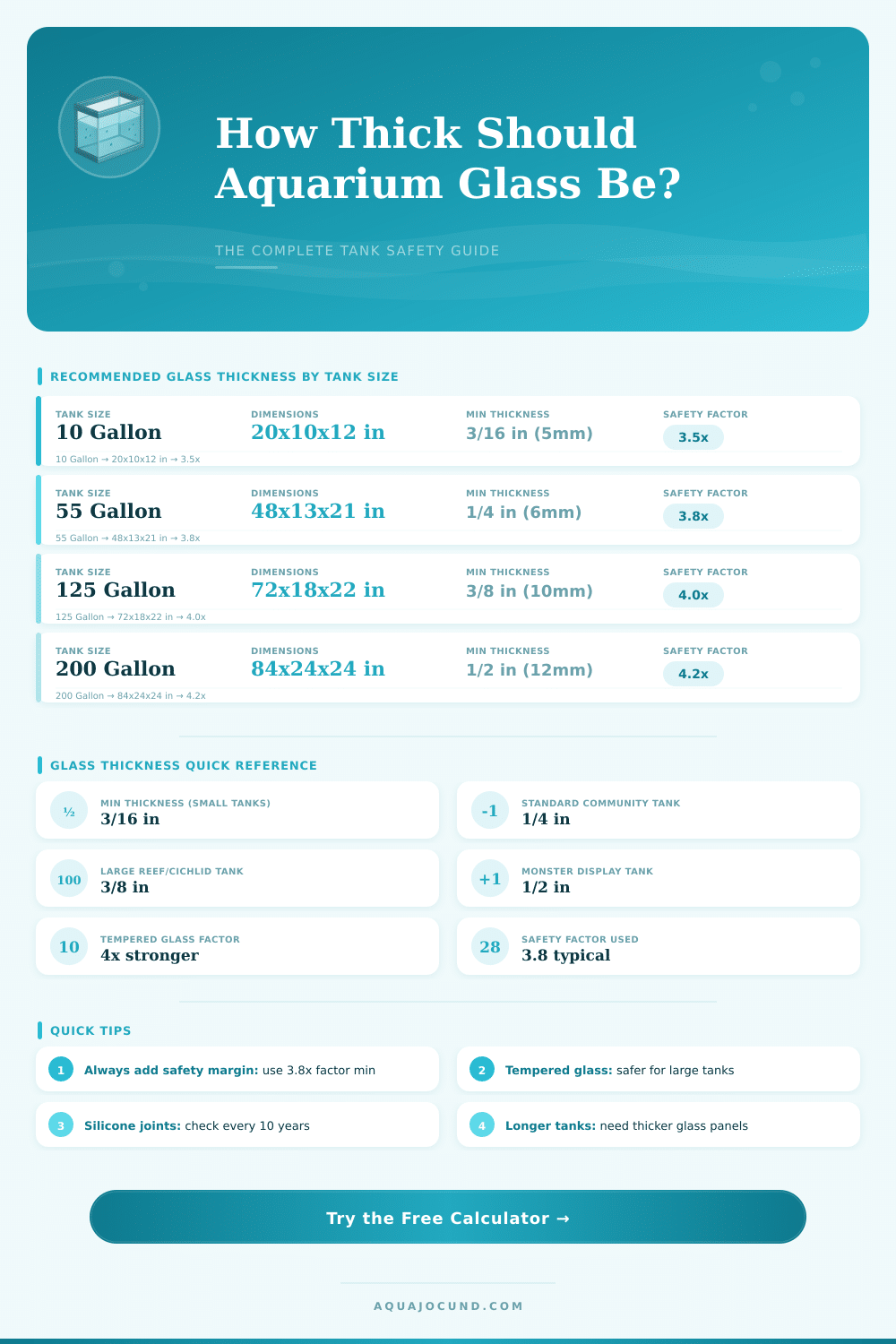
| Tank Size | Height | Min Thickness (in) | Min Thickness (mm) | Glass Type |
|---|---|---|---|---|
| Up to 12 gal | Up to 12 in | 3/16 in | 5 mm | Annealed |
| 12–40 gal | 12–18 in | 1/4 in | 6 mm | Annealed |
| 40–90 gal | 18–24 in | 5/16 in | 8 mm | Annealed/Tempered |
| 90–150 gal | 22–28 in | 3/8 in | 10 mm | Tempered |
| 150–250 gal | 24–30 in | 1/2 in | 12 mm | Tempered |
| 250+ gal | 30+ in | 5/8+ in | 16+ mm | Tempered / Laminated |
| Tank Name | Dimensions (L×W×H in) | Volume (gal) | Volume (L) | Rec. Thickness |
|---|---|---|---|---|
| Nano / Betta 5 Gal | 16 × 8 × 10 | 5.5 | 20.8 | 3/16 in (5mm) |
| 10 Gallon Standard | 20 × 10 × 12 | 10 | 37.9 | 3/16 in (5mm) |
| 20 Gallon Long | 30 × 12 × 12 | 20 | 75.7 | 1/4 in (6mm) |
| 29 Gallon | 30 × 12 × 18 | 29 | 109.8 | 1/4 in (6mm) |
| 40 Gallon Breeder | 36 × 18 × 16 | 40 | 151.4 | 1/4 in (6mm) |
| 55 Gallon | 48 × 13 × 21 | 55 | 208.2 | 5/16 in (8mm) |
| 75 Gallon | 48 × 18 × 24 | 75 | 283.9 | 3/8 in (10mm) |
| 90 Gallon | 48 × 18 × 24 | 90 | 340.7 | 3/8 in (10mm) |
| 125 Gallon | 72 × 18 × 22 | 125 | 473.2 | 3/8 in (10mm) |
| 180 Gallon | 72 × 24 × 25 | 180 | 681.4 | 1/2 in (12mm) |
| Depth (in) | Depth (cm) | Pressure (psi) | Pressure (kPa) | Typical Tank Use |
|---|---|---|---|---|
| 10 in | 25.4 cm | 0.36 psi | 2.5 kPa | Nano / Betta tanks |
| 12 in | 30.5 cm | 0.43 psi | 3.0 kPa | 10–20 gal standard |
| 16 in | 40.6 cm | 0.58 psi | 4.0 kPa | 40 gal breeder |
| 18 in | 45.7 cm | 0.65 psi | 4.5 kPa | 29–55 gal |
| 21 in | 53.3 cm | 0.76 psi | 5.2 kPa | 55–75 gal |
| 24 in | 61.0 cm | 0.87 psi | 6.0 kPa | 75–125 gal |
| 28 in | 71.1 cm | 1.01 psi | 7.0 kPa | 150–200 gal |
| 30 in | 76.2 cm | 1.08 psi | 7.5 kPa | 200+ gal display |
Choosing the right Thickness of glass for a Glass Aquarium is not something that you want to ignore. It seriously affects the safety of your tank, its strength and whether it stays whole over long time. The main factor?
The size of the tank. Little aquariums handle thinner glass fine but when you pick a bigger model, you must consider heavy panels that hold the whole water pressure.
How to Choose the Right Glass Thickness for Your Aquarium
What really decides the Thickness is the height of the water column. The higher the Glass Aquarium the thicker the glass must be to resist the pressure. Low short aquariums work well for simple builds.
Here glass of around 3 to 4 mm thick is enough. A 24-gallon aquarium belongs to the small group, and 6 mm glass works great for it. The same goes for a typical 40-gallon tank.
Here the 6 mm Thickness is exactly what you need.
When you go past 4 feet in length, 12 mm glass becomes the better option. If you have really tall setups between 1.5 and 2 metres? Then you need at least 20 mm Thickness for safety.
The most common tanks between 1 and 1.4 metres work well with 12 mm. Deeper models need more Thickness to stop bending, or otherwise you must add braces to the top and bottom. If centre braces and corner support are used, then thinner glass of around 10 mm can really be enough.
So, consider also the part of safety factor. The standard is 3.8, and although it does not guarantee everything, it removes almost all risks of breaking; unless the glass is damaged or has bad quality originally. Take a sample with a 120 x 40 x 55 cm tank with only 8 mm glass.
The calculations show that 10 mm wood reach the 3.8 safety level, but 8 mm only 2.5. That gap does not deserve to be ignored. Some experts push even stricter values; reach 7.6 for no-polished edges or 5 for polished edges in tanks without braces.
Online calculators for glass Thickness can help figure out what you really need. They take volume, surface area, weight and the needed Thickness based on your measures. The problem is that they are not perfect.
One tool approved a 48 x 24 x 24-gallon tank with 12 mm glass, but the actual tank clearly bent when it was filled. Use several calculators and take the average asthe more reliable way.
There is also the choice of material between tempered and standard glass. Tempered glass is almost five times stronger than standard, although one does not suggest it for very big aquariums. PMMA, the acrylic option, weighs almost half of glass and has double the strength.
It bends more easily, has a lower light bending rate and allows clearer sight through slim panels. One big Glass Aquarium window from acrylic had 60 cm Thickness. The bottom panel does not always need to be as thick as the sides (here the forces are mostly pressing), not bending.