🌡️ Fish Tank Heater Size Calculator
Find the exact wattage you need to keep your aquarium at the perfect temperature
| Tank Name | Dimensions (L x W x H in) | Volume (gal / L) | Temp Rise 10°F | Temp Rise 20°F | Recommended Heater |
|---|---|---|---|---|---|
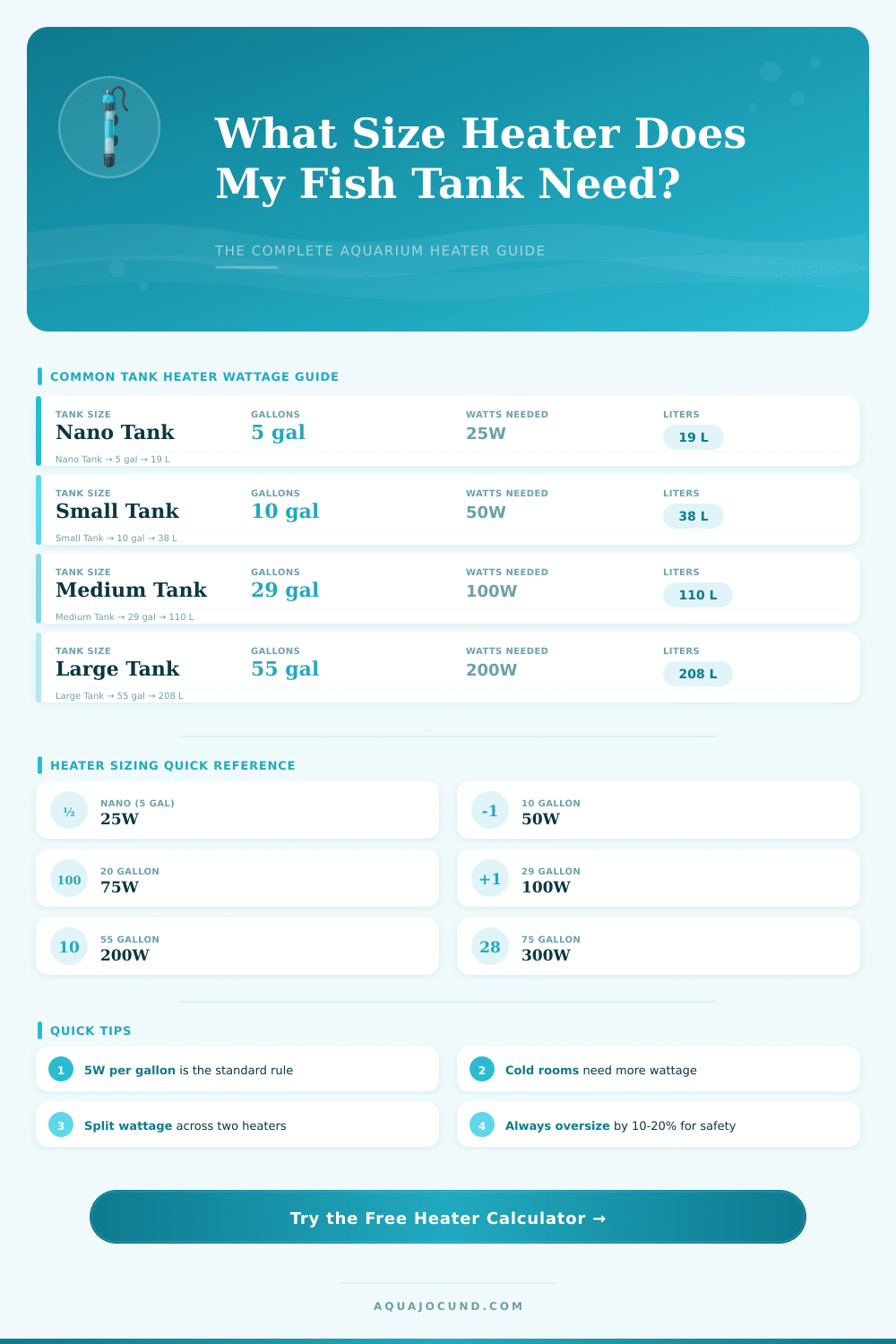
| Nano 5 Gallon | 16 x 8 x 10 | 5 gal / 19 L | 25W | 50W | 25–50W |
| 10 Gallon Standard | 20 x 10 x 12 | 10 gal / 38 L | 50W | 75W | 50–100W |
| 20 Gallon Long | 30 x 12 x 12 | 20 gal / 76 L | 75W | 150W | 100–150W |
| 29 Gallon | 30 x 12 x 18 | 29 gal / 110 L | 100W | 200W | 150–200W |
| 40 Gallon Breeder | 36 x 18 x 16 | 40 gal / 151 L | 150W | 250W | 200–250W |
| 55 Gallon | 48 x 13 x 21 | 55 gal / 208 L | 200W | 300W | 200–300W |
| 75 Gallon | 48 x 18 x 21 | 75 gal / 284 L | 250W | 400W | 300W x 1–2 |
| 90 Gallon | 48 x 18 x 24 | 90 gal / 341 L | 300W | 450W | 300W x 2 |
| 125 Gallon | 72 x 18 x 22 | 125 gal / 473 L | 400W | 600W | 300W x 2 |
| 180 Gallon | 72 x 24 x 25 | 180 gal / 681 L | 600W | 900W | 300W x 3 |
| Temp Rise (°F) | Temp Rise (°C) | Watts per Gallon | Watts per Liter | Typical Scenario |
|---|---|---|---|---|
| 5°F | 2.8°C | 2.5W/gal | 0.66W/L | Warm house, tropical fish |
| 10°F | 5.6°C | 5W/gal | 1.32W/L | Standard heated home |
| 15°F | 8.3°C | 7.5W/gal | 1.98W/L | Cool basement / room |
| 20°F | 11.1°C | 10W/gal | 2.64W/L | Cold garage / winter |
| 25°F | 13.9°C | 12.5W/gal | 3.30W/L | Unheated garage |
| 30°F | 16.7°C | 15W/gal | 3.96W/L | Outdoor / extreme cold |
| Heater Type | Efficiency Factor | Best For | Notes |
|---|---|---|---|
| Submersible (In Tank) | 1.0x (baseline) | Most aquariums | Most common, easy to adjust |
| Inline (Canister) | 1.3x more efficient | Planted tanks, aquascapes | Hidden, very stable temps |
| Sump Mounted | 1.15x more efficient | Reef tanks, large systems | Heats return water |
| External Hang-On | 0.85x less efficient | Smaller tanks | Partial exposure to air |
For tanks over 40 gallons, using two heaters each at half the total required wattage provides redundancy and more even heat distribution. If one heater fails, the second keeps your tank from crashing.
Your heater must overcome the largest temperature difference between your room and your tank target. Calculate for the coldest your room gets (e.g., at night or in winter) not the average. Add a 10–20% safety buffer to handle cold snaps.
If you have fish, then you need a heater. It is important. Whether you deal with freshwater or saltwater aquarium, keeping water at the right heat separates healthy, active fish from stressed and sick.
Also aquarium plants and corals depend on that. Most fish dislike cold water. Certainly there are exceptions, but almost all aquarium species prefer around 25 to 30 degrees Celsius.
How to Choose and Use a Fish Tank Heater
For instance, bettas and discus need it really warm: between 24 and 29 degrees. Tropical fish are a bit more flexible they do well in 24 to 27 degrees. Goldfish on the other hand are the rebels of cold water…
They are happiest between 20 and 23 degrees.
The world of heaters changed a lot over the years. There are underwater models, that hide under water, and compact units, that do not need much space, even now Wi-Fi connected heaters for controlling them by phone. Some models set themselves to a fixed temperature…
That is usual for fully underwater types. Others have controls, where you can adjust the settnigs. All of them have a thermostat, that turns off the energy, when the water reaches the wanted heat.
The maximum limit is around 32 degrees, before they shut off.
To choose the right power does not require being smart, but it does matter. The simple calculation, that I use, is around 5 watts per gallon, if you want too warm the water about 5 degrees above room temperature and have a cover to keep the heat. So small aquariums are fine with 50 watts, while big ones can need 300 watts or more.
For a 75-liter tropical Fish Tank a 100-watt heater works. The Eheim Jäger models are popular in aquarium groups and they work very well.
Here is something, that commonly is not mentioned: use two heaters at the same time. It seems like extra cost, but it is a wise idea. The heat spreads more evenly from two places in the Fish Tank.
And really, that is the main benefit… The quality of heaters is not as good as before. A back-up heater saves the situation, if one fails, the second keeps the heat.
Some fish keepers even use two lower-power models, so that if one stays switched on, the Fish Tank warms more slowly.
The place of the heater also matters. Most must stand at a 45-degree angle, so check the instructions for your model. Placing it beside moving water helps to scatter the heat through the whole Fish Tank.
More expensive models sometimes work outside the water, but most break, if not submerged, and that is dangerous for your fish.
When the temperature drops during the cold months, check well whether your heater switches on and off properly. If it stays in one state, consider replacing it. Stuck heaters caused many fires in aquariums over the years.
Adding a separate thermostat to the heater is the best way. Such outside thermostats cost only 40 to 60 dollars andthey last well in most cases.