🐠 Fish Tank Filter Size Calculator
Find the ideal filter GPH and turnover rate for your aquarium — works for freshwater, planted, cichlid, and reef tanks
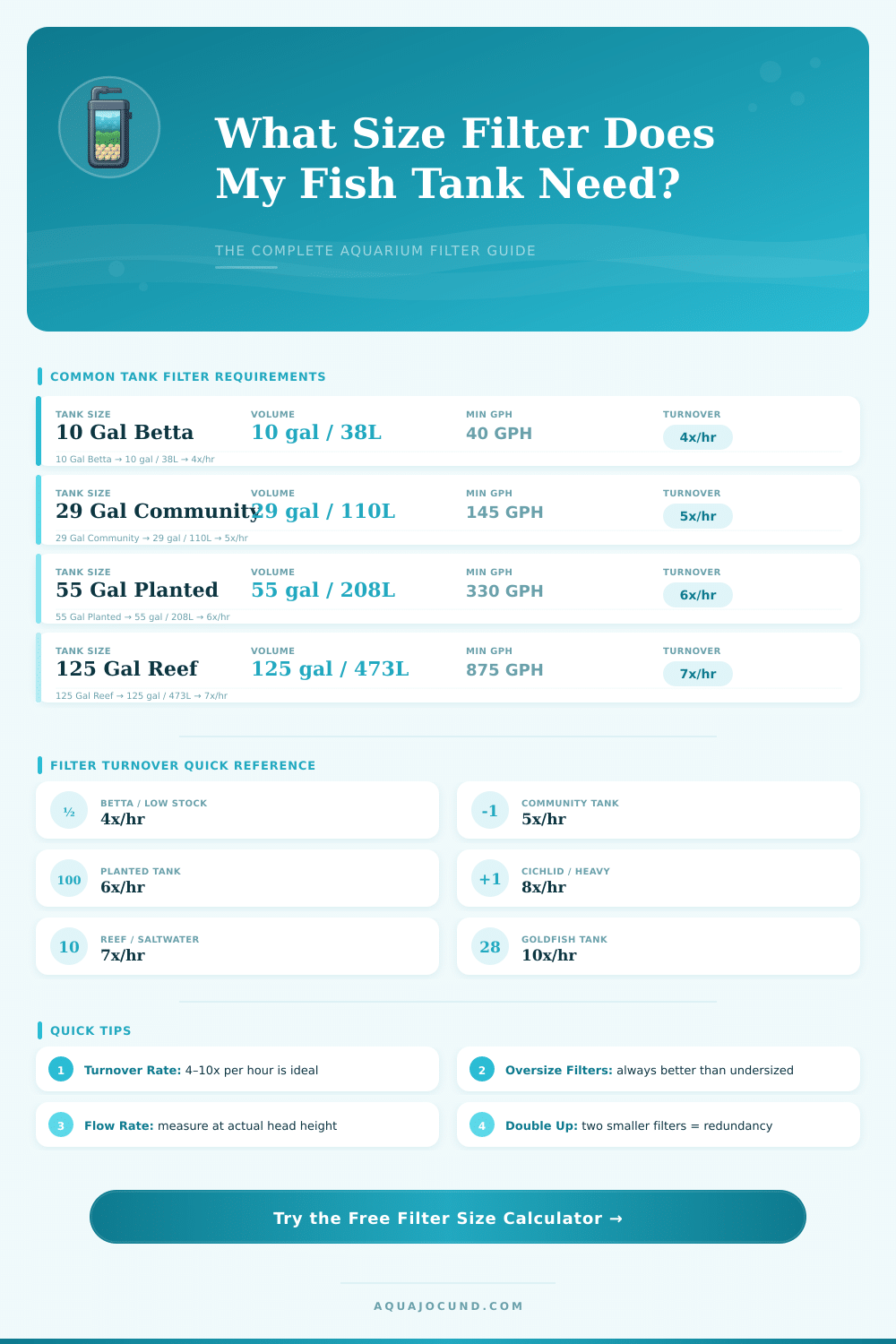
| Tank Type | Turnover Rate | Min GPH (per 10 gal) | Min LPH (per 40L) | Notes |
|---|---|---|---|---|
| Betta / Single Fish | 4x per hour | 40 GPH | 160 LPH | Gentle surface agitation preferred |
| Shrimp / Nano Tank | 4x per hour | 40 GPH | 160 LPH | Low flow prevents shrimp being sucked in |
| Community Freshwater | 5x per hour | 50 GPH | 200 LPH | Most general-purpose setups |
| Planted Tank | 5x per hour | 50 GPH | 200 LPH | Avoid CO2 off-gassing with surface agitation |
| Hospital / Quarantine | 6x per hour | 60 GPH | 240 LPH | Higher turnover aids oxygenation |
| Reef / Saltwater | 7x per hour | 70 GPH | 280 LPH | Plus separate circulation pumps for flow |
| Cichlid / Heavy Stock | 8x per hour | 80 GPH | 320 LPH | High bioload requires extra filtration |
| Goldfish Tank | 10x per hour | 100 GPH | 400 LPH | Very high waste producers |
| Tank Name | Dimensions (L x W x H in) | Volume (gal) | Volume (L) | Min GPH (5x) | Min LPH (5x) |
|---|---|---|---|---|---|
| 2.5 Gal Mini | 12 x 6 x 8 | 2.5 | 9.5 | 13 | 48 |
| 5 Gal Nano | 16 x 8 x 10 | 5 | 19 | 25 | 95 |
| 10 Gal Standard | 20 x 10 x 12 | 10 | 38 | 50 | 190 |
| 15 Gal High | 24 x 12 x 12 | 15 | 57 | 75 | 285 |
| 20 Gal Long | 30 x 12 x 12 | 20 | 76 | 100 | 380 |
| 29 Gal Standard | 30 x 12 x 18 | 29 | 110 | 145 | 550 |
| 40 Gal Breeder | 36 x 18 x 16 | 40 | 151 | 200 | 755 |
| 55 Gal Standard | 48 x 13 x 21 | 55 | 208 | 275 | 1040 |
| 75 Gal Standard | 48 x 18 x 21 | 75 | 284 | 375 | 1420 |
| 90 Gal Standard | 48 x 18 x 24 | 90 | 341 | 450 | 1705 |
| 125 Gal Standard | 72 x 18 x 21 | 125 | 473 | 625 | 2365 |
| 180 Gal Standard | 72 x 24 x 25 | 180 | 681 | 900 | 3405 |
| Media Type | Effective Volume / 10 gal | Surface Area | Replacement Interval | Best For |
|---|---|---|---|---|
| Mechanical Sponge | ~0.15 L media | Low | Rinse monthly; replace every 6 mo | All tanks, pre-filter |
| Ceramic Rings (Bio) | ~0.3 L media | ~300 m²/L | Rarely replaced, rinse in tank water | Freshwater biological |
| Bio-Matrix | ~0.25 L media | ~350 m²/L | Rarely replaced | High-bioload tanks |
| Kaldnes K1 (MBBR) | ~0.2 L media | ~500 m²/L | Self-cleaning in moving bed | Heavy stock, cichlids |
| Activated Carbon | ~1/4 cup / 10 gal | High surface | Replace every 2–4 weeks | Odor/color removal |
| Zeolite | ~1/4 cup / 10 gal | Medium | Replace every 1–2 weeks | Ammonia absorption, goldfish |
| Filter Floss | ~50 g / 10 gal | Very high | Replace every 1–2 weeks | Polishing water clarity |
Filter manufacturers rate their products at best-case flow with no media restriction. In real-world conditions with media loaded, flow drops 20–40%. Always choose a filter rated for at least 1.5x your actual tank volume for reliable turnover.
For canister and sump filters, every 12 inches (30 cm) of vertical lift (head height) reduces pump flow by approximately 10–20%. This calculator accounts for head height when estimating actual delivered GPH. Measure from pump outlet to tank water surface.
Fish tanks do not stay clean, they quickly get dirty. You can get seaweed, that dissolving stuff helps, except fish waste, that builds up, and dangerous bacteria, that clearly lives in that dirty surrounding. So every aquarium needs a reliable filter.
What makes a filter truly efficient? It helps to keep the water clear and remove garbage, like bits of food, dead plants and waste. But here the main part: it provides a home for big groups of helpful bacteria.
How to choose the right fish tank filter
Those bacteria do the hard work of turning ammonia (poison for fish) into nitrite, that later breaks into nitrates. Nitrates do not matter in low amounts and even are useful as food for water plants. Basically, a good filter is not something one can ignore It is needed for any tank system.
When one chooses a filter, there are many options. Canister filters, outside, internal, hang-on-back models, sponge, under-gravel screening (the list does not end). For something truly simple and friendly to the budget, sponge filters are hard to beat.
They also prove themselves reliable. Hang-on-back models, like the line of AquaClear, gained strong fame and stay likde for fair reasons.
Outside filters offer bigger skill than the internal. They are much more easily cleaned than internal, that commonly has tricky corners and pockets, that one hardly reaches. Here another advantage of outside: they stand outside of the aquarium, so your underwater landscape stays nice and without mess.
Now about canister filters, those sit under the aquarium and use pressure to push water through good media, seizing even small particles. The disadvantage? They can cost a lot.
By the way, the created airflow can too strengthen in small aquariums. A good homemade solution, that works surprisingly, is making a spray bar from PVC-tube with drilled holes for spreading the water flow.
Many brands got a good name in this field. Fluval, AquaClear, Seachem Tidal, Marineland and OASE all produce great gear. The line Seachem Tidal gets especially positive opinions from Fish Tank fans.
For small setups under 20 gallons, the compact Finnex PX-360 is a good option. Hygger offers cheap internal sponge filters with rooms for bio-media, that work by means of air pumps and keep costs low. If you search something slim, that does not take a lot of space in the aquarium, Sicce and Fluval both deserve too mind for internal filters.
Choose the right Filter Size depending on several things: the size of your Fish Tank, the fish types you keep, whether they like strong or gentle water flow and how much you are ready to spend. Some fish truly dislike fast flows, while others benefit here. More biological screening always is useful.
Using two filters is truly smart tactics; if one fails, the second protects your bacterial group. Over-filtering usually works well, if the flow does not tire your fish. One spot, that matters more than one thinks: never wash filter media in tap water.
Press it in old water from theaquarium, to not kill those helpful bacteria, that you grew with effort.