🐟 Fish Per Gallon Calculator
Calculate the ideal stocking level for your aquarium based on tank size, shape, and fish type
| Tank Name | Dimensions (L x W x H in) | US Gallons | Liters | Surface Area (sq in) |
|---|---|---|---|---|
| 2.5 Gallon Nano | 12 x 6 x 8 | 2.5 | 9.5 | 72 |
| 5 Gallon Nano Cube | 16 x 8 x 10 | 5 | 18.9 | 128 |
| 10 Gallon Standard | 20 x 10 x 12 | 10 | 37.9 | 200 |
| 20 Gallon Long | 30 x 12 x 12 | 20 | 75.7 | 360 |
| 29 Gallon Standard | 30 x 12 x 18 | 29 | 109.8 | 360 |
| 40 Gallon Breeder | 36 x 18 x 16 | 40 | 151.4 | 648 |
| 55 Gallon Standard | 48 x 13 x 21 | 55 | 208.2 | 624 |
| 75 Gallon Standard | 48 x 18 x 21 | 75 | 283.9 | 864 |
| 90 Gallon Standard | 48 x 18 x 24 | 90 | 340.7 | 864 |
| 125 Gallon Standard | 72 x 18 x 21 | 125 | 473.2 | 1296 |
| 180 Gallon Standard | 72 x 24 x 25 | 180 | 681.4 | 1728 |
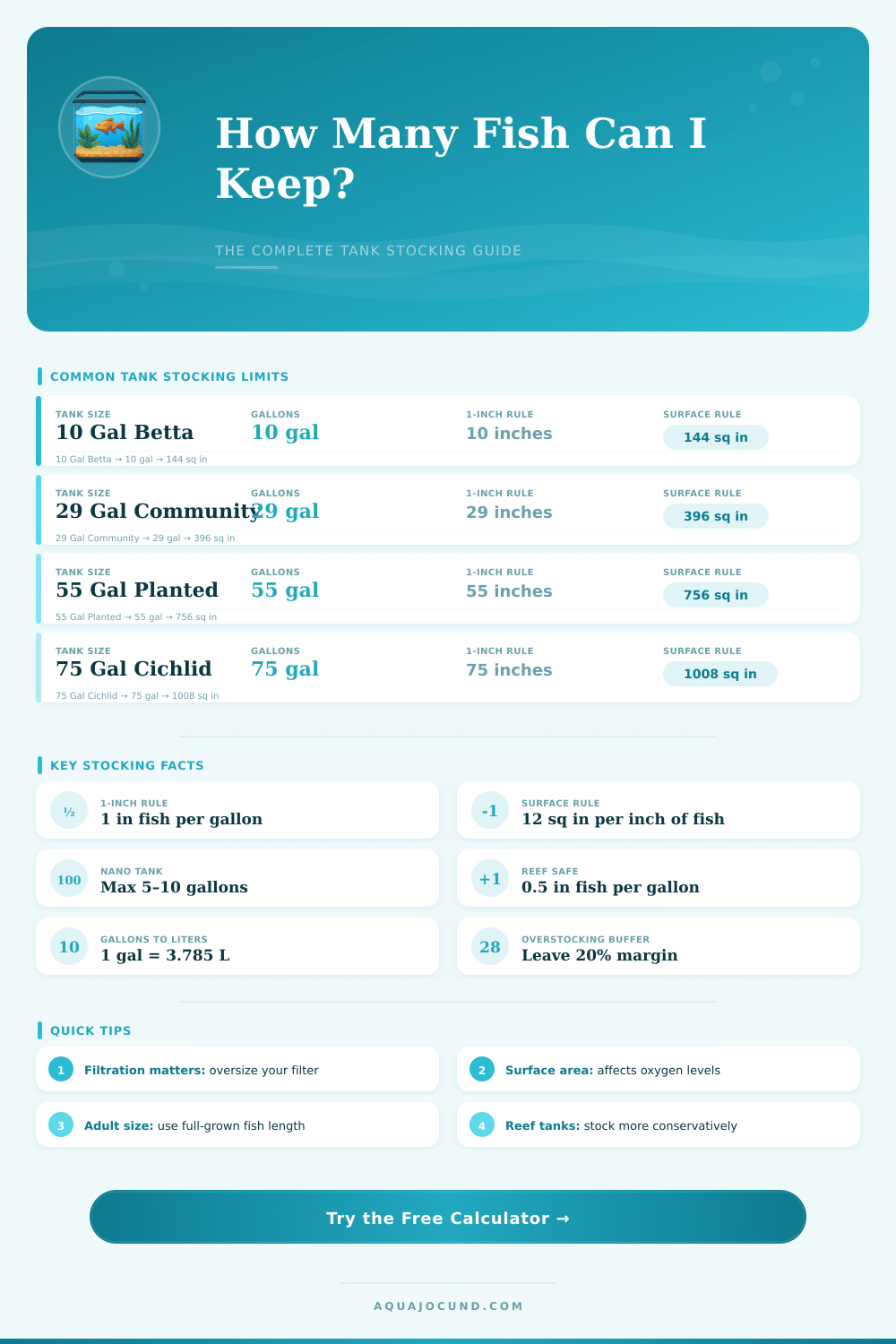
| Rule / Tank Type | Inches of Fish per Gallon | cm of Fish per Liter | Best For | Notes |
|---|---|---|---|---|
| Community Freshwater | 1.0 in/gal | 0.4 cm/L | Tetras, livebearers, corydoras | Classic rule, start here |
| Aggressive Freshwater | 0.75 in/gal | 0.3 cm/L | Barbs, semi-aggressive species | Extra space reduces stress |
| Heavily Planted | 1.5 in/gal | 0.6 cm/L | Dense plant setups | Plants aid filtration |
| Reef / Marine | 0.5 in/gal | 0.2 cm/L | Saltwater fish | Marine fish need more space |
| Cichlid / Large Fish | 0.5 in/gal | 0.2 cm/L | African/South American cichlids | High waste producers |
| Nano / Betta | 2.0 in/gal | 0.8 cm/L | Small nano species | Tiny fish, dense planting |
| Shrimp Tank | 10 shrimp/gal | 2.6 shrimp/L | Neocaridina, Caridina | No fish rule applies |
| Surface Area Rule | — | — | All freshwater | 12 sq in surface per inch of fish |
| Volume | Community (1 in/gal) | Reef (0.5 in/gal) | Planted (1.5 in/gal) | Shrimp (10/gal) |
|---|---|---|---|---|
| 5 gal (18.9 L) | 5 in total | 2.5 in total | 7.5 in total | 50 shrimp |
| 10 gal (37.9 L) | 10 in total | 5 in total | 15 in total | 100 shrimp |
| 20 gal (75.7 L) | 20 in total | 10 in total | 30 in total | 200 shrimp |
| 29 gal (109.8 L) | 29 in total | 14.5 in total | 43.5 in total | 290 shrimp |
| 40 gal (151.4 L) | 40 in total | 20 in total | 60 in total | 400 shrimp |
| 55 gal (208.2 L) | 55 in total | 27.5 in total | 82.5 in total | 550 shrimp |
| 75 gal (283.9 L) | 75 in total | 37.5 in total | 112.5 in total | 750 shrimp |
| 125 gal (473.2 L) | 125 in total | 62.5 in total | 187.5 in total | 1,250 shrimp |
Always base your stocking calculations on the maximum adult size of each fish, not the juvenile size at purchase. A 1-inch fish at the store may grow to 6 inches as an adult — always plan for the full-grown length to avoid overstocking.
For tanks with unusual shapes (tall narrow cylinders, tall display tanks), the surface area rule is more accurate than the inch-per-gallon rule. Surface area governs oxygen exchange – wider tanks with more surface area support more fish regardless of volume.
Picking Fish for an aquarium ranks among the main issues of this hobby. In ideal cases, filling the tank would like to simply choose the most attractive Fish bear it home and lay it in the water. None would care about diseases, that Fish could get, about parasitic problems, food refusal or conflicts with tankmates.
Even so reality works otherwise.
How to Pick Fish and Stock Your Aquarium
Using an online calculator for stocking forms a solid start. AqAdvisor serves as a resource, that helps to plan the number of tropical Fish. It bases on a vast database, and its algorithm intends to be quite careful.
The focus rests on lasting Fish health and balanced stability, instead of on maximizing amount. Some other programs consider more than 800 species of Fish, allow to check compatibility and even convert between liters and Gallon. Such aids are useful especially for newcomers.
Although some reckon, that AqAdvisor too confines, many hobbyists successfully pass the 100 percent limit without troubles. One argues, that too strict rules can brake the learning process and deter sharing of experiences. When one does start, even so, staying conservative seems wise.
The size of the aquarium plays a big role. A tank of 10 Gallon indeed is way too little and leaves little space for a varied community of Fish. Almost always bigger is more useful.
If it is possible to choose bigger, do that. Little tanks hamper the care, because the water changes happen more quickly. With a little system, biological burden forms the main risk.
Regular testing of the water by means of chemical kits helps too control nitrate levels and pH-level stable.
The rule of one inch per Gallon commonly appears in discussions. It points, that for every inch of Fish one must add a Gallon of water. Like this a three-inch betta requires three Gallon.
Other advice offers one pound of Fish for eight to ten Gallon in a well working tank. Three main elements determine the stock level, and their insight eases decisions about adding Fish.
Because of the cycling process, a complete cycle without Fish, where the biological systems handle two parts per million of ammonia in 24 to 48 hours, allows to stock without slowdown. Even so none rushes that. If snails form part of the setup, enter them first, so that the group spreads before Fish arrive, that would eat them.
The most aggressive or territorial species enterultimately.
Search in aquarium forums the name of species together with minimal size of tank to deliver reliable info. Simply skip the smallest offered size. For instance, a calculator could suggest changing 26 percent of water weekly and hardness between 5 and 12 dH.
Setting up a saltwater aquarium requires five steps to reach everything correctly.