🐟 Fish Food Calculator
Calculate the exact daily & weekly feeding amounts for your aquarium based on fish type, count, and weight
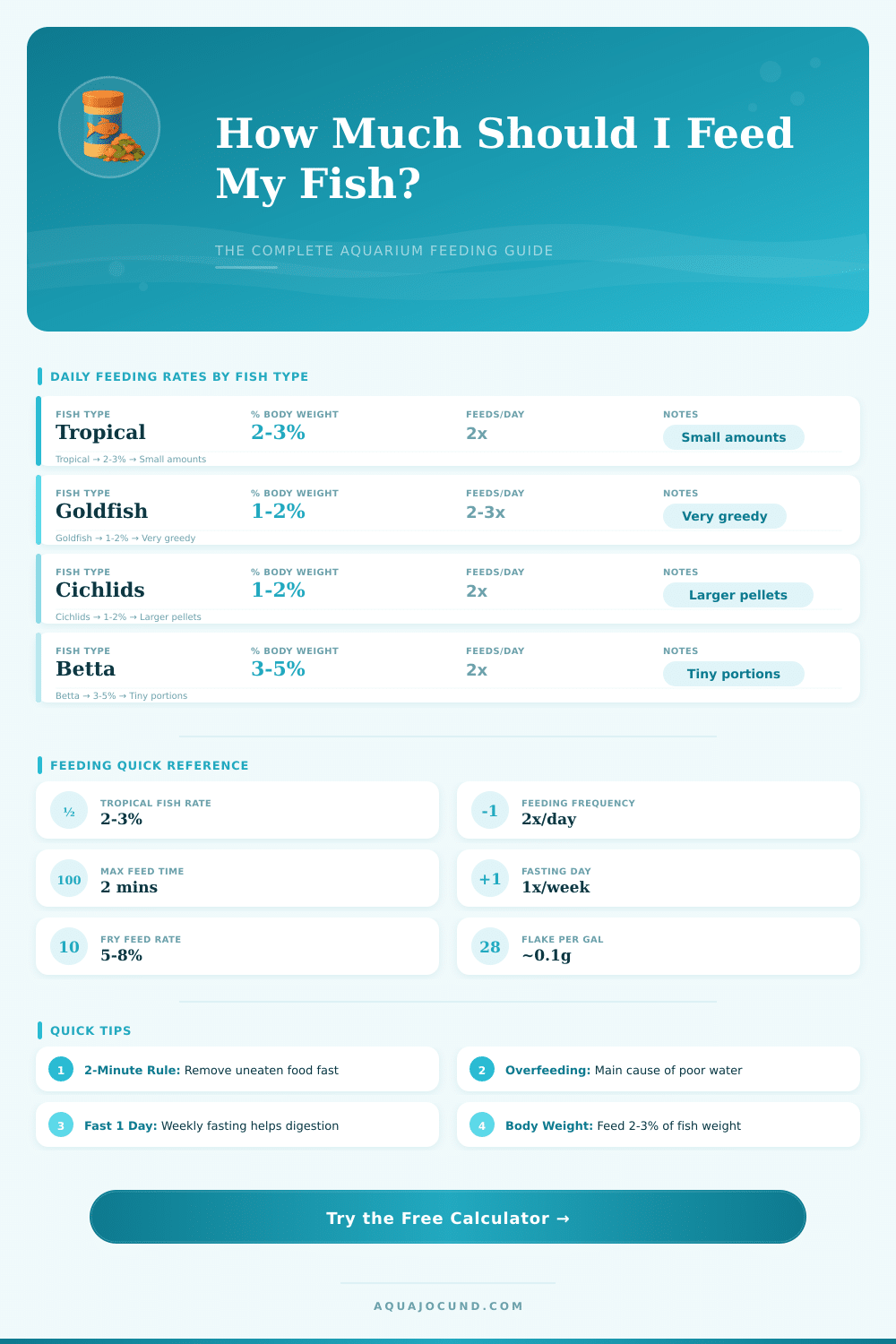
| Fish Type | % Body Wt / Day | Feeds / Day | Recommended Food | Notes |
|---|---|---|---|---|
| Tropical (General) | 2–3% | 2x | Flake / Micro Pellet | Small amounts, 2-min rule |
| Betta Fish | 3–5% | 2x | Pellet / Freeze-Dried | Tiny portions only |
| Goldfish | 1–2% | 2–3x | Pellet / Flake | Very greedy; prone to overfeeding |
| Cichlid | 1–2% | 2x | Large Pellet | Protein-rich diet preferred |
| Shrimp | 2–4% | 1–2x | Algae Wafer / Powder | Every other day for planted tanks |
| Reef / Marine | 1–2% | 2x | Marine Pellet / Flake | Supplement with live food |
| Discus | 3–5% | 3x | Gel / Freeze-Dried | Sensitive; high protein needed |
| Pleco / Catfish | 1–2% | 1x | Algae Wafer / Sinking | Feed at night; sinking food only |
| Fry (Baby Fish) | 5–8% | 4–6x | Powdered / Infusoria | Multiple small feedings per day |
| Tank Name | Dimensions (L x W x H in) | Volume (gal) | Volume (L) |
|---|---|---|---|
| Nano Cube 5 | 12 x 12 x 12 | 5 | 19 |
| 10 Gallon | 20 x 10 x 12 | 10 | 38 |
| 20 Gallon Long | 30 x 12 x 12 | 20 | 76 |
| 29 Gallon | 30 x 12 x 18 | 29 | 110 |
| 40 Gallon Breeder | 36 x 18 x 16 | 40 | 151 |
| 55 Gallon | 48 x 13 x 21 | 55 | 208 |
| 75 Gallon | 48 x 18 x 21 | 75 | 284 |
| 125 Gallon | 72 x 18 x 22 | 125 | 473 |
| Daily Amount | Per Week | Per Month | Per Year |
|---|---|---|---|
| 0.1g (0.004oz) | 0.7g | 3g | 36.5g |
| 0.5g (0.02oz) | 3.5g | 15g | 182.5g |
| 1g (0.035oz) | 7g | 30g | 365g |
| 2g (0.07oz) | 14g | 60g | 730g |
| 5g (0.18oz) | 35g | 150g | 1,825g |
| 10g (0.35oz) | 70g | 300g | 3,650g |
Election of good Fish Food for fishes commonly confuses folks. Here are many brands and kinds, but different ideas about what best works. Big part of the cause is strip food, that gives everything needed and helps good health while it stays easy for digestion.
A quiet aquarium benefits from quality Fish Food because it reduces the waste.
How to Choose Fish Food
Fishes split into plant-eating, all-eating and meat-eating species. Main needs range according to every group. Fish Food is meant to match that demand and sometimes add colors for more vivid look.
The label shows the first ingredient, that has big weight. For meat-eating fishes the answer is meat or for plant-eating ones vegetables, but a genuinely good mix reduces the need to search for the ideal one.
Brands of dry foods, for instance New Life Spectrum and Northfin, stand out because they do not depend on grains and their leftovers. Northfin beats many rivals in ingredients, so it deserves the a bit higher price. Fluval Bug Bites well serves as everyday meal each second day.
Hikari ranks among favorites, because fishes commonly seem to love it very much. Omega One convinces especially the veggie pills and flakes for plant-eating fishes.
Frozen foods form an entirely other group. Hikari, Omega One and San Francisco Bay answer for frozen or freeze-dried kinds. Frozen bloodworms please many fishes, although they cost more then flakes or brine shrimps for nutrition.
Frozen brine shrimps, mysis shrimps, daphnia, glassworms and copepods all answer as extra parts in the everyday menu.
Some fish keepers favor making homemade food at home. A common method is to mix tuna, salmon, peas, kale and spirulina with gelatin. For more color one can add pepper.
Plecos and shrimps like wet vegetables, such as zucchini, spinach, green beans and squash.
Goldfish have their own separate tastes. Some of them genuinely favor Tetra lagoflakes above all others. Pellets for goldfish, that float and keep form, are useful because they sink slowly while they get wet.
Koi fishes well accept Tetra feed, occasionally also Hikari.
For tiny fishes, like neon tetras or rasboras, micro pellets prove to be very good. Spirulina flakes form another solid choice. Cichlid keepers usually choose special cichlid flakes, and some mixes carry even garlic.
Live foods, like white worms or grindal worms, can be used, but not all fishes get excited about them. The main point stays diversity. Combining dry, frozen and freshfoods helps to keep healthy and happy fishes.