🐟 Fish Farming Profit Per Acre Calculator
Estimate annual yield, feed requirements, and net returns for your fish farming operation
| Species | FCR Range | Stocking (fish/acre) | Harvest Weight (lbs) | Grow-Out (months) | Survival Rate |
|---|---|---|---|---|---|
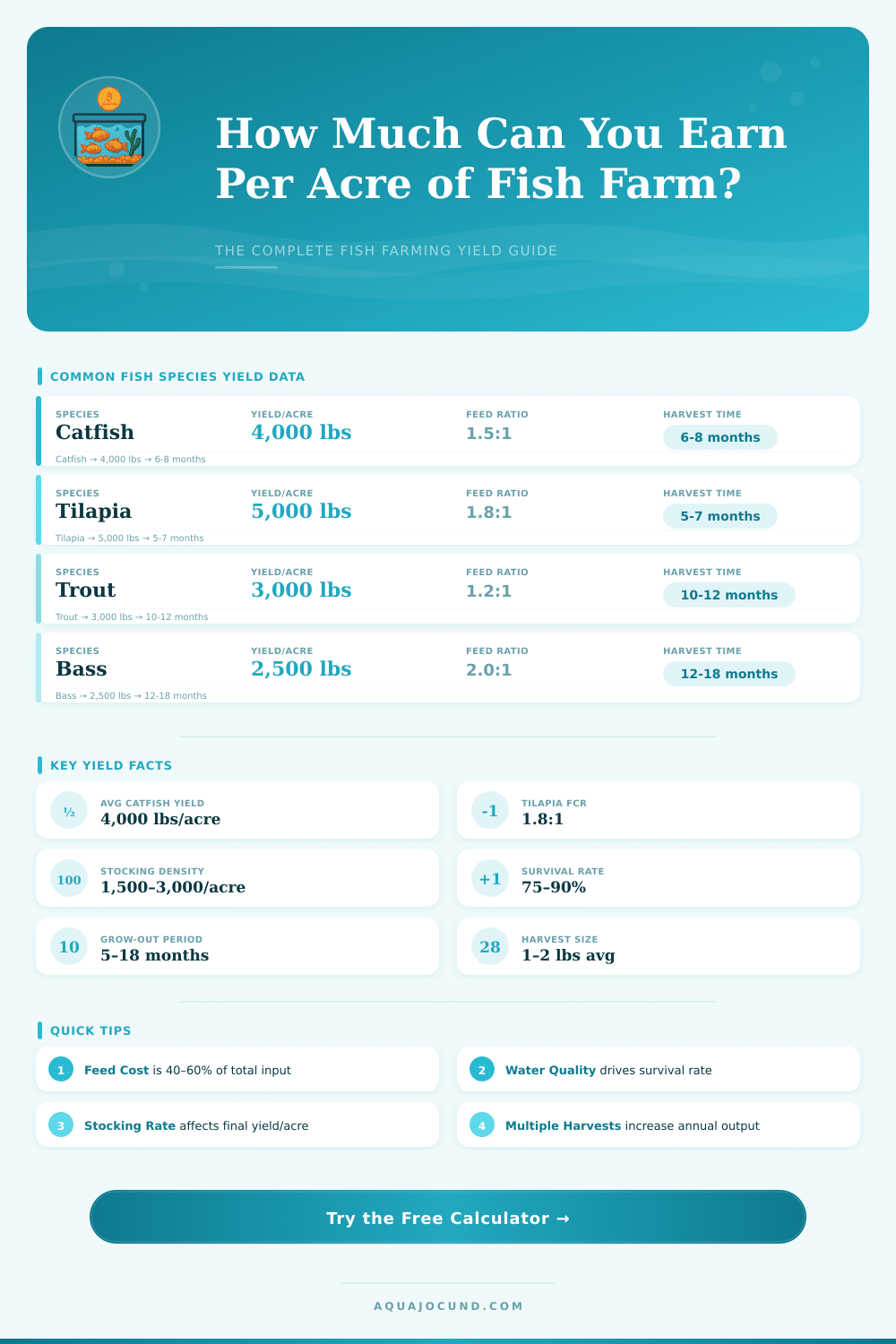
| Channel Catfish | 1.4 – 1.8 | 1,000 – 2,000 | 1.0 – 2.0 | 6 – 8 | 80 – 90% |
| Tilapia | 1.6 – 2.0 | 1,500 – 3,000 | 1.0 – 1.5 | 5 – 7 | 85 – 92% |
| Rainbow Trout | 1.0 – 1.4 | 2,000 – 4,000 | 0.5 – 1.0 | 10 – 12 | 78 – 88% |
| Largemouth Bass | 1.8 – 2.2 | 500 – 1,200 | 1.0 – 2.0 | 12 – 18 | 75 – 85% |
| Atlantic Salmon | 1.1 – 1.3 | 3,000 – 5,000 | 8.0 – 12.0 | 12 – 18 | 85 – 93% |
| Common Carp | 2.0 – 2.5 | 800 – 1,500 | 2.0 – 4.0 | 8 – 12 | 82 – 90% |
| White Shrimp | 1.5 – 2.0 | 15,000 – 25,000 | 0.04 – 0.06 | 4 – 6 | 70 – 85% |
| Yellow Perch | 1.8 – 2.2 | 1,000 – 2,000 | 0.3 – 0.5 | 12 – 18 | 72 – 82% |
| System Type | Typical Yield Multiplier | Water Depth | Density Potential | Water Volume (gal/acre) |
|---|---|---|---|---|
| Earthen Pond | 1.0x (baseline) | 4 – 8 ft | Moderate | 1.3M – 2.7M |
| Cage Culture | 0.8x – 1.2x | 8 – 20 ft | High | 2.7M – 6.5M |
| Raceway / Flow-Through | 1.5x – 2.5x | 2 – 4 ft | Very High | 650K – 1.3M |
| Recirculating (RAS) | 3.0x – 8.0x | Variable | Extremely High | Variable |
| Yield (lbs/acre) | FCR 1.2 | FCR 1.5 | FCR 2.0 | FCR 2.5 |
|---|---|---|---|---|
| 1,000 lbs (454 kg) | 1,200 lbs feed | 1,500 lbs feed | 2,000 lbs feed | 2,500 lbs feed |
| 2,000 lbs (907 kg) | 2,400 lbs feed | 3,000 lbs feed | 4,000 lbs feed | 5,000 lbs feed |
| 3,000 lbs (1,361 kg) | 3,600 lbs feed | 4,500 lbs feed | 6,000 lbs feed | 7,500 lbs feed |
| 5,000 lbs (2,268 kg) | 6,000 lbs feed | 7,500 lbs feed | 10,000 lbs feed | 12,500 lbs feed |
| 10,000 lbs (4,536 kg) | 12,000 lbs feed | 15,000 lbs feed | 20,000 lbs feed | 25,000 lbs feed |
Fish Farming fits to become a money-making business, even so it depends on several factors. Whether it is about kind of fish, costs for labor and utilities, quality together with amount of the received product, or maybe the global market… Everything affects the result.
There is also strong competition from the whole world especially from regions where the labor costs much less.
Can Fish Farming Make Money?
Tilapia rank between the most popular fish for eating everywhere on the globe, so the need stays high. Because tilapia grow very quickly, that makes them ideal for tiny businesses that require quick income. Farming of tilapia can give Profit between 20 and 30 percent yearly, according to the size of the farm, quality of management and situation on the market.
Tilapia bear big amounts of babies, and the babies eat cheaply early, so costs for food stay low in the first stages. Buying fish food in big batches, one must not spend too much.
Fish of high value, for instance salmon, trout, catfish and bass, usually generate more income because of their higher prices. Species that require more time to grow, as salmon, commonly give even bigger Profit. Shellfish, as oysters and clams, also turn out very rewarding thanks to the strong demand.
Salmon grow in coastal waters and people value them because of the full flavr.
Tiny fish farms can reach yearly Profit between 50 000 and 100 000 dollars. Vast businesses earn even more, because they operate well. Only the American farming of catfish had in 2016 entirely 624 professional ranchers in 32 states, that produced more then 385 millions of pounds of catfish, valued at 363 millions of dollars.
Even so Fish Farming is not simple. Many farms of pangasius and tilapia indeed win money, but some lose because of heavy market prices and failed management of costs. Keeping the buildings warm in winter for the right heat of the fish costs a lot.
Local Fish Farming requires huge amounts only to reach break even. Fish farms earn because they grow huge crowds of fish, but even those require a lot of attention. That must involve you almost your wholelife.
Indeed the most money-making Fish Farming activities are those who breed and sell fancy fish. Exclusive discus, rare cichlids and freshwater rays can give nice amounts. Some breeders of cichlids sell their babies for almost 60 dollars each unit.
Even so farms who sell eating fish generate millions of fish and reach only thin margins, commonly selling them for under one dollar each bit.
One interesting way is the mix of Fish Farming with vegetable growing. Some ranchers earn selling vegetables together with fish, keeping costs of the fish part to minimum while they grow rewarding crops. Adding arrangement of fish to the whole system also helps to reach Profit.
Use cheap but healthy feeds from the bottom part of the food chain helps to control costs. Plant-eating fish species, as many in India and China, require fewer food.