🐟 Fish Age Calculator
Estimate your fish's age in human-equivalent years and track lifespan milestones by species
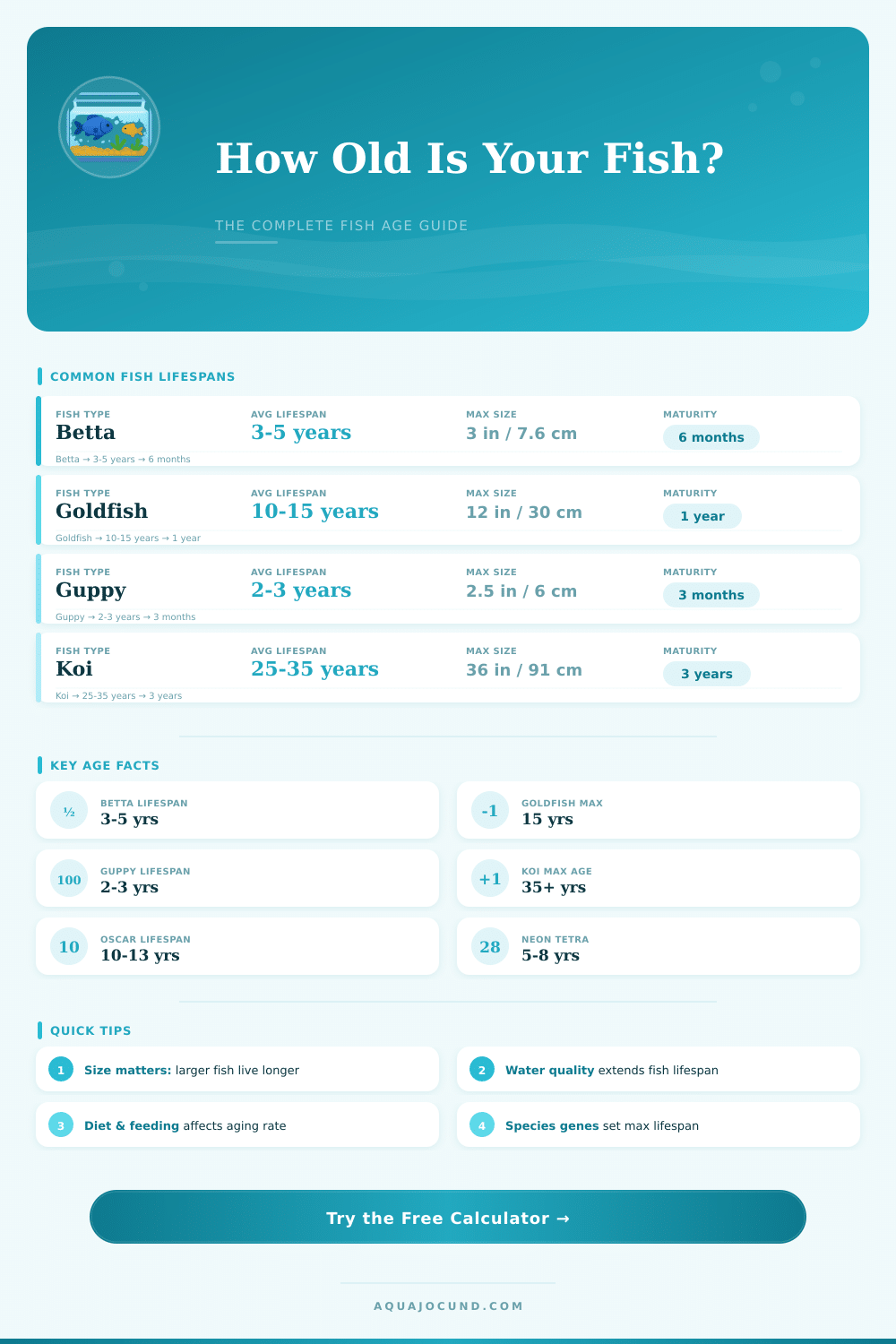
| Species | Avg Lifespan | Max Lifespan | Max Size (in) | Max Size (cm) | Maturity Age | Human Year Factor |
|---|---|---|---|---|---|---|
| Betta Fish | 3–5 yrs | 7 yrs | 3 in | 7.6 cm | 6 months | 15x |
| Goldfish | 10–15 yrs | 20 yrs | 12 in | 30 cm | 12 months | 5x |
| Guppy | 2–3 yrs | 5 yrs | 2.5 in | 6 cm | 3 months | 20x |
| Koi | 25–35 yrs | 50+ yrs | 36 in | 91 cm | 36 months | 2x |
| Oscar | 10–13 yrs | 15 yrs | 14 in | 35 cm | 12 months | 6x |
| Neon Tetra | 5–8 yrs | 10 yrs | 1.5 in | 4 cm | 3 months | 10x |
| Angelfish | 8–12 yrs | 15 yrs | 6 in | 15 cm | 8 months | 7x |
| African Cichlid | 8–10 yrs | 12 yrs | 8 in | 20 cm | 9 months | 7x |
| Common Pleco | 10–15 yrs | 20 yrs | 24 in | 61 cm | 18 months | 5x |
| Discus | 10–15 yrs | 18 yrs | 8 in | 20 cm | 12 months | 6x |
| Fish Age | Betta (Human Yrs) | Goldfish (Human Yrs) | Koi (Human Yrs) | Guppy (Human Yrs) | Life Stage |
|---|---|---|---|---|---|
| 3 months | ~4 yrs | ~1.25 yrs | ~0.5 yrs | ~5 yrs | Juvenile |
| 6 months | ~8 yrs | ~2.5 yrs | ~1 yr | ~10 yrs | Juvenile/Sub-adult |
| 1 year | ~15 yrs | ~5 yrs | ~2 yrs | ~20 yrs | Young Adult |
| 2 years | ~30 yrs | ~10 yrs | ~4 yrs | ~40 yrs | Adult |
| 3 years | ~45 yrs | ~15 yrs | ~6 yrs | ~60 yrs | Mature Adult |
| 5 years | ~75 yrs | ~25 yrs | ~10 yrs | ~100 yrs | Senior |
| 10 years | N/A | ~50 yrs | ~20 yrs | N/A | Senior |
| 20 years | N/A | ~100 yrs | ~40 yrs | N/A | Geriatric |
| Species | Juvenile Size | Sub-Adult Size | Adult Size | Full Grown Size | Growth Rate |
|---|---|---|---|---|---|
| Betta | 0.5–1 in | 1–2 in | 2–2.5 in | 3 in / 7.6 cm | 0.5 in/month |
| Goldfish | 0.5–2 in | 2–5 in | 5–9 in | 12 in / 30 cm | 1 in/month (young) |
| Guppy | 0.3–0.8 in | 0.8–1.5 in | 1.5–2 in | 2.5 in / 6 cm | 0.3 in/month |
| Koi | 1–4 in | 4–12 in | 12–24 in | 36 in / 91 cm | 2–4 in/yr |
| Oscar | 1–3 in | 3–8 in | 8–12 in | 14 in / 35 cm | 1 in/month (young) |
| Angelfish | 0.5–1 in | 1–3 in | 3–5 in | 6 in / 15 cm | 0.5 in/month |
Figuring out the Age of Fish maybe seems a bit weird idea, but it is a lot like the method for finding the Age of a tree. Like a tree Fish always forms layers from growth. Those layers leave rings, that one can count.
For Age Fish, the main ways are looking at its scales or studying its otolith structures, that is little bones in the inner ear.
How to Find a Fish’s Age
Otoliths are found in the organs for balance and hearing in Fish. They are made up of minerals and calcium carbonate. Study by means of radiocarbon method of otoliths help to also guess exactly the Age of Fish.
In one study one compared two ways with otoliths and scales, that using them together give the best result, that shwoed max Age of 15 years for that species.
Besides scales and otoliths, scientists also count growth rings on vertebrae, fin spines, lenses, teeth and some bones, for instance jaw bones or the chest girdle. The best method depends on the Fish species and on the area in that it lives. Fish that goes through clear seasons, like changes of cold too heat or of dry to wet, usually form more visible patterns of growth.
One commonly chooses scales, because they are more simple to gather and process, if only they have clear growth marks. Some species have soft scales, that are hard to pull out, for example the Atlantic herring or the Atlantic mackerel. Young Fish or those soft species sometimes are frozen whole, so that one can cut them and study later in a lab.
Knowing the Age of Fish is important for care about Fish populations. That forms part of rating about supplies and about insight, as those populations change over time. If one knows the Age of Fish in a group from the same year, it helps guess how many they die because of fishing or natural reasons.
Assuming that the biggest Fish is the most old simply does not count. That would be like the idea, that every person taller than six feet has reached 100 years of Age.
At the University of Georgia one set up a lab thanks to a gift of the Association about Fish and Creatures of Wild Nature, for making structures for knowing ages. There is also an open collection of images of high quality, that shows structures for Age Fish with confirmed ages. People can look by species to study otoliths, scales, fin spines and other parts.
Open access like this helps to protect those precious bits and give to others a chance to learn about the process of Age guessing. Steps like putting otoliths in resin allow precise cutting in thin sections and improve the accuracy of FishAge rating.
Fish always grow through their whole life and do not show aging like this clearly as birds or mammals. When Fish becomes more old, it usually becomes bigger and moves more slowly, what makes it easier prey for hunters. That explains partly, where it comes from, that few Fish truly die because of old age in naturalsurroundings.