🐠 Aquarium Volume Calculator
Calculate exact tank volume in gallons & liters for rectangle, cylinder, bow front & more shapes
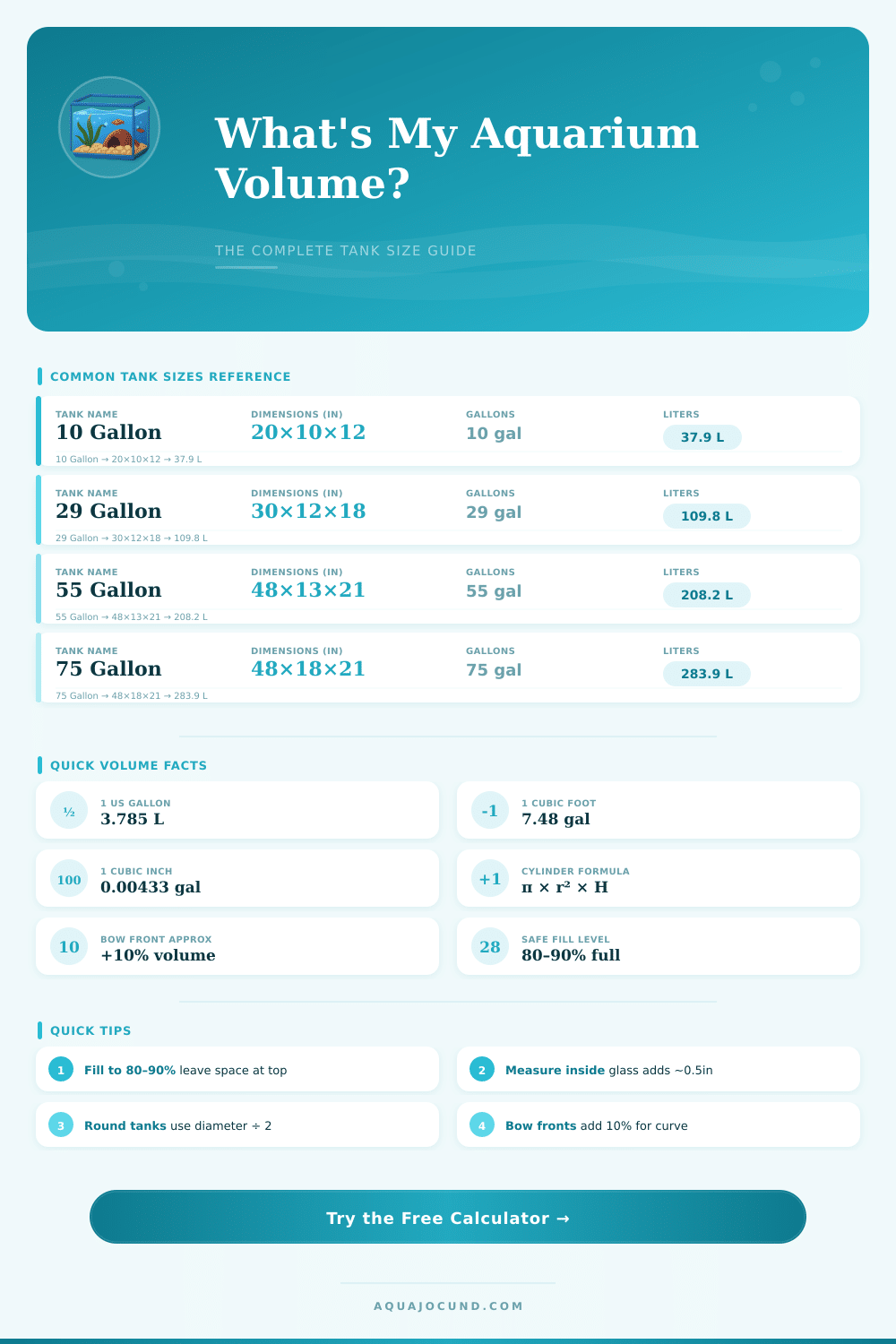
| Tank Name | Dimensions (L×W×H inches) | Volume (US Gal) | Volume (Liters) |
|---|---|---|---|
| Nano / Pico 2.5 Gal | 12 × 6 × 8 | 2.5 gal | 9.5 L |
| 5 Gallon Nano | 16 × 8 × 10 | 5.0 gal | 18.9 L |
| 10 Gallon Standard | 20 × 10 × 12 | 10.0 gal | 37.9 L |
| 15 Gallon | 24 × 12 × 12 | 15.0 gal | 56.8 L |
| 20 Gallon High | 24 × 12 × 16 | 20.0 gal | 75.7 L |
| 20 Gallon Long | 30 × 12 × 12 | 20.0 gal | 75.7 L |
| 29 Gallon | 30 × 12 × 18 | 29.0 gal | 109.8 L |
| 40 Gallon Breeder | 36 × 18 × 16 | 40.0 gal | 151.4 L |
| 55 Gallon | 48 × 13 × 21 | 55.0 gal | 208.2 L |
| 75 Gallon | 48 × 18 × 21 | 75.0 gal | 283.9 L |
| 90 Gallon | 48 × 18 × 24 | 90.0 gal | 340.7 L |
| 125 Gallon | 72 × 18 × 22 | 125.0 gal | 473.2 L |
| 180 Gallon | 72 × 24 × 25 | 180.0 gal | 681.4 L |
| Volume | US Gallons | Liters | Freshwater Weight |
|---|---|---|---|
| Small Nano Tank | 5 gal | 18.9 L | 41.7 lbs / 18.9 kg |
| Standard Starter | 10 gal | 37.9 L | 83.4 lbs / 37.9 kg |
| Small Community | 20 gal | 75.7 L | 166.8 lbs / 75.7 kg |
| Medium Community | 40 gal | 151.4 L | 333.6 lbs / 151.4 kg |
| Large Community | 55 gal | 208.2 L | 458.7 lbs / 208.2 kg |
| Large Show Tank | 75 gal | 283.9 L | 625.5 lbs / 283.9 kg |
| XL Show Tank | 125 gal | 473.2 L | 1042.5 lbs / 473.2 kg |
| Tank Volume | Heater Wattage | Filter Turnover (GPH) | Lighting (PAR zone) |
|---|---|---|---|
| Up to 10 gal (38 L) | 25–50W | 40–100 GPH | Low–Medium |
| 10–20 gal (38–76 L) | 50–100W | 100–200 GPH | Medium |
| 20–40 gal (76–151 L) | 100–150W | 200–400 GPH | Medium–High |
| 40–75 gal (151–284 L) | 150–200W | 400–750 GPH | High |
| 75–125 gal (284–473 L) | 200–300W | 750–1250 GPH | High |
| 125+ gal (473+ L) | 300–500W | 1250+ GPH | Very High |
Knowing the precise Volume of your Aquarium is more difficult than most folks think. This decides everything; it points how much life the tank fits, and the real measures that fishes will comfortably populate here. Well do that genuinely matter.
For simple rectangular tanks it is fairly easy. For instance we measure the length, width and height, in inches or centimetres, that does not have gravity. We multiply those three values to receive the cubic units, later we convert to gallons or liters.
How to Measure the Volume of Your Aquarium
The change results around 7.48 American gallons for one cubic foot. When you work with centimetres instead, simply multiply length by width by height, later divide by 1000 to reach liters.
Consider a sample with a tank of 50 cm by 60 cm by 70 cm. Multiply them together and you find 210 000. Divide that by 1000 and result is 210 liters.
Even so not every Aquarium is a perfect cube, here starts the quirks. Websites with calculators can count all bizarre forms: rolls, globes, ovals. For oval tanks especially, one must estimate the surface of the cross section, later multiply by teh length.
Here it becomes funny. The volumes that stores announce not always match the actual content. I found an Aquarium labelled as 100 liters, that indeed stores 120 liters, when I entered the real measures in a calculator.
This is a big difference. The other way, a 90-gallon tank commonly genuinely only holds 65 until 70 gallons, after you include rock and decorations.
Substrate, heaters, filters. Everything that takes space in your available area. Every Aquarium sold in a certain size will not genuinely store so much water, after the devices go in.
For a tank of 100 x 50 x 50 cm, considering the 2 until 3 cm that you leave from the top, it ends with around 211 liters of used water.
Consider also the wait entirely. One gallon of freshwater in normal density weighs around 8.34 pounds. Glass aquariums vary a lot.
A 10-gallon weighs about 11 pounds without water, while a 265-gallon monster reaches almost 400 pounds alone. The measures decided the biggest part of the Volume question, but many other things can alter the causes.
One practical trick to estimate the Volume without tools: measure the height of the tank, divide that by 10, later mark that distance from the bottom. Fill until that line and measure the water. Multiply by 10 and you have a reliable rough guess.
Devices like power-calculators and flow-meters also are useful. They base on the listed Volume to determine the heater sizes andfilter needs, what removes much from the wild attempt from the setup.