🪨 Aquarium Substrate Calculator
Calculate exactly how much substrate you need for any tank shape, size, and substrate depth
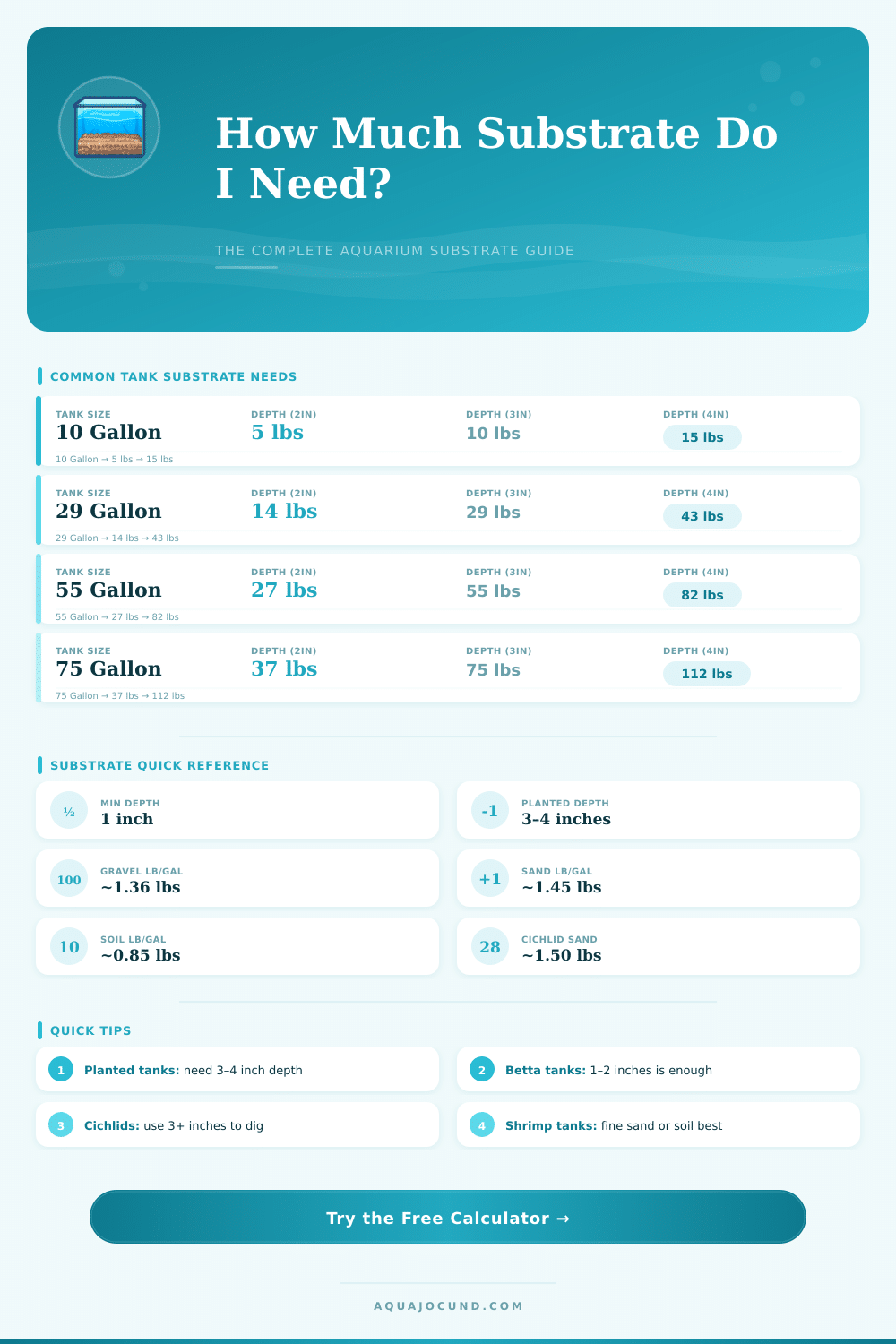
| Tank Type | Recommended Depth | Depth (cm) | Notes |
|---|---|---|---|
| Betta / Nano Tank | 1 – 2 inches | 2.5 – 5 cm | Minimal; easy cleaning |
| Community Fish Tank | 2 – 3 inches | 5 – 7.5 cm | Standard depth for most setups |
| Planted / Aquascape Tank | 3 – 4 inches | 7.5 – 10 cm | Root zone for live plants |
| Shrimp Tank | 2 – 3 inches | 5 – 7.5 cm | Fine substrate preferred |
| Cichlid Tank | 3 – 5 inches | 7.5 – 12.5 cm | Deep sand for digging |
| Reef / Marine Tank | 0.5 – 1 inch or 4+ inches | 1.3 – 2.5 cm or 10+ cm | Shallow or deep sand bed (DSB) |
| Goldfish Tank | 2 – 3 inches | 5 – 7.5 cm | Smooth gravel to avoid injury |
| Biotope Setup | 3 – 4 inches | 7.5 – 10 cm | Match natural habitat depth |
| Tank Name | Dimensions (L x W x H in) | Volume (gal) | Volume (L) |
|---|---|---|---|
| Nano Cube 5 Gallon | 16 x 8 x 10 | 5.5 | 20.8 |
| 10 Gallon Standard | 20 x 10 x 12 | 10 | 37.9 |
| 20 Gallon Long | 30 x 12 x 12 | 20 | 75.7 |
| 29 Gallon Standard | 30 x 12 x 18 | 29 | 109.8 |
| 40 Gallon Breeder | 36 x 18 x 16 | 40 | 151.4 |
| 55 Gallon Standard | 48 x 13 x 21 | 55 | 208.2 |
| 75 Gallon Standard | 48 x 18 x 21 | 75 | 283.9 |
| 125 Gallon Standard | 72 x 18 x 22 | 125 | 473.2 |
| Tank Volume | Gravel (lbs / kg) | Sand (lbs / kg) | Aquasoil (lbs / kg) |
|---|---|---|---|
| 5 Gallons | 5.5 / 2.5 | 5.8 / 2.6 | 3.4 / 1.5 |
| 10 Gallons | 10.9 / 4.9 | 11.6 / 5.3 | 6.8 / 3.1 |
| 20 Gallons | 16.3 / 7.4 | 17.4 / 7.9 | 10.2 / 4.6 |
| 29 Gallons | 24.4 / 11.1 | 26.1 / 11.8 | 15.3 / 6.9 |
| 40 Gallons | 38.8 / 17.6 | 41.4 / 18.8 | 24.3 / 11.0 |
| 55 Gallons | 43.5 / 19.7 | 46.4 / 21.0 | 27.2 / 12.3 |
| 75 Gallons | 60.3 / 27.4 | 64.3 / 29.2 | 37.8 / 17.1 |
| 125 Gallons | 100.5 / 45.6 | 107.2 / 48.6 | 63.0 / 28.6 |
For planted tanks, consider a nutrient-rich base layer (like aquasoil or root tabs substrate) at 1–2 inches topped with 1–2 inches of capping substrate like sand or fine gravel. This provides both root nutrition and a clean appearance. Calculate each layer separately using this tool.
Many aquascapers slope substrate from front (1 inch) to back (4+ inches) for depth perspective. Use the average depth for calculation, then add a 15–20% overage buffer. For large aquascapes, use hardscape materials (rocks, wood) under the substrate at the back to reduce the total substrate weight needed.
The Substrate of Aquarium form the bottom layer in tanks. It commonly is made up of grit, sand, ground or even ready clay. The right choice matter more than many folks assume and there are many options for that.
Big advantage of Substrate are, that it holds useful germs. Those germs most like to spread on grit, sand or any material, that rests at the bottom of the water. In bigger surface grows more many good germs, that helps to keep the chemistry of the water healthy and lasting.
What to Put on the Bottom of Your Aquarium
Without Substrate the Aquarium does work, even so lacks enough places, where those helpful germs can settle.
Whether one must use Substrate in Aquarium? Everything depends on the style and the goal. It gives nicer look, more space for germs and funguses, vast range for plants and animals, plus ease the growth of alive plants.
Some favour Aquarium without bottom layer, but then one loses all that profit.
In Aquarium with fresh water presents chiefly three kinds of Substrate: grit, sand and ground. Sand well works, because it stops organic partacles from sinking too deeply in the bottom. Natural color sand hides seaweed and garbage, making them less visible.
Plants in sand are simpler, and it allows roots of plants lodge flatly, especially for those, that root well. Even so, clean sand can be hard, because vacuuming it without losing some parts of the upper layer is almost not possible.
Also exist special Substrate for plants, as ADA Aqua Soil and other types. Those rich globes from ground call active Substrate, because they lower the pH-value and soften the hardness of the water. Because of that they are popular in shrimp tanks and Aquarium with many root-feeding plants.
During the time, even so, active Substrate runs out in nourishment, when plants grow and people dump the slices.
Products as Attribute-Complete belong to inert Substrate, that stores ions, that plants later absorb by means of their roots. Some from them carry alive germs, that helps to convert fish waste in nourishment for plants, pushing the cycle in the Aquarium faster and reliable. Also mixing Substrate has value, for instance, combine Attribute-Complete with Fluval Stratum and black sand, for dark look with rich nourishment.
Also the price plays role. The tiniest cost comes from clear sand or grit, that even so well serve. Sand from pool-filters and black diamond blast sand from stores for supplies answers for Aquarium.
Complete Substrate, that intends to be used alone, cost the most, but commonly deliver the best results. Basic layer-products form the base, that one covers by means of clear grit or sand. Honest efforts fortake care of planted Aquarium matter much more than the choice of Substrate.