🌊 Aquarium Return Pump Size Calculator
Find the ideal GPH & flow rate for your sump return pump — freshwater, planted, reef & more
| Tank Name | Dimensions (L×W×H in) | Volume (gal) | Volume (L) | Freshwater Min GPH | Reef Min GPH |
|---|---|---|---|---|---|
| Nano Cube 5 | 12 × 12 × 12 | 5 | 19 | 50 | 100 |
| 10 Gal Standard | 20 × 10 × 12 | 10 | 38 | 100 | 200 |
| 20 Gal Long | 30 × 12 × 12 | 20 | 76 | 200 | 400 |
| 29 Gal Standard | 30 × 12 × 18 | 29 | 110 | 290 | 580 |
| 40 Gal Breeder | 36 × 18 × 16 | 40 | 151 | 400 | 800 |
| 55 Gal Standard | 48 × 13 × 21 | 55 | 208 | 550 | 1100 |
| 75 Gal Standard | 48 × 18 × 21 | 75 | 284 | 750 | 1500 |
| 90 Gal Standard | 48 × 18 × 24 | 90 | 341 | 900 | 1800 |
| 125 Gal Standard | 72 × 18 × 21 | 125 | 473 | 1250 | 2500 |
| 180 Gal Standard | 72 × 24 × 24 | 180 | 681 | 1800 | 3600 |
| Component | Equivalent Head (ft) | Equivalent Head (m) | GPH Loss Est. |
|---|---|---|---|
| 1 ft of vertical rise | 1.0 ft | 0.30 m | ~5% |
| 90° elbow (PVC) | ~1.0 ft | ~0.30 m | ~5% |
| 45° elbow (PVC) | ~0.5 ft | ~0.15 m | ~2.5% |
| Ball valve (open) | ~0.5 ft | ~0.15 m | ~2.5% |
| Check valve | ~4.0 ft | ~1.22 m | ~20% |
| 10 ft horizontal pipe | ~0.5 ft | ~0.15 m | ~2.5% |
| Pump strainer/screen | ~0.5 ft | ~0.15 m | ~2.5% |
| GPH Rating | LPH Equiv. | Suitable Tank Volume | Typical Use Case |
|---|---|---|---|
| 50–150 GPH | 189–568 LPH | 5–20 gal | Nano / small freshwater |
| 150–400 GPH | 568–1514 LPH | 20–55 gal | Community freshwater, sump |
| 400–800 GPH | 1514–3028 LPH | 40–90 gal | Freshwater sump, small reef |
| 800–1500 GPH | 3028–5678 LPH | 75–125 gal | Mid-size reef, FOWLR |
| 1500–3000 GPH | 5678–11356 LPH | 125–200 gal | Large reef sump return |
| 3000+ GPH | 11356+ LPH | 200+ gal | Large display reef tanks |
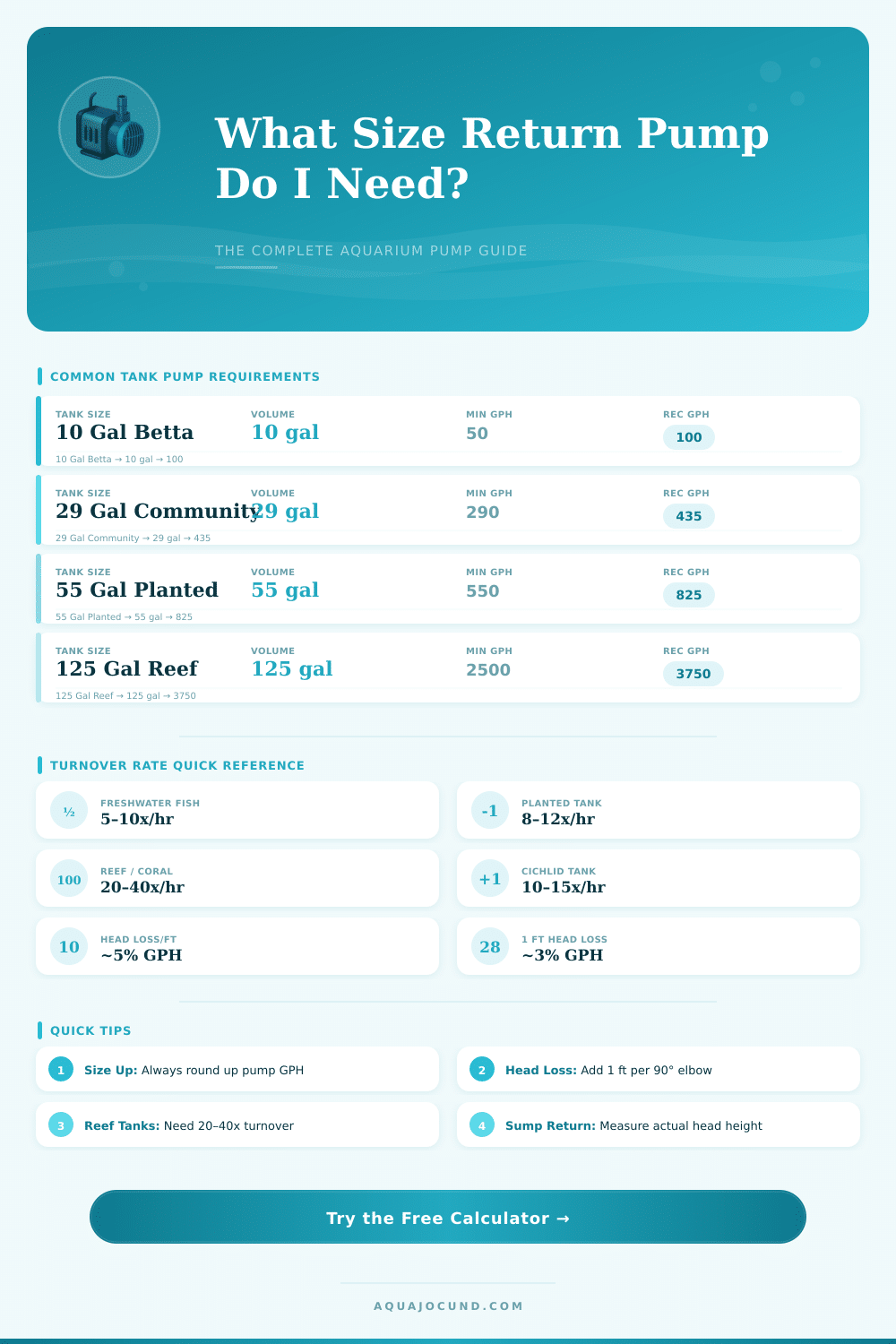
Always calculate your total head height before choosing a pump. Every foot of vertical lift, every elbow, and every valve reduces your effective GPH. A pump rated at 1000 GPH at 0 ft of head may only deliver 600 GPH at 4 ft of head. Use the effective GPH after head loss — not the rated GPH — to confirm your turnover rate.
When calculating turnover rate for a sump-based system, use the combined volume of your display tank plus sump. For a 75-gallon display with a 30-gallon sump, your total system volume is 105 gallons. Size your return pump based on this total volume, and ensure your drain line can handle the full rated flow of your return pump to prevent overflows.
The Return Pump is the main device that pushes the water from the sump or filter upward in the main Aquarium. When your sump sits below the tank, that pump sends the water back upward, so everything stays in good flow. If it does not work well then your filters, heaters and protein-skimmers will not do their task right.
That pump makes sure that the sea life gets the oxygen and food that it needs.
How to Choose a Return Pump
Return Pumps form a key part in every Aquarium setup. One should not ignore them during purchase of gear. On the other hand, you do not need to spend a fortune on that.
Brands like Simplicity Aquatics offer DC-pumps in four different sizes, and every type includes control for teh speed.
DC-pumps enjoy big popularity. They allow you to easily change the flow, and this also saves energy. Compared to other kinds, they make less heat in the Aquarium.
Some DC-pumps can be controlled by phone apps or special Aquarium systems, for example the Neptune Apex or Coralvue Hydros. For instance, the Nautilus DC-pump gets 0-10V analog input for such control. The Nautilus-pumps come in seven sizes, from 300 gallons per hour for little nano-tanks too 3200 GPH for huge setups.
Each includes slow start, silent flow during mode, and they have full two-year guarantee.
Sicce and Eheim pumps are known for their almost total silence. The Sicce type is compact, but it moves a big amount of water. The Reef Octopus RANGE forms another solid option, that runs almost without noise even at maximum force.
Some models cost more, but full DC Return Pumps from big brands usually aremore expensive overall.
The flow rating and the height are the most important points during choice of a Return Pump. Commonly one aims for around eight to ten times the volume of your tank per minute. For a 65-gallon tank that means something around 650 GPH.
One can use PVC-tubes or flexible tubing for the connections. PVC needs to be glued, so that salt does not build up at the joints. Silicone tubing helps to reduce the vibrations.
Some pumps include everything you need for the whole Aquarium. Innovative Marine makes silent and strong submersible DC Return Pumps for their Fusion all-in-one Aquariums, also the Universal Mini Power Jet. There are also back-up pumps for certain models, like the Reef Casa Studio.
A nice benefit of some DC-pumps is the option of a feed pause, that allows you to stop the flow for a short time. The Ecotech back-up battery even can keep the Return Pump in low force during loss of electricity, working as life support for the whole tank.