🌿 Aquarium Fertilizer Dosing Calculator
Calculate precise fertilizer doses for your planted tank — liquid nutrients, root tabs & CO2 budgets
| Tech Level | Dose Multiplier | CO2 Recommended | Light Intensity | Notes |
|---|---|---|---|---|
| Low Tech | 0.5x (half dose) | No | Low (<30 PAR) | Slow-growing plants; minimal fertilizer needed |
| Medium Tech | 1.0x (standard) | Yes (20–30 ppm) | Medium (30–50 PAR) | Typical planted community tank |
| High Tech | 1.5x (boosted) | Yes (25–35 ppm) | High (>50 PAR) | Fast growth; requires consistent dosing |
| Tank Name | Dimensions (L x W x H in) | Volume (gal) | Volume (L) | Floor Area (sq in) |
|---|---|---|---|---|
| Nano 5 Gallon | 16 x 8 x 10 | 5.5 | 20.8 | 128 |
| 10 Gallon Standard | 20 x 10 x 12 | 10.4 | 39.4 | 200 |
| 20 Gallon Long | 30 x 12 x 12 | 18.7 | 70.8 | 360 |
| 29 Gallon Standard | 30 x 12 x 18 | 28.0 | 106.0 | 360 |
| 40 Gallon Breeder | 36 x 18 x 16 | 41.7 | 157.9 | 648 |
| 55 Gallon Standard | 48 x 13 x 21 | 57.0 | 215.7 | 624 |
| 75 Gallon Standard | 48 x 18 x 21 | 77.6 | 293.8 | 864 |
| 125 Gallon Standard | 72 x 18 x 22 | 130.4 | 493.7 | 1296 |
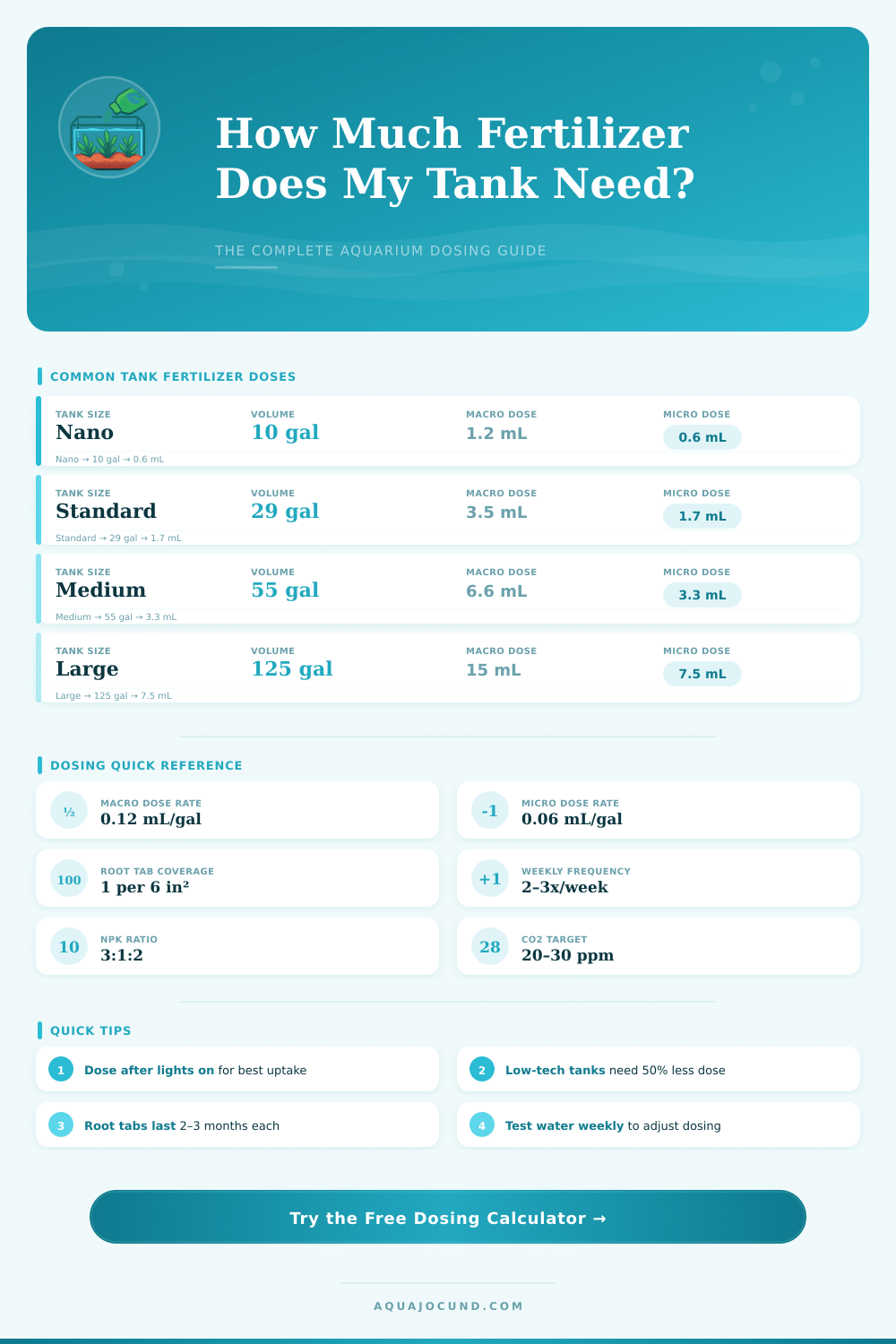
| Tank Volume | Macro 3x/wk (mL) | Micro 3x/wk (mL) | All-in-One 3x/wk (mL) | Root Tabs (every 8 wks) |
|---|---|---|---|---|
| 5 gal / 19 L | 1.8 | 0.9 | 1.5 | 1–2 tabs |
| 10 gal / 38 L | 3.6 | 1.8 | 3.0 | 2–3 tabs |
| 20 gal / 76 L | 7.2 | 3.6 | 6.0 | 4–5 tabs |
| 29 gal / 110 L | 10.4 | 5.2 | 8.7 | 6–7 tabs |
| 40 gal / 151 L | 14.4 | 7.2 | 12.0 | 8–10 tabs |
| 55 gal / 208 L | 19.8 | 9.9 | 16.5 | 10–12 tabs |
| 75 gal / 284 L | 27.0 | 13.5 | 22.5 | 14–16 tabs |
| 125 gal / 473 L | 45.0 | 22.5 | 37.5 | 22–26 tabs |
Always begin at 50% of the calculated dose for the first two weeks, especially in new tanks. Monitor for algae blooms — a sign of excess nutrients — and yellowing leaves, which indicate a deficiency. Increase in 25% increments weekly until plants thrive.
Add liquid fertilizers 30–60 minutes after the light period begins when plant metabolism is highest. For root tabs, push them 1–2 inches into the substrate near heavy root feeders like Amazon swords and cryptocorynes. Replace every 8–12 weeks.
Live plants in an Aquarium need good food to grow and here come the Fertilizer Dosing products. Only the waste of fish usually does not suffice, it usually does not give the right amounts of nitrates, potassium, phosphorus and those trace minerals, that plant species truly want to absorb. Almost all setups with many plants in the end need some kind of Fertilizer Dosing so that the green stay thick and healthy.
Plants need big nutrients like nitrogen, phosphorus and potassium (N, P and K for short). Also, they want small nutrients and minerals… Especially magnesium and iron.
Fertilizer Tips for Aquarium Plants
Nitrogen works as the main workhorse for pushing the growth of leaves. Plants like high levels of nitrates, because they easily absorb and quickly are useful. Over time, aquariums naturally gather trace elements like calcium, magnesium, iron and potassium from the food for fish and the tap water that you add.
All-in-one liquid fertilizers became very popular, because they remove the need for experiments. Easy Green is one of the most favourite products, and for good reason, it stores everything that water plants need, in one bottle. It also is safe for fish, shrimp and snails, what matters when you have a mixed Aquarium.
Flourish is another reliable option, that won loyal fans. They offer even Flourish Comprehensive for planted aquariums and Flourish If for setups with many shrimp.
Seachem Flourish often comes up, but here is the problem. It can become hard soon. You often will have to buy several bottles, and the instructions for dosing are not really easy.
So the all-in-one method most often wins. Tropica offers two liquid fertilizers that deserve attention: Specialised Nutrition (their micro) and Specialised Nutrition (their macro). Note: some brands, like Tropica, prefer to keep the NPK-levels low and trust more in nutrients that already exist in the Aquarium.
One important notice, do not use fertilizers for land plants in your Aquarium. They have levels way too high, and can carry chemicals that do not work for aquatic life. This is especially dangerous in aquariums with shrimp or other invertebrates, because such products often store loosely bound copper-levels.
Dry fertilizers, made specially for aquatic plants, are however cheap and much more safe.
An Aquarium with low light, only some plants and fish, really does not knead Fertilizer Dosing, especially without adding CO2. High-tech setups with strong lighting and CO2? They almost always need regular Fertilizer Dosing. It is better to share the dose in small everyday portions than to dump the whole weekly amountat once…
Like this nutrients get used slowly, not all at once. Some labels of fertilizers promise that they will not cause algae bumps, but that is silly talk at best. The best Fertilizer Dosing depends on the style of your Aquarium, your experience and what plant species you grow.