🌱 CO2 Aquarium Calculator
Calculate the ideal CO2 dosing rate, bubble count, and daily CO2 needs for your planted tank
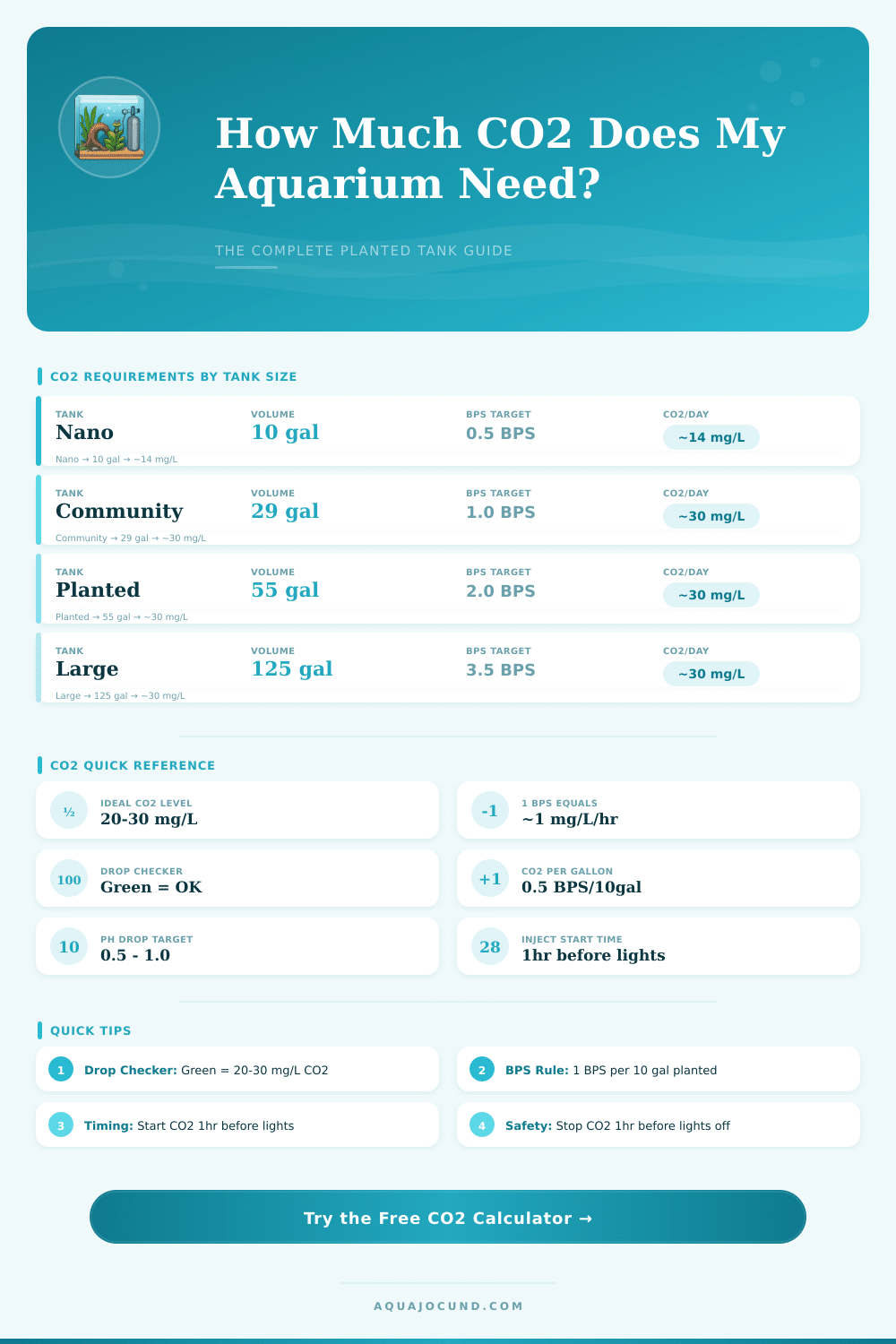
| Tank Size | BPS (Low Plant) | BPS (Medium Plant) | BPS (High Plant) | Target CO2 mg/L |
|---|---|---|---|---|
| 5 gal (19 L) | 0.25 BPS | 0.5 BPS | 0.75 BPS | 20–30 |
| 10 gal (38 L) | 0.5 BPS | 1.0 BPS | 1.5 BPS | 20–30 |
| 20 gal (76 L) | 0.75 BPS | 1.5 BPS | 2.5 BPS | 20–30 |
| 29 gal (110 L) | 1.0 BPS | 2.0 BPS | 3.0 BPS | 20–30 |
| 40 gal (151 L) | 1.5 BPS | 2.5 BPS | 3.5 BPS | 20–30 |
| 55 gal (208 L) | 2.0 BPS | 3.0 BPS | 4.5 BPS | 20–30 |
| 75 gal (284 L) | 2.5 BPS | 4.0 BPS | 6.0 BPS | 20–30 |
| 125 gal (473 L) | 3.5 BPS | 6.0 BPS | 9.0 BPS | 20–30 |
| Tank Name | Dimensions (L x W x H in) | Volume (gal) | Volume (L) |
|---|---|---|---|
| Nano Cube 5 gal | 16 x 8 x 10 | 5 gal | 19 L |
| 10 Gallon Standard | 20 x 10 x 12 | 10 gal | 38 L |
| 20 Gallon Long | 30 x 12 x 12 | 20 gal | 76 L |
| 29 Gallon Standard | 30 x 12 x 18 | 29 gal | 110 L |
| 40 Gallon Breeder | 36 x 18 x 16 | 40 gal | 151 L |
| 55 Gallon Standard | 48 x 13 x 21 | 55 gal | 208 L |
| 75 Gallon Standard | 48 x 18 x 21 | 75 gal | 284 L |
| 90 Gallon Standard | 48 x 18 x 24 | 90 gal | 341 L |
| 125 Gallon Standard | 72 x 18 x 22 | 125 gal | 473 L |
| 180 Gallon Standard | 72 x 24 x 25 | 180 gal | 681 L |
| Cylinder Size | CO2 Capacity | Approx. Duration (20 gal) | Approx. Duration (55 gal) |
|---|---|---|---|
| 20oz (0.57 kg) | 20 oz CO2 | 1–2 months | 2–3 weeks |
| 2.5 lb (1.1 kg) | 2.5 lb CO2 | 3–5 months | 1–2 months |
| 5 lb (2.3 kg) | 5 lb CO2 | 6–9 months | 2–3 months |
| 10 lb (4.5 kg) | 10 lb CO2 | 12–18 months | 4–6 months |
| 20 lb (9.1 kg) | 20 lb CO2 | 2+ years | 8–12 months |
Add CO2 to a planted Aquarium helps the plants grow better and well. Three main things matter for the best growth of water plants, and if some of them work badly bad algae can take over the whole Aquarium. Adding CO2 gives the plants the needed push for them to grow well.
Pressurized CO2 is the most common way to add CO2 to the Aquarium. Such systems are long lasting and can be fairly simple to install. A basic pressurized system needs a tank for CO2, a controller with a solenoid valve to time everything, a check valve, a bubble counter and a diffuser.
How to Use CO2 in a Planted Aquarium
Some devices also include a pH meter or a professional dosing system. There are especially small systems, designed for tabletop and dwarf Aquariums of one to ten gallons, that come with a disposable CO2 cartridge, controller, solenoid vlave and bubble counter.
CO2 diffusers work by pushing CO2 through a porous ceramic disc, that breaks the gas into small bubbles. That helps the plants absorb CO2 better and reduce gaseous waste. Another method is to force CO2 into a long tube, where it mixes with water before entering the Aquarium.
Tubes made for CO2 can stop loss of gas, but regular Aquarium tubes work well too. The whole setup maybe will be a bit less efficient, but the difference probably does knot matter a lot. Normal tubes are flexible and easier to use.
Most Aquariums use lights and CO2 for around eight hours a day. Newcomers, that worry about algae, could prefer shorter light periods, for example six hours. CO2 should stay running until the final hour of the light period, because then the water already is fully packed.
Aeration causes gas exchange with the surrounding air, what can remove CO2 from the water. Even so, every case is different.
In the natural world, plants receive CO2 naturally from the soil and decaying plant materials. In a closed Aquarium on the other hand, CO2 lacks a lot. Fresh water absorbs CO2 quickly, and decay of plants in the water is minimal.
If one uses natural decay to provide CO2, then it matters to limit the mixing of air and water by avoiding things like foam filters, air stones and wet filters.
Too much CO2 however can create real trouble. High amounts cause fishes to breathe at the surface or even suffocate, if the situation does not get better soon. Fishes do not need CO2…
They breathe oxygen and release CO2 through their gills, just like people do. Plants use that CO2 for photosynthesis and produce oxygen as a side effect. So called “liquid CO2” products really are only algae killers and donot truly work as a carbon supply for plants in any important way.