❄️ Aquarium Chiller Size Calculator
Find the exact chiller capacity needed for your fish tank — supports all shapes, reef & freshwater, metric & imperial
| Tank Type | Target Temp (°F) | Target Temp (°C) | Typical ΔT Needed | Load Factor |
|---|---|---|---|---|
| Freshwater Community | 72–78°F | 22–26°C | 4–10°F | 1.0x |
| Planted / CO2 Injected | 70–76°F | 21–24°C | 6–12°F | 1.1x |
| Saltwater FOWLR | 75–80°F | 24–27°C | 2–7°F | 1.1x |
| Reef / Coral | 75–78°F | 24–26°C | 4–9°F | 1.25x |
| Jellyfish | 65–72°F | 18–22°C | 10–20°F | 1.2x |
| Coldwater (Trout/Salmon) | 55–65°F | 13–18°C | 15–30°F | 1.3x |
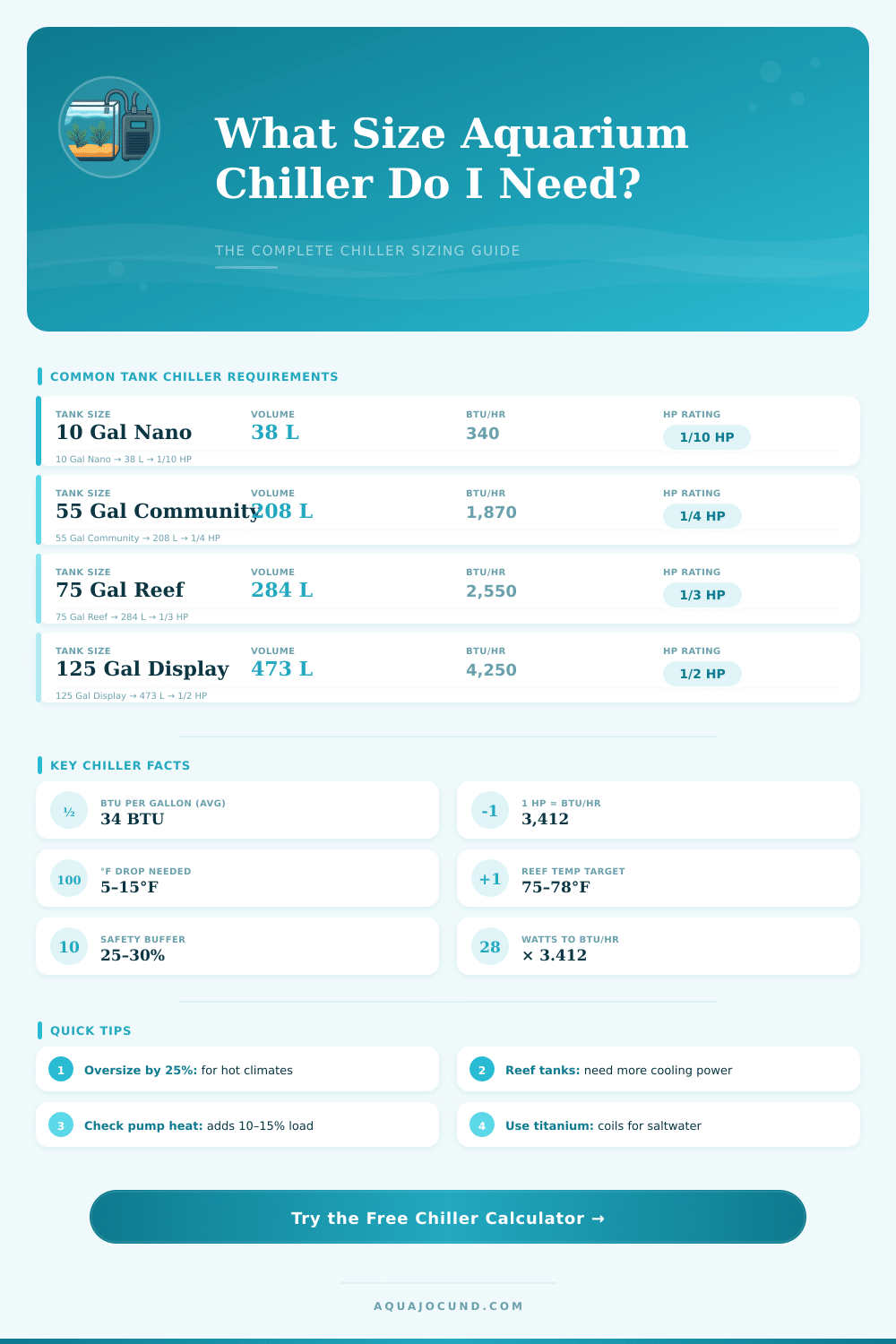
| Tank Name | Dimensions (L x W x H in) | Volume (Gal) | Volume (L) | Approx BTU/hr | Min HP Rating |
|---|---|---|---|---|---|
| 5 Gal Nano | 16 x 8 x 10 | 5.5 | 20.8 | 187 | 1/15 HP |
| 10 Gallon | 20 x 10 x 12 | 10.4 | 39.3 | 354 | 1/10 HP |
| 20 Gal Long | 30 x 12 x 12 | 17.9 | 67.8 | 609 | 1/10 HP |
| 29 Gallon | 30 x 12 x 18 | 26.8 | 101.5 | 912 | 1/8 HP |
| 40 Gal Breeder | 36 x 18 x 17 | 38.5 | 145.7 | 1,310 | 1/5 HP |
| 55 Gallon | 48 x 13 x 21 | 55.0 | 208.2 | 1,870 | 1/4 HP |
| 75 Gallon | 48 x 18 x 21 | 74.0 | 280.2 | 2,516 | 1/3 HP |
| 100 Gallon | 60 x 18 x 20 | 93.0 | 352.0 | 3,162 | 1/3 HP |
| 125 Gallon | 72 x 18 x 22 | 125.0 | 473.2 | 4,250 | 1/2 HP |
| 180 Gallon | 72 x 24 x 25 | 185.0 | 700.2 | 6,290 | 3/4 HP |
| HP Rating | BTU/hr | Watts (cooling) | Typical Tank Range (Gal) | Typical Tank Range (L) |
|---|---|---|---|---|
| 1/15 HP | 227 | 67 | Up to 10 gal | Up to 38 L |
| 1/10 HP | 341 | 100 | 10–25 gal | 38–95 L |
| 1/8 HP | 427 | 125 | 20–35 gal | 76–132 L |
| 1/5 HP | 682 | 200 | 35–55 gal | 132–208 L |
| 1/4 HP | 853 | 250 | 50–80 gal | 189–303 L |
| 1/3 HP | 1,137 | 333 | 70–120 gal | 265–454 L |
| 1/2 HP | 1,706 | 500 | 100–180 gal | 379–681 L |
| 3/4 HP | 2,559 | 750 | 160–260 gal | 606–984 L |
| 1 HP | 3,412 | 1,000 | 250–350 gal | 946–1,325 L |
Aquarium Chiller is a device that helps to lower the temperature of the water in aquariums. It goes by various names, for instance aquarium cooler, chiller for aquarium water, saltwater chiller, fish tank chiller or simply tank chiller. Imagine it as a little machine that works similarly to a refrigerator to cool the aquarium.
One can call it also a cooling unit for aquarium or device to cool aquarium.
How an Aquarium Chiller Works
Those chillers served to cool the water in an aquarium until the right temperature for the inhabitants of the tank, especially fishes and corals in saltwater setups. They are useful also in hydroponic systems. People that live in warm areas like Singapore, California or Texas commonly struggle with high temperatures year-round or during the summer.
Without cooling, the temperature in the tank can rise until the middle of the 80th degrees, what risks the aquatic life. Species that love freshwater, like axolotls and river trout, really require chillers to survive.
So, how does an Aquarium Chiller really work? The heat moves from the water of the aquarium into cooling liquid. The cold liquid compresses and changes from liquid to gas by means of the compressor.
The pressure that the compressor creates, drives the whole process. The heat that builds up hear, throws itself into the surrounding space. Some models have titanium coil structure for best contact, where cold air enters from the front and warm air exits from the back.
Most chillers work as inline coolers. A pump pushes the water through the device and then back into the aquarium. Some types connect to the tubes of the aquarium filter, while others have an internal probe to directly control and change the temperature.
There are also coil tank chillers that simply put a cold coil in the water, without need of a probe, but they still require circulation of the water. Inline chillers come in two types: air cooled and water cooled.
Choosing the right Size is very important. If you use a chiller that does not match the load and runs at lower flow than planned, it will cause problems. An Aquarium Chiller designed for a small tank hardly will cope with a big water volume.
A cheaper option is a fan that blows above the water surface, because it helps evaporate the water and cool it a bit. Even so, a fan will force you to often change the water, although it can save money. Suspended lamps, kept higher above the surface, also can lower thetemperature a bit.
Chillers can cost a lot, and they do release heat into the room. The fan of the unit sometimes sounds loud and causes vibrations. Asking well before you buy is worth the effort, because staying with a too weak or bad quality device is not fun.