🧪 Aquarium Alkalinity Calculator
Calculate exactly how much buffer to add to raise KH in your fish tank — for any tank size or shape
| Buffer Type | Raise 1 dKH per 10 gal | Raise 1 dKH per 38L | Effect on pH | Best For |
|---|---|---|---|---|
| Baking Soda (NaHCO₃) | 0.84 g | 0.84 g | Mild raise | Freshwater general |
| Pure Sodium Bicarbonate | 0.84 g | 0.84 g | Mild raise | Freshwater precision |
| Seachem Alkalinity Buffer | ~0.60 g | ~0.60 g | Stabilizes 7.0–7.8 | Community, planted |
| Reef / Marine Buffer | ~0.50 g | ~0.50 g | Raises to 8.3 | Reef / saltwater |
| Soda Ash (Na₂CO₃) | 0.53 g | 0.53 g | Significant raise | Rift lake, hard water |
| Potassium Bicarbonate | 1.0 g | 1.0 g | Minimal | Planted CO₂ tanks |
| Kalkwasser Ca(OH)₂ | ~0.74 g | ~0.74 g | Strong raise | Reef calcium/alk combo |
| Crushed Coral (passive) | Varies | Varies | Gradual raise | Long-term buffer |
| Tank Name | Dimensions (in) | Volume (gal) | Volume (L) | Typical KH Target |
|---|---|---|---|---|
| 5 Gal Nano | 16 × 8 × 10 | 5.5 | 20.8 | 3–5 dKH |
| 10 Gal Betta | 20 × 10 × 12 | 10.4 | 39.3 | 3–5 dKH |
| 20 Gal Long | 30 × 12 × 12 | 17.9 | 67.7 | 4–7 dKH |
| 29 Gal Community | 30 × 12 × 18 | 26.8 | 101.5 | 4–8 dKH |
| 40 Gal Breeder | 36 × 18 × 16 | 34.7 | 131.2 | 4–8 dKH |
| 55 Gal Planted | 48 × 13 × 21 | 56.7 | 214.5 | 3–6 dKH |
| 75 Gal Cichlid | 48 × 18 × 21 | 78.5 | 297.1 | 6–12 dKH |
| 125 Gal Reef | 72 × 18 × 22 | 130.0 | 492.1 | 8–12 dKH |
| dKH (degrees) | ppm (mg/L as CaCO₃) | mEq/L | mmol/L |
|---|---|---|---|
| 1 dKH | 17.9 ppm | 0.357 mEq/L | 0.179 mmol/L |
| 2 dKH | 35.8 ppm | 0.714 mEq/L | 0.357 mmol/L |
| 4 dKH | 71.6 ppm | 1.428 mEq/L | 0.714 mmol/L |
| 6 dKH | 107.4 ppm | 2.142 mEq/L | 1.071 mmol/L |
| 8 dKH | 143.2 ppm | 2.856 mEq/L | 1.428 mmol/L |
| 10 dKH | 179.0 ppm | 3.570 mEq/L | 1.785 mmol/L |
| 12 dKH | 214.8 ppm | 4.284 mEq/L | 2.142 mmol/L |
| 15 dKH | 268.5 ppm | 5.355 mEq/L | 2.678 mmol/L |
alkalinity is a rating of the skill of water to preserve its pH level stable. It stops fast changes in pH, that could injure the fishes and other creatures in the aquarium. Without enough alkalinity lacks something to cancel the acids, that naturally build up in the tank.
Like this the pH can slowly sink during the time. Regular change of water can help keep everything in order even so add a bit of buffer in the water ensure bigger calm.
Why alkalinity is important in aquariums
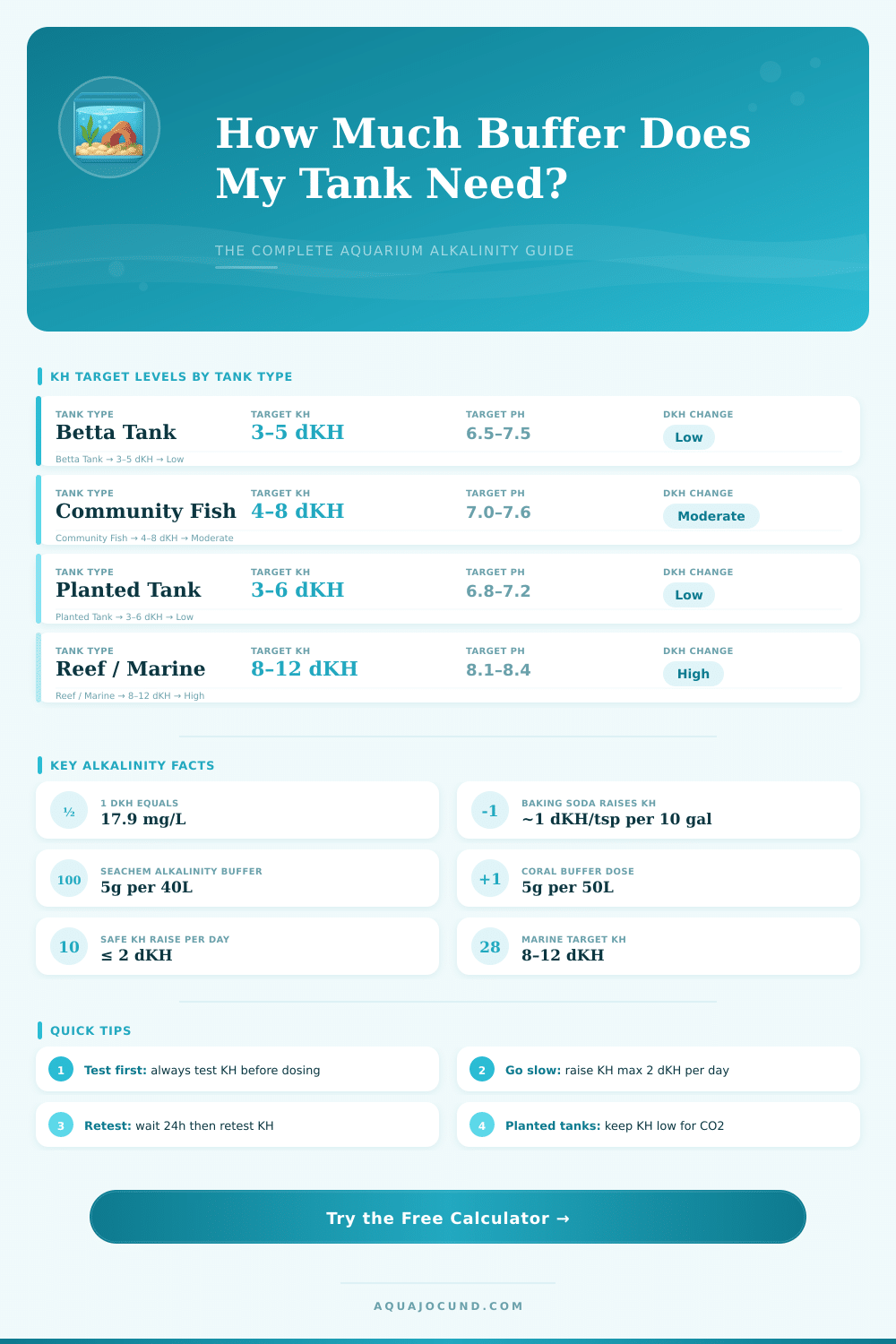
Consider the buffer skill as the amount of acid, needed to lower the pH of salt water until the moment, when bicarbonate turns in carbonic acid. Simply said, higher alkalinity ensure stronger chemical balance in reef aquarium. Specially for reef setups, the ideal range of alkalinity are about 8 until 12 dKH.
That range are needed for the growth of corals and the formation of their skeletons, and it also prevents accidents as swings of pH, burns because of alkalinity, bleaching of corals and loss of tussie.
pH and alkalinity are bound, but they no match. Water hardness are also relevant, but entirely different. Hardness relate to the amount of settled minerals in the water.
Trace minerals can push the water more basic, during substances as tannins from driftwood act as acids and lower the pH. Sheets of almonds work well for softening too hard water also.
Some species of fishes genuinely like higher level of alkalinity. Snails, guppies, platies and swordfish all benefit in relatively basic water, during the aquarium are quite a lot spatial and own good biological filter. Alive floating plants or mock floating plants provide to the fishes places for hiding.
Tap water commonly is very hard and basic. Some sources of tap water can raise the pH above 10, what answers only for the most tough fishes. RO-filter is one way to settle that.
Buy water from aquarium shops or use products for softening of water in the tank are other options. If RO-water works correctly, it should exit with zero or almost no alkalinity, what could hurt the nitrogen cycle, because the tiny organisms, that cycle the tank, indeed consume alkalinity.
Level of alkalinity almost at zero is actually a problem. At least 80 ppm should be the goal for stable pH. On the other hand, very high alkalinity also can create trouble.
In reef aquariums, it can stop the absorbing of calcium of corals and worsen the amount of calcium. Some salt mixes come with genuinely high levels of alkalinity, that can cause problems during changes of water. Experienced fishkeepers stripped, that cheap test kits give wrong results, so use reliable test kits are very important.
During changes, go slowly are more smart than tooverdo.
Common advice is do not touch the alkalinity alone, if the aquarium seems in good state. Bother to alter settings of water can lead to mistakes and hamper the settling of the tank than needed. Used coral is one way to raise alkalinity in soft water.