
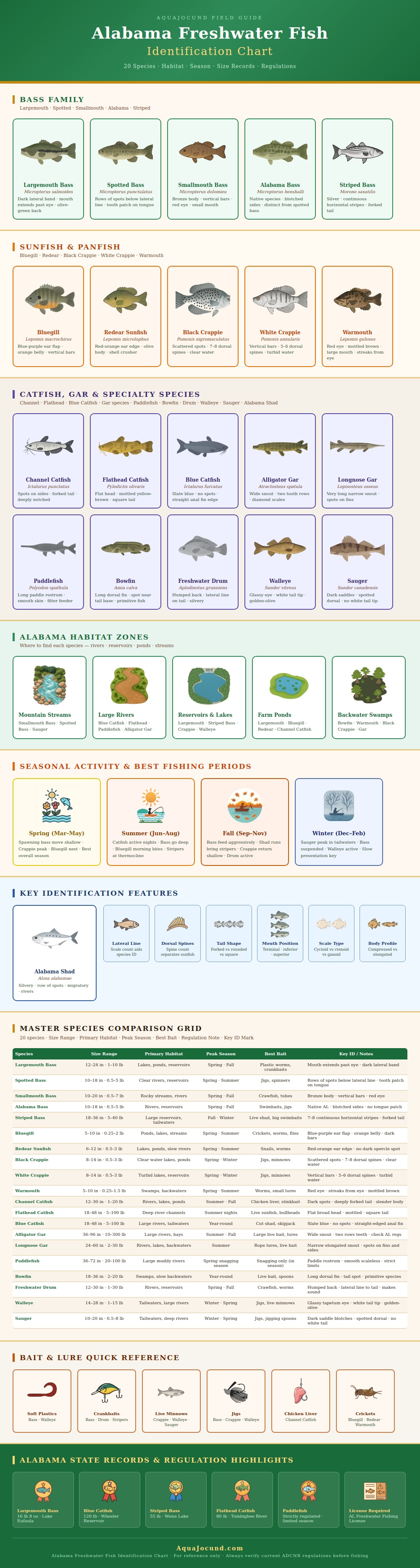
Alabama contains many differents types of freshwater fish that live in the state. To determine which type of fish is being observed, there are different characteristics of the fish that need to be evaluated because different types of fish lives in different habitats and have different regulations regarding there catch. By identifying the physical characteristic of the fish, such as the shape of its mouth, the pattern of its scales, and the shape of its fins, you can determine the type of fish that is being observed.
If you dont correctly identify the fish, it is possible to violate fishing regulations. There are several different species within the bass family that live in the rivers, lakes, and reservoirs of Alabama. For example, largemouth bass has a large jaw that extends past the eye of the fish, and have a dark horizontal band on its side.
How to Identify Freshwater Fish in Alabama
Spotted bass are a different species because they have dark spots located below the lateral line of they body, as well as a specific patch of teeth located on its tongue. Smallmouth bass have bronze-colored bodies with vertical bar along their sides, as well as red eyes. The Alabama bass is a native species of the state and has blotched patterns along its side.
Striped bass have seven or eight stripes along their silver body. You can distinguish each of these species based off the size of their mouth, the patterns of the spots on their bodies, and the shape of their tail forks. Panfish are another group of fish that live in Alabama, and tend to live in large groups.
Bluegill panfish have blue ear flaps and orange bellies. Redear sunfish have a red-orange edge along one of the ear flaps of its head. Crappie panfish can either be black crappie or white crappie fish.
Black crappie have black spots on their silvery sides, while white crappie have faint vertical bars along their sides. Warmouth panfish have a mottled brown body with red eyes. Each of these species live in different habitats within the state, so a bluegill fish that lives in a pond experiences a different environment than a bluegill fish that live in a stream.
Catfish and several other large species of fish are also found in Alabama’s waters. These fish live in the deeper and darker areas of the water. Channel catfish has small spots on their tail fin.
Flathead catfish have a mottled yellow-brown body and a flat head. The blue catfish is a different species from the catfish that lives in Alabama because its body is slate-colored and it have no spots on its body. Additionally, the anal fin of the blue catfish is straight-edged.
The alligator gar has a wide snout with diamond-shaped scales. The longnose gar is a different species because it has a thin, needle-like snout. The paddlefish has a large body without scale and a paddle-shaped snout.
The bowfin has a long dorsal fin and one spot on its tail. Additionally, you can find other types of fish in Alabama including drum, walleye, sauger, and shad. The location of the water will determine the type of fish that are found in the water.
For instance, mountain streams contains smallmouth bass and sauger because of the rocky bottoms of these streams. Large rivers contains species like catfish and gars. Reservoirs contain largemouth bass, striped bass, and crappie.
Farm ponds contains bluegill and channel catfish. Lastly, swamps contains bowfin and warmouth. The different seasons will affect the activity of the fish and the type of bait that you should use when fishing for these fish species.
For instance, spring is the season when you can find bass and crappie in the shallow waters of lakes to spawn. Catfish are most active at night in the summer, as well as striped bass moving to different water temperature. Most fish will eat more frequently during the fall seasons.
Lastly, sauger become active in certain areas of the water during the winter seasons. Depending on the type of fish that you are pursuing, you can use different types of bait. For instance, plastic lure work well when you are fishing for bass.
You use jigs when fishing for crappie and walleye species. Additionally, you can use live minnows when fishing for many of the fish species. To correctly identify the type of fish in the water, there are several feature of the fish that you should examine.
For instance, the body shape, the tail fin of the fish, the spots on the fishs lateral line, and the dorsal spines are features that can help to identify the type of fish. Additionally, the position of the mouth on the head can help to determine the type of diet of the fish species. For instance, fish species with terminal mouths will eat at the surface of the water while those with inferior mouths will eat from the bottom of the lake or river.
Additionally, examining the jaw and the patterns on the body can help you to determine the regulations of the fish species that you are identifying. You should of checked the local laws too. Its important to follow them.
One of the most moddern ways to learn is to observe the fishs habitat. The fishs size and color can also provide clues. Youll find that many fish is hard to identify at first.
