💨 Aquarium Air Pump Size Calculator
Find the correct GPH, pressure, and wattage for your tank setup
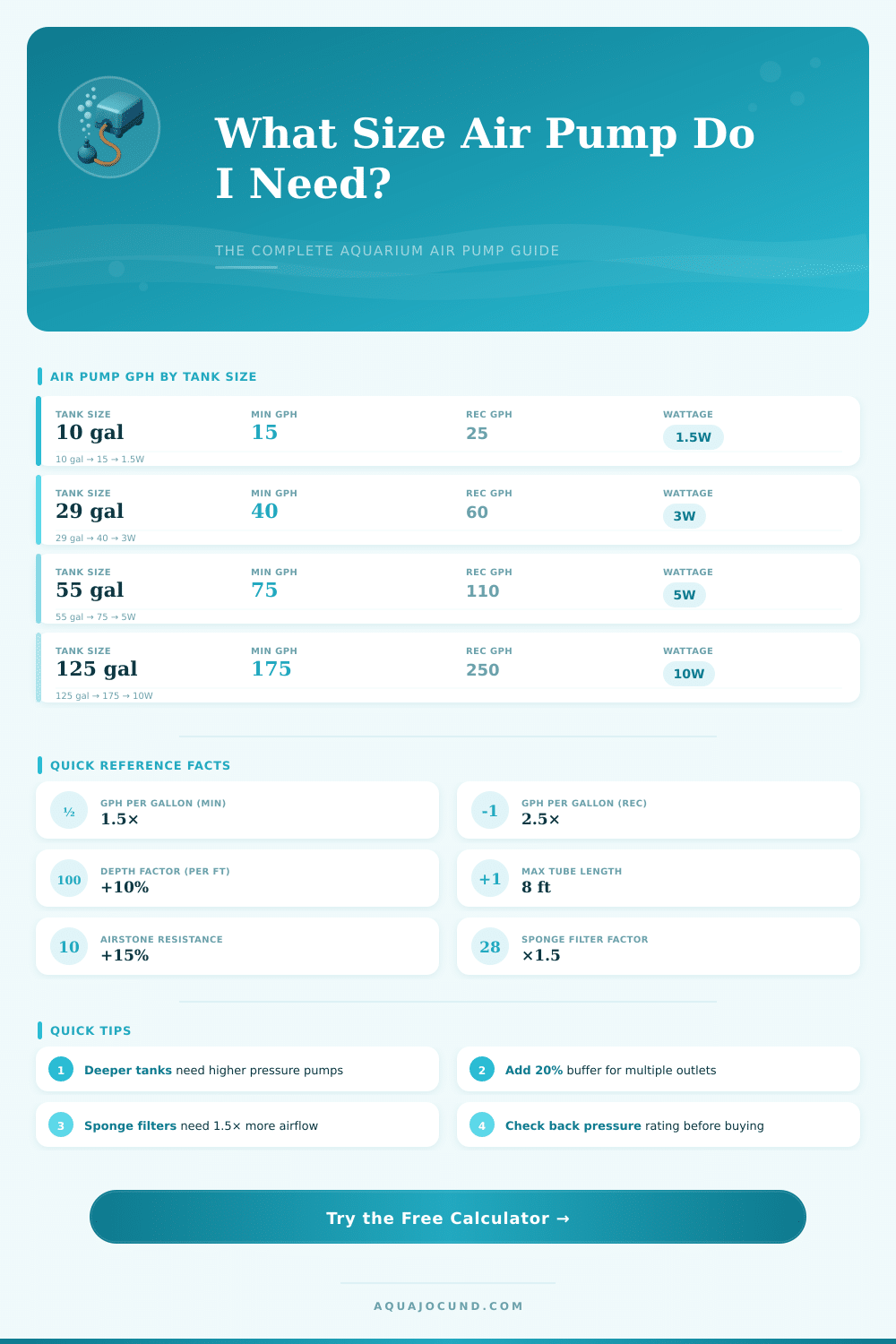
| Tank Name | Dimensions (in) | Volume (gal) | Volume (L) | Min GPH | Rec GPH | Est. Wattage | Outlets Needed |
|---|---|---|---|---|---|---|---|
| Nano Cube 5 Gal | 12×8×8 | 5 | 18.9 | 8 | 13 | 1.0W | 1 |
| 10 Gal Betta | 20×10×12 | 10 | 37.9 | 15 | 25 | 1.5W | 1 |
| 20 Gal Long Shrimp | 30×12×12 | 20 | 75.7 | 30 | 50 | 2.5W | 1 |
| 29 Gal Community | 30×12×18 | 29 | 109.8 | 44 | 73 | 3.0W | 2 |
| 40 Gal Breeder | 36×18×16 | 40 | 151.4 | 60 | 100 | 4.5W | 2 |
| 55 Gal Planted | 48×13×21 | 55 | 208.2 | 83 | 138 | 5.0W | 2 |
| 75 Gal Cichlid | 48×18×21 | 75 | 283.9 | 113 | 188 | 7.0W | 3 |
| 125 Gal Reef | 72×18×22 | 125 | 473.2 | 188 | 313 | 10.0W | 4 |
| Water Depth (ft) | Water Depth (cm) | Pressure Added (psi) | GPH Correction Factor | Effect on Pump |
|---|---|---|---|---|
| 0.5 ft | 15.2 cm | +0.22 psi | +5% | Negligible |
| 1.0 ft | 30.5 cm | +0.43 psi | +8% | Minor |
| 1.5 ft | 45.7 cm | +0.65 psi | +15% | Moderate |
| 2.0 ft | 61.0 cm | +0.87 psi | +22% | Significant |
| 2.5 ft | 76.2 cm | +1.08 psi | +30% | High — upgrade pump |
| 3.0 ft | 91.4 cm | +1.30 psi | +40% | Very High — use rated pump |
| GPH (Gallons/Hour) | LPH (Liters/Hour) | LPM (Liters/Min) | Suitable For |
|---|---|---|---|
| 10 GPH | 37.9 LPH | 0.63 LPM | Nano tanks up to 7 gal |
| 25 GPH | 94.6 LPH | 1.58 LPM | 10–15 gal tanks |
| 50 GPH | 189.3 LPH | 3.15 LPM | 20–29 gal tanks |
| 100 GPH | 378.5 LPH | 6.31 LPM | 40–55 gal tanks |
| 150 GPH | 567.8 LPH | 9.46 LPM | 55–75 gal tanks |
| 250 GPH | 946.4 LPH | 15.77 LPM | 100–125 gal tanks |
| 400 GPH | 1514.2 LPH | 25.24 LPM | 180–240 gal tanks |
Choosing the right Air Pump Size for your Aquarium is important. An air pump is a device that stands outside the fish tank. It uses electricity from a wall outlet or battery to push air in the Aquarium.
The air goes from the pump through a tube and then in the tank. The main task of an air pump is to blow air from the outside into the water. Every pump has a different output and the right model depends on the size of the tank.
How to Choose the Right Air Pump for Your Fish Tank
Air pumps are not designed to be placed underwater. If one places one in the Aquarium, it probably will cause a short circuit and it will stop working, because those pumps are not waterproof.
Those pumps help to ensure that fish have enough oxygen to breathe. That especially matters when causes like medicine in the water or other things lower the oxygen levels. When the pump blows air, it creates bubbles.
The bubbles rise to the surface and pop up, which moves the surface. Such surface motion helps to bring more oxygen into the water. Air pumps togather with air stones create a steady flow of tiny bubbles and water movement in both freshwater and saltwater tanks.
Filters usually move the water quite a lot by themselves. Even so, adding an air pump can strengthen surface movement and help to avoid low-oxygen “dead zones“, especially in bigger tanks. If the filter runs by means of an air pump, then the pump is needed so that the filter fully works.
Without it, the filter simply stays there and does nothing. Some air pumps also have an energy-saving mode that switches the heir on for fifteen seconds and then off for fifteen seconds, which helps to save battery life. Adjustable control of airflow makes some pumps useful for both tiny and big tanks.
One can use the pump also for decoration, for instance to create bubbles or a waterfall effect. At some models it is possible to change the air output and the bubble pattern. Air stones help to scatter the air in very tiny bubbles, which reduces noise and looks nice.
Noise is an important factor. Linear piston pumps have fewer parts to break and usually run more quietly. Membrane pumps can wear out over time, because the membranes harden or crack.
Having a backup pump is a wise idea, because any pump later will fail, and not noticing that could mean dead fish.
The placement matters also. It is strongly suggested to keep the air pump above the water level. If the pump sits under the tank and the electricity ends, water can siphon back through the tube.
That could cause flooding or even electrical shock when the electricity returns. A check valve between the pump and the Aquarium helps to stop that backflow problem. You also can use a T-connection in the tube to share theairflow between different devices without too much strain on the pump.