🐟 Fish Pond Pump Size Calculator
Calculate the correct pump flow rate (GPH/LPH) for your fish pond based on volume, pond type, and head height
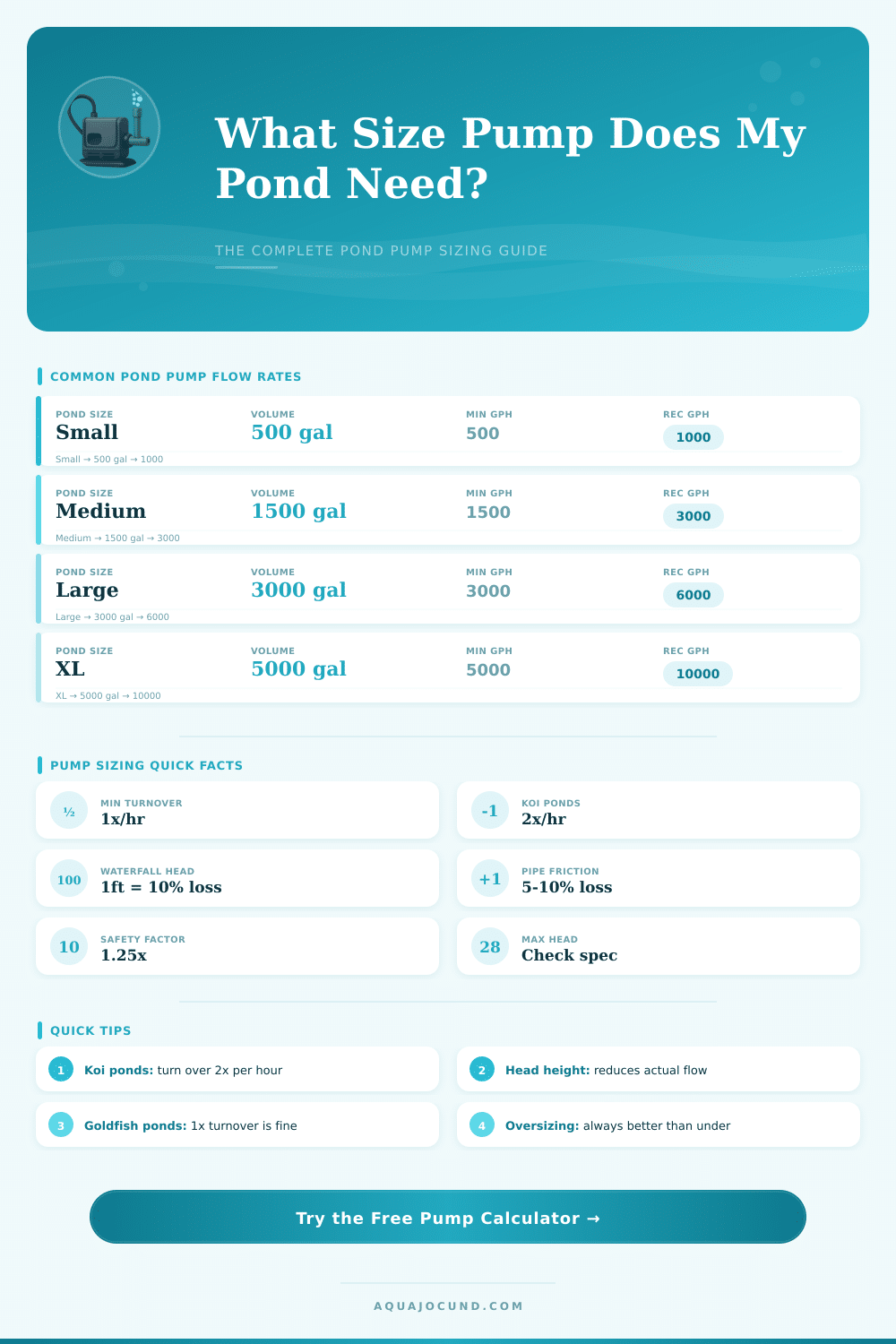
| Pond Type | Volume (gal) | Volume (L) | Min GPH (Goldfish) | Rec GPH (Koi) | Min Wattage |
|---|---|---|---|---|---|
| Patio Tub | 100 | 379 | 100 | 200 | 20W |
| Small Garden | 300 | 1,136 | 300 | 600 | 45W |
| Small Pond | 500 | 1,893 | 500 | 1,000 | 75W |
| Medium Pond | 1,000 | 3,785 | 1,000 | 2,000 | 120W |
| Standard Koi | 1,500 | 5,678 | 1,500 | 3,000 | 180W |
| Large Pond | 3,000 | 11,356 | 3,000 | 6,000 | 350W |
| XL Koi Pond | 5,000 | 18,927 | 5,000 | 10,000 | 600W |
| Competition Koi | 10,000 | 37,854 | 10,000 | 20,000 | 1200W |
| Head Height (ft) | Head Height (m) | Flow Loss % | 1000GPH Pump Actual | 2000GPH Pump Actual | Pipe Size Rec. |
|---|---|---|---|---|---|
| 0 ft (submersed) | 0 m | 0% | 1,000 GPH | 2,000 GPH | 1 inch |
| 1 ft | 0.3 m | 10% | 900 GPH | 1,800 GPH | 1 inch |
| 2 ft | 0.6 m | 20% | 800 GPH | 1,600 GPH | 1.5 inch |
| 3 ft | 0.9 m | 30% | 700 GPH | 1,400 GPH | 1.5 inch |
| 5 ft | 1.5 m | 50% | 500 GPH | 1,000 GPH | 2 inch |
| 8 ft | 2.4 m | 80% | 200 GPH | 400 GPH | 2 inch |
| 10 ft | 3.0 m | 100% | 0 GPH | 0 GPH | 3 inch |
| Pipe Diameter | Max Recommended GPH | Max Recommended LPH | Typical Pond Size | Friction Loss |
|---|---|---|---|---|
| 1 inch (25mm) | 600 GPH | 2,271 LPH | Up to 500 gal | High |
| 1.5 inch (38mm) | 1,500 GPH | 5,678 LPH | 500–2,000 gal | Medium |
| 2 inch (51mm) | 3,500 GPH | 13,249 LPH | 2,000–5,000 gal | Low |
| 3 inch (76mm) | 10,000 GPH | 37,854 LPH | 5,000+ gal | Very Low |
Fish Pond pump simply is a water pump, that is like the one used in aquarium, only bigger. They push water through filters what helps add oxygen to the pool and stop problems like seaweed and mosquitoes. Without motion of water, the pool becomes ideal place for farming of mosquitoes and turns into a low-oxygen mess, that only the plants can not fix.
Commonly bad smell and slime in water comes because of absence of airflow or circulation hence the pump is needed for everything to stay fresh.
How to Choose a Fish Pond Pump
Pumps for pools commonly are called the heart of the water garden. They do the lovely sound of flowing water, while circulating it through the screening for clean. For the most many water setups, one suggests a sunk pump.
Some of them go in the pool, while others sit outside. There are also solar pumps for pools, although those most commonly are small for fountains or similar.
Very important is to choose the right Pump Size. In a small pool of around 500 gallons without water features, a pump with 750 GPH easy speed will be enough for good circulation and screening. For big pools the math changes.
A pool of 5,000 gallons maybe rquires a 10,000 GPH pump, so that it push the water through filter materials at least twice in an hour. The deeper the pump is, the more pressure is lost during pumping upward. A pump for a fall must also raise water several feet high, what reduces the actual amount.
Some full kits for screening come with a sunk Fish Pond pump, built-in UV cleaner and various kinds of filter materials. They can run a fountain and fall together, what really eases the cause. Back-up bits, like separate filters and sponges, are easily found, because something can brake sharply.
One thing to control is, that fish do not get stuck in the pump. It should have protection at the entry, that allows only things more small than a certain size. A pre-filter at the entry helps to keep fishes, leaves and bigger bits away from getting stuck.
Some owners of pools found their fish sucked in the zone of the pump, so adding protection around the entry is wise advice.
Total Pond and Vivosun are good brands for top pumps. Pondmaster also has a good name with some options for budget. Running the pump all the time is usual, especially if fishes are there.
A small pump of 60 watts costs only around 54 dollars yearly for constant use, according to calculations. If fishes live in the pool, leave the pumpwork always, that is the best way.