🐠 Saltwater Fish Per Gallon Calculator
Calculate the ideal number of saltwater fish for your reef or FOWLR tank — fast and accurate.
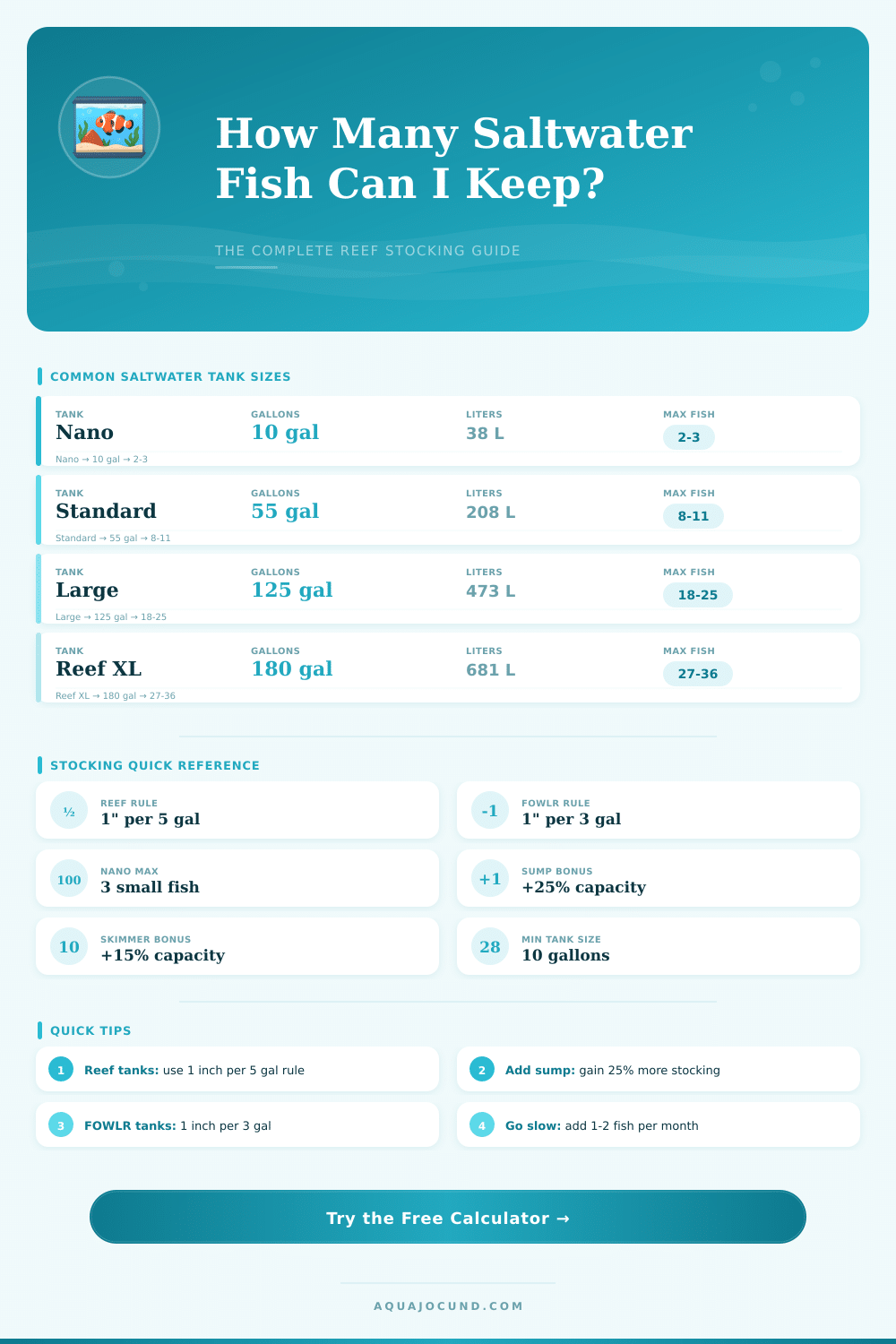
| Tank Name | Dimensions (L x W x H) | Volume (Gal) | Volume (Liters) | Reef Max (Fish) | FOWLR Max (Fish) |
|---|---|---|---|---|---|
| 5 Gal Nano Cube | 12" x 12" x 12" | 5.2 gal | 19.7 L | 1–2 | 2–3 |
| 10 Gal Standard | 20" x 10" x 12" | 10.4 gal | 39.4 L | 2–3 | 3–4 |
| 20 Gal Long | 30" x 12" x 12" | 18.7 gal | 70.8 L | 3–4 | 5–7 |
| 29 Gal Standard | 30" x 12" x 18" | 28.1 gal | 106.4 L | 5–7 | 8–11 |
| 40 Gal Breeder | 36" x 18" x 16" | 37.8 gal | 143.1 L | 6–9 | 10–14 |
| 55 Gal Standard | 48" x 13" x 21" | 55.4 gal | 209.6 L | 9–13 | 15–20 |
| 75 Gal Standard | 48" x 18" x 21" | 75.3 gal | 285.0 L | 12–18 | 20–28 |
| 90 Gal Standard | 48" x 18" x 25" | 89.7 gal | 339.5 L | 14–21 | 23–34 |
| 125 Gal Standard | 72" x 18" x 22" | 124.7 gal | 472.1 L | 19–28 | 32–46 |
| 180 Gal Show | 72" x 24" x 25" | 185.4 gal | 701.7 L | 29–43 | 48–68 |
| Fish Size Category | Avg Adult Length | Min Tank (Reef) | Min Tank (FOWLR) | Space Per Fish |
|---|---|---|---|---|
| Nano / Dwarf | under 2 in (5 cm) | 5 gal / 19 L | 5 gal / 19 L | 5–8 gal / fish |
| Small | 2–3 in (5–7.5 cm) | 10 gal / 38 L | 10 gal / 38 L | 8–15 gal / fish |
| Medium | 3–6 in (7.5–15 cm) | 30 gal / 114 L | 20 gal / 76 L | 15–30 gal / fish |
| Large | 6–10 in (15–25 cm) | 75 gal / 284 L | 55 gal / 208 L | 30–60 gal / fish |
| X-Large | over 10 in (25 cm) | 150 gal / 568 L | 100 gal / 379 L | 60+ gal / fish |
The choice of good Saltwater Fish for aquarium depends much on the capacity in gallons, that the tank has. In a 20-gallon aquarium one can only keep heavy mass of around 8 until 9 inches of fishes. That allows maybe four little fishes every long about 2 inches.
For a 20-gallon tank, the fishes should stay under 4 inches as adults. So one must avoid species like rabbitfish, triggerfish, eels, pufferfish and some bigger clownfish, for instance Maroon, Clarkii and Tomato.
Pick Saltwater Fish for Your Tank Size
In a 20-gallon Saltwater Fish setup, good picks are damsels, chromis, firefish and some blennies with gobies. Mandarinfish and Skunk Blennies fit by size, but they are really hard to take care of, so the most many owners of aquariums should skip them. A sample of good group for a 20-gallon reef tank is two misbar clownfish togehter with bumblebee shrimp goby, that works well.
Small aquariums usually are everything under 30 or 40 gallons, depending on who one asks. A 10-gallon Saltwater Fish aquarium is possible, but when one adds sand and rocks, the real water volume drops to around 5 or 6 gallons. That makes everything very tight.
Even so it is possible too arrange a 10-gallon mixed reef. For something like an 8-gallon tank, the best way is choose strong corals and limit yourself to one little fish. A pair of yellow guard goby with pistol shrimp can well work in such a little setup.
Keeping clownfish in a 3-gallon desk aquarium seems nice, but it is risky. Also a 5-gallon tank is too little for Saltwater Fish. Beginners should rather use an aquarium of at least 20 until 28 gallons as a starting point.
Any Saltwater Fish tank under 40 gallons can be hard for beginners.
Big aquariums give more options. A 30-gallon tank works for bicolor blenny, that reaches around 4 inches and needs at least 30 gallons. Starry Blenny and Lawnmower Blenny are good starter fishes, that need 30 gallons and eat a lot daily.
At 70 gallons or more, the coral beauty angelfish makes a strong and colorful option. Some folks dislike 55-gallon tanks because they are only long and not wide. A 60-gallon wide tank is quite a lot wide and long for a tang, what makes it more practical.
In Saltwater Fish setups, one must have fewer fishes per aquarium than in freshwater. Keeping the water in good quality is key. An old rough rule was one inch of fish for 5 gallons, but that never worked great, because it does not consider everything.
A 15-gallon tank can hold at most two clownfish, even then they maybe will need bigger space when they grow. A biggertank is almost always better for stability in a Saltwater Fish setup.