🐟 Gourami Fish Water Temperature Checker
Check if your tank temperature is safe for your gourami species and get heater sizing recommendations
| Species | Min °F (°C) | Ideal °F (°C) | Max °F (°C) | pH Range | Diff. Level |
|---|---|---|---|---|---|
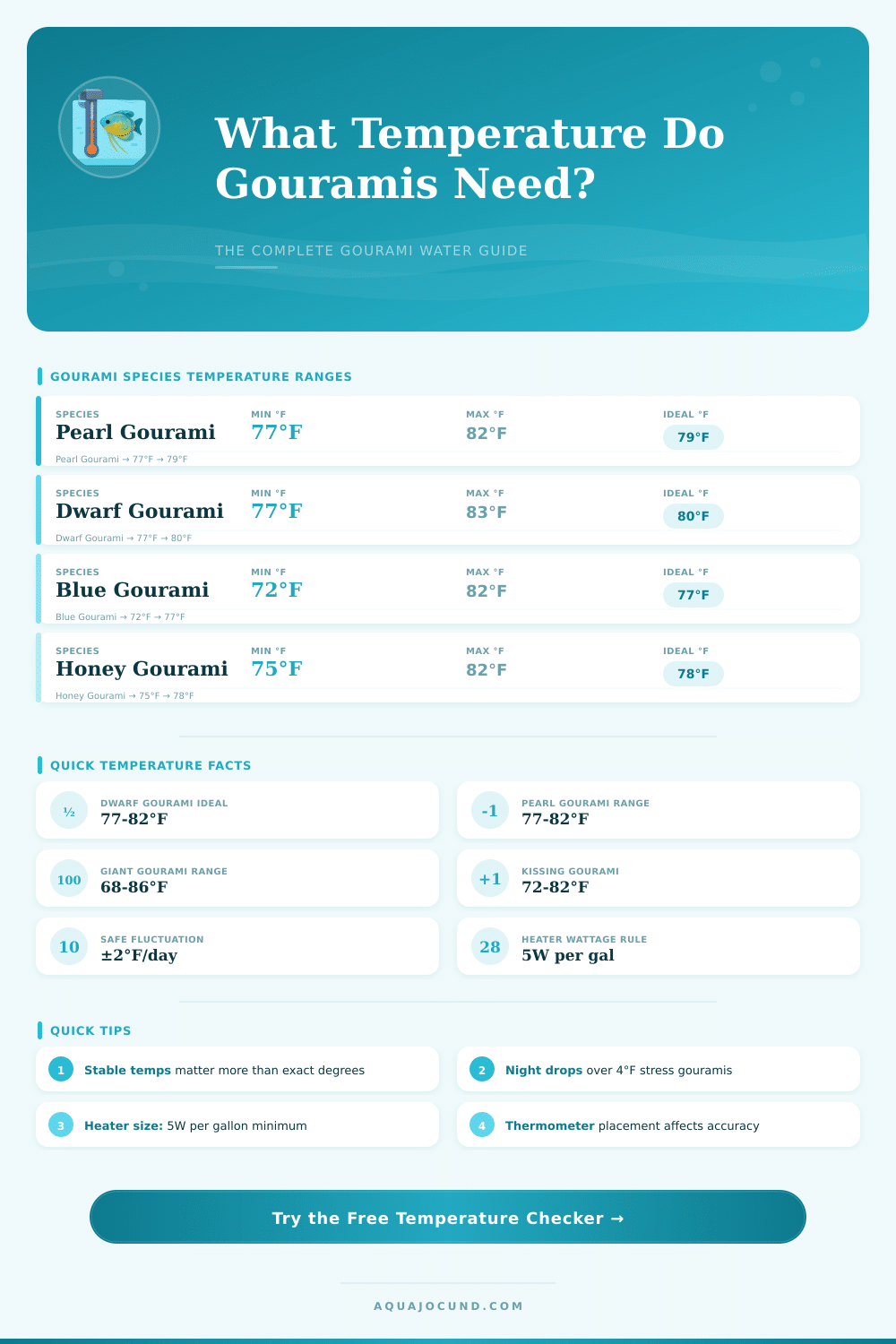
| Dwarf Gourami | 77°F (25°C) | 79–80°F (26–27°C) | 82°F (28°C) | 6.0–7.5 | Beginner |
| Pearl Gourami | 77°F (25°C) | 79–80°F (26–27°C) | 82°F (28°C) | 6.5–8.0 | Beginner |
| Blue (3-Spot) Gourami | 72°F (22°C) | 76–78°F (24–26°C) | 82°F (28°C) | 6.0–8.0 | Beginner |
| Honey Gourami | 75°F (24°C) | 77–79°F (25–26°C) | 82°F (28°C) | 6.0–7.5 | Beginner |
| Kissing Gourami | 72°F (22°C) | 76–78°F (24–26°C) | 82°F (28°C) | 6.8–8.5 | Beginner |
| Giant Gourami | 68°F (20°C) | 76–80°F (24–27°C) | 86°F (30°C) | 6.5–8.0 | Intermediate |
| Moonlight Gourami | 77°F (25°C) | 79–82°F (26–28°C) | 83°F (28°C) | 6.0–7.0 | Beginner |
| Sparkling Gourami | 76°F (24°C) | 78–80°F (26–27°C) | 82°F (28°C) | 6.0–7.5 | Intermediate |
| Chocolate Gourami | 77°F (25°C) | 80–82°F (27–28°C) | 86°F (30°C) | 4.0–6.0 | Expert |
| Snakeskin Gourami | 72°F (22°C) | 78–82°F (26–28°C) | 86°F (30°C) | 6.0–8.0 | Beginner |
| Tank Volume | ΔT = 5°F (2.8°C) | ΔT = 10°F (5.6°C) | ΔT = 20°F (11°C) | Recommended Wattage |
|---|---|---|---|---|
| 5 gal / 19 L | 25W | 50W | 75W | 25–50W |
| 10 gal / 38 L | 50W | 75W | 150W | 50–75W |
| 20 gal / 76 L | 75W | 150W | 200W | 100W |
| 29 gal / 110 L | 100W | 150W | 250W | 150W |
| 40 gal / 151 L | 150W | 200W | 300W | 200W |
| 55 gal / 208 L | 200W | 250W | 400W | 250W |
| 75 gal / 284 L | 250W | 300W | 500W | 300W |
| 125 gal / 473 L | 400W | 500W | 750W | 500W |
| Tank Name | Dimensions (L x W x H in) | Volume (gal) | Volume (L) |
|---|---|---|---|
| Nano Cube 5 Gal | 12 x 12 x 12 | 5.2 | 19.7 |
| 10 Gallon Standard | 20 x 10 x 12 | 10 | 37.9 |
| 20 Gallon Long | 30 x 12 x 12 | 20 | 75.7 |
| 20 Gallon High | 24 x 12 x 16 | 20 | 75.7 |
| 29 Gallon | 30 x 12 x 18 | 29 | 109.8 |
| 40 Gallon Breeder | 36 x 18 x 16 | 40 | 151.4 |
| 55 Gallon | 48 x 13 x 20 | 55 | 208.2 |
| 75 Gallon | 48 x 18 x 21 | 75 | 283.9 |
| 125 Gallon | 72 x 18 x 21 | 125 | 473.2 |
| Heater Type | Efficiency | Best For | Watt Adjustment |
|---|---|---|---|
| Submersible | 95% | All tank sizes | No adjustment |
| Inline | 98% | Canister filter setups | –5% (more efficient) |
| Sump/Hang-on | 85% | Large tanks, sumps | +15% (less efficient) |
| Substrate Cable | 90% | Planted tanks | +10% (supplemental only) |
| External Canister | 97% | Large display tanks | –3% (efficient) |
The water temperature in an aquarium matters much more than many folks think. Fish from tropical regions usually need their water between 75 and 80 degrees Fahrenheit, around 24 to 27 degrees Celsius for those that use the metric system. Even so fish for fresh water like it quite a lot colder, between 60 and 75 degrees Fahrenheit.
Every species has its own ideal range, so it is worth asking about the needs of your own fish before putting it in the aquarium.
Right Water Temperature for Aquarium Fish
Goldfish show well, as cold water fish work without a heater most commonly. They find themselves very well at the usual temperature of the room, around 60 to 75 degrees Fahrenheit. Many owners of goldfish successfully keep their aquariums at 68 to 72 degrees without any heating device.
Discus fish, on the other hand, love heat and want it quite a lot warmer. Mollies also enjoy warmer conditions, comfortably between 74 and 80 degrees. Betta fish are more demadning, they want exactly 78 to 80 degrees, and if the water cools a bit, they look weak, because they simply slow their metabolism.
Most tropical community aquariums benefit, when one aims for 76 to 80 degrees. I noticed, that a steady level at around 78 degrees works four some popular species. For any tropical setup you need a reliable heater.
Some aquariums skip the heater and simply follow the room temperature, which sometimes works for goldfish, but not for tropical fish. Here is a sample: I once measured an aquarium at 66 degrees, although the room itself moved between 69 and 70, in the end it almost killed the fish beside the stairs.
Here comes the trouble with too high temperatures. Cold water holds more oxygen than warm water. When your fish warms, its metabolism kicks in strongly, so it needs more oxygen to live; but the water delivers less.
Not a good mix. Also, heat leads to faster aging in fish and makes their hearts work harder. Plants in water suffer too.
Leaves turn yellow and collapse, when one goes past 84 degrees Fahrenheit.
Fish become truly stressed because of sudden changes in temperature. Small aquariums are the worst problem, because the water can change quickly in some hours. It matters more to keep things stable in the wanted limits of your fish than to insist on a perfect number.
When change is needed, move one degree per day is the clearest way. This works through slow and steady steps.
Fitting fish in the aquarium goes more smoothly, if all fish like the same water temperature. Problems come up, when the max for one species is the minimum for another, both end up a bit sad. Using a heater with a lower setting gives added safety.
If theheater stays stuck in the on position, the low level stops it from cooking your aquarium. Check your temperature log, if you can, heaters fail without prior warning.