🌡️ Saltwater Fish Water Temperature Checker
Check if your current tank temperature is safe, get heater & chiller sizing recommendations, and find ideal ranges for your specific tank type.
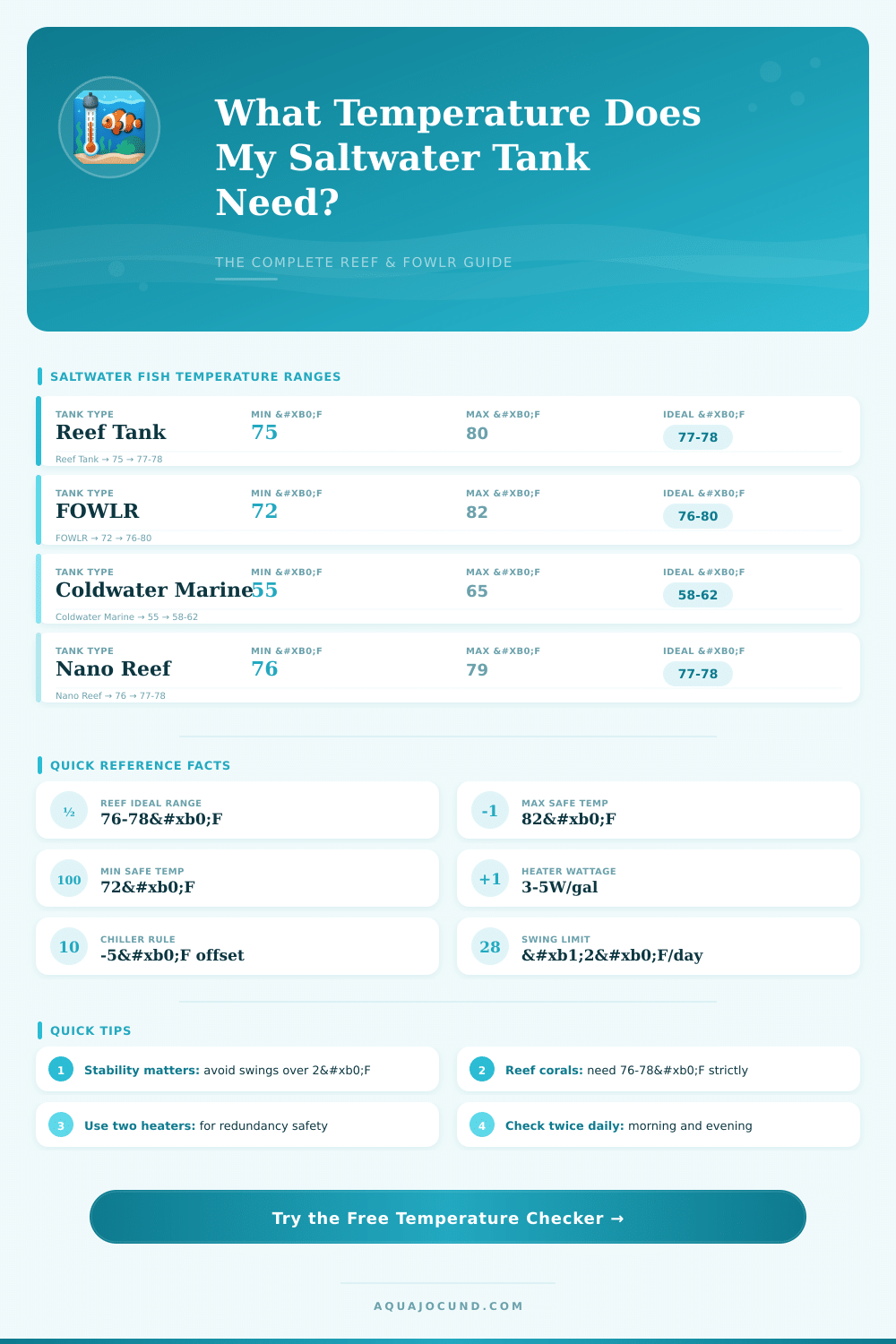
| Species / Tank Type | Min °F | Max °F | Ideal °F | Min °C | Ideal °C |
|---|---|---|---|---|---|
| Reef Tank (General) | 74 | 82 | 76–78 | 23.3 | 24.4–25.6 |
| SPS Dominant Reef | 75 | 79 | 76–77 | 23.9 | 24.4–25.0 |
| LPS / Soft Coral Reef | 74 | 82 | 77–79 | 23.3 | 25.0–26.1 |
| FOWLR (Fish Only w/ Rock) | 72 | 84 | 76–80 | 22.2 | 24.4–26.7 |
| Clownfish (Amphiprion spp.) | 74 | 82 | 76–80 | 23.3 | 24.4–26.7 |
| Tang / Surgeonfish | 75 | 82 | 77–80 | 23.9 | 25.0–26.7 |
| Lionfish (Pterois spp.) | 72 | 80 | 74–78 | 22.2 | 23.3–25.6 |
| Mandarin Dragonet | 75 | 80 | 76–79 | 23.9 | 24.4–26.1 |
| Seahorse (Hippocampus) | 68 | 74 | 70–72 | 20.0 | 21.1–22.2 |
| Coldwater Marine (Garibaldi) | 55 | 65 | 58–62 | 12.8 | 14.4–16.7 |
| Mangrove / Estuary Setup | 74 | 86 | 78–82 | 23.3 | 25.6–27.8 |
| Nano Reef (under 20 gal) | 76 | 80 | 77–78 | 24.4 | 25.0–25.6 |
| Tank Volume | Volume (L) | Min Watts | Recommended Watts | Two-Heater Setup | Notes |
|---|---|---|---|---|---|
| 5 gallons | 19 L | 25W | 50W | 2 x 25W | Nano — prone to spikes |
| 10 gallons | 38 L | 50W | 75W | 2 x 50W | Use controller |
| 20 gallons | 76 L | 75W | 100W | 2 x 75W | Standard nano reef |
| 29 gallons | 110 L | 100W | 150W | 2 x 100W | Common community size |
| 40 gallons | 151 L | 150W | 200W | 2 x 150W | Breeder / aggressive |
| 55 gallons | 208 L | 200W | 250W | 2 x 200W | Most popular size |
| 75 gallons | 284 L | 250W | 300W | 2 x 250W | Inline heater ideal |
| 90 gallons | 341 L | 300W | 400W | 2 x 300W | Sump-mount recommended |
| 125 gallons | 473 L | 400W | 500W | 2 x 400W | Use temp controller |
| 180 gallons | 681 L | 600W | 800W | 2 x 600W | Sump / inline required |
| Tank Name | Dimensions (L x W x H in) | Volume (gal) | Volume (L) |
|---|---|---|---|
| Nano Cube 5G | 12 x 12 x 12 | 5.2 | 19.7 |
| Nano Reef 10G | 20 x 10 x 12 | 10.4 | 39.4 |
| Standard 20G Long | 30 x 12 x 12 | 20.2 | 76.5 |
| 29G Community | 30 x 12 x 18 | 20.2–29 | 76–110 |
| 40G Breeder | 36 x 18 x 16 | 40.0 | 151.4 |
| 55G Standard | 48 x 12 x 20 | 55.0 | 208.2 |
| 75G Standard | 48 x 18 x 20 | 75.0 | 283.9 |
| 90G Display | 48 x 18 x 24 | 90.0 | 340.7 |
| 125G Display | 72 x 18 x 22 | 125.0 | 473.2 |
| 180G Show | 72 x 24 x 24 | 180.0 | 681.4 |
Temperature-control in a saltwater aquarium matters more than most many fish keepers know. Especially reef setups form tender ecosystems, that does not tolerate sudden change well. Only a shift of 1 or 2 degrees can stress corals, fish and invertebrates, pushing their whole health in the aquarium difficult.
Why so, what are the ideal clean water temperature for a saltwater aquarium? The safe range sits around 76 until 82 degrees Fahrenheit, although many folks keep it exactly in the centre; between 78 and 80 works well for everything. For typical tropical saltwater fish and corals, between 75 and 78 degrees Fahrenheit commonly hits the perfect value.
Keep Your Saltwater Aquarium Temperature Stable
Here around 24 until 26 degrees Celsius, if you think metric. Wild tropical sea life usually lives in waters, that ranges of around 75°F until 80°F. Even so, many saltwater tropical fish and invertebrates genuinely come from regions, where water stays in the low until centre of 80th degrees, so that means they also can succeed.
Here the cause even so, there is no magic number, that answers for everything. The right water temperature really depends on what genuinely lives in your aquarium. Different saltwater fish have different original places and comfortable ranges.
For instance, Hawaiian reef setups liek the centre of 70th degrees. Know what each species genuinely requires, makes all the difference in the world.
Pushing fish to the far limits of its water temperature range causes real tension, disease and even can shorten its lifetime. If a species lists as tolerating between 72 and 80, aiming around 75 or 76 probably will be your sweet spot. Some saltwater fish become noticeably annoyed, when it falls to 75, while others do not seem bothered.
There are also those saltwater fish, that surprisingly handle water at room temperature, we talk about around 70 until 73 degrees.
Stability beats perfection each occasion. Everyday water temperature shifts should stay inside 1 or 2 degrees. Even a change of 2 until 3 degrees, that happens quickly, can cause stressful reactions in saltwater fish.
I saw fish enter reel shock only because of extremes in water temperature, where recent addition of fish struggled until stabilisation, that is, when everything clicks.
Avoid big heats entirely. Metal halide lighting systems can warm aquariums upward to 90 degrees, and that is genuinely hazardous area. High heat kills saltwater fish, without exception.
Salt water does not hold oxygen like fresh water, and warmer water keeps even less. Keeping it a bit colder helps to slow metabolism of fish. They can grow a bit more slowly, but honest it is.
Running on the cold side gives you a safe reserve, if a heater decides to fail. Some hobbyists simply leave aquariums at surrounding room temperature, allowing swing of 80 until 82 in summer down to 72 until 74 in winter, using a heater only when needed to escape dangerousdrops.
Water temperature mismatches during water changes pass overlooked too commonly. Even the same degree difference between new water and aquarium water deserves to be minded.