🐟 Tilapia Fish Feed Calculator
Calculate daily & weekly feed amounts for your tilapia pond or tank by growth stage, fish weight, and feed type
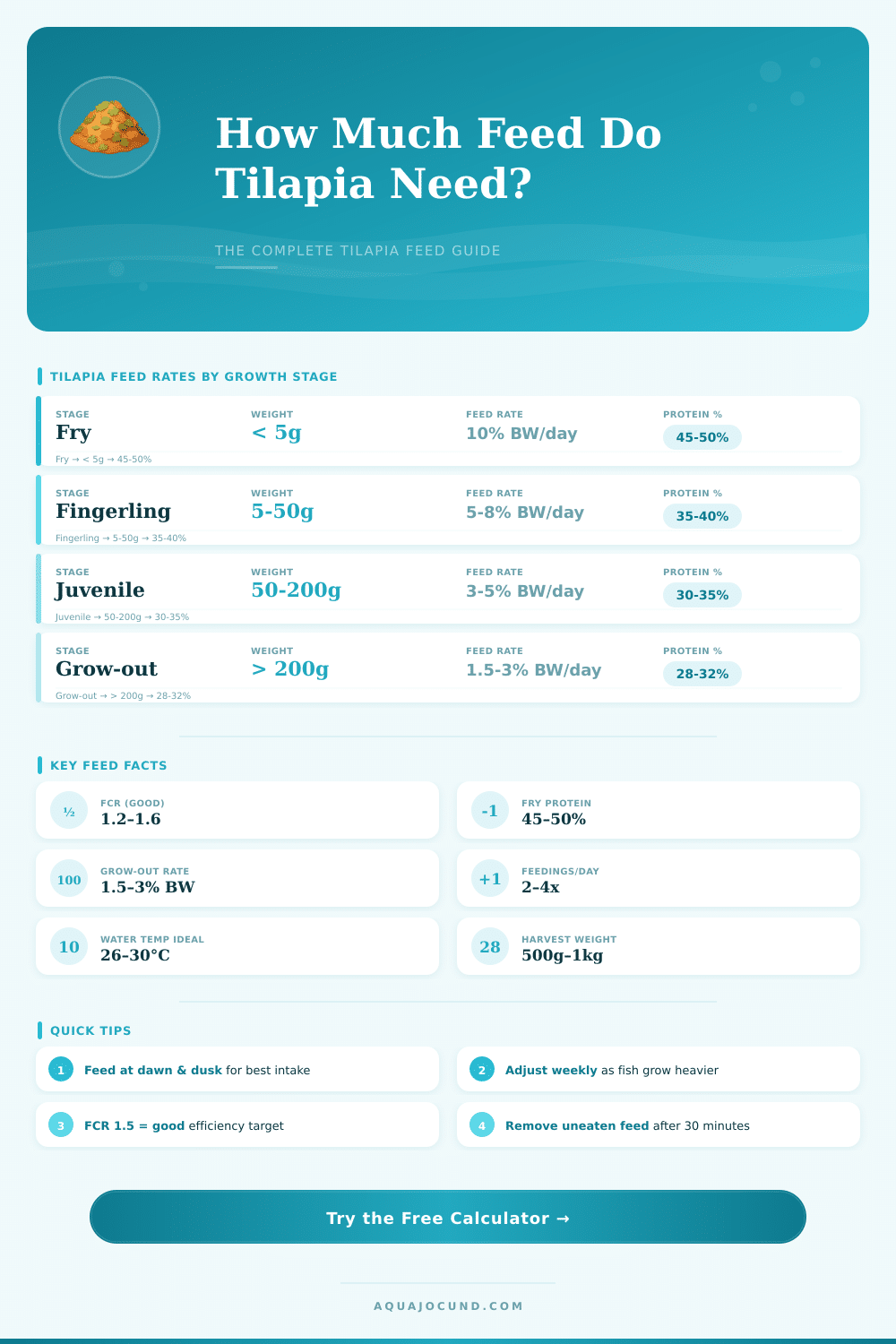
| Growth Stage | Fish Weight | Feed Rate (% BW/day) | Protein Required | Feedings/Day |
|---|---|---|---|---|
| Fry | < 5g (< 0.01 lbs) | 8–12% | 45–50% | 4–6x |
| Early Fingerling | 5–20g (0.01–0.04 lbs) | 6–8% | 40–45% | 3–4x |
| Late Fingerling | 20–50g (0.04–0.11 lbs) | 4–6% | 35–40% | 3x |
| Juvenile | 50–200g (0.11–0.44 lbs) | 3–5% | 30–35% | 2–3x |
| Sub-adult | 200–400g (0.44–0.88 lbs) | 2–3% | 28–32% | 2x |
| Grow-out | 400g–1kg (0.88–2.2 lbs) | 1.5–2% | 28–30% | 2x |
| Water Temp (°F) | Water Temp (°C) | Feed Rate Adjustment | Notes |
|---|---|---|---|
| Below 60°F | < 16°C | Stop feeding | Metabolism too low |
| 60–65°F | 16–18°C | Reduce 70% | Very slow growth |
| 65–72°F | 18–22°C | Reduce 40% | Below optimal |
| 72–78°F | 22–26°C | Reduce 15% | Slightly below optimal |
| 78–86°F | 26–30°C | Full rate (100%) | Optimal range |
| 86–91°F | 30–33°C | Reduce 10% | Slightly above optimal |
| Above 91°F | > 33°C | Reduce 30%+ | Stress, reduce feeding |
| System Type | Volume | Typical Fish Count | Daily Feed Need* |
|---|---|---|---|
| Hobby Tank | 100–500 gal / 380–1,900 L | 10–50 fish | 0.1–0.5 lbs / 0.05–0.2 kg |
| Small Aquaponics | 500–2,000 gal / 1.9–7.6 kL | 50–200 fish | 0.5–2 lbs / 0.2–0.9 kg |
| Backyard Pond | 0.1–0.5 acre / 400–2,000 m² | 200–1,000 fish | 2–8 lbs / 0.9–3.6 kg |
| RAS Tank | 1,000–5,000 gal / 3.8–19 kL | 300–2,000 fish | 5–20 lbs / 2.3–9 kg |
| Commercial Pond | 0.5–2 acres | 2,000–10,000 fish | 20–100 lbs / 9–45 kg |
| Cage Culture (1 cage) | 1m³ / 264 gal | 50–300 fish/m³ | 0.5–5 lbs / 0.2–2.3 kg |
Tilapia are omnivore fish during their young age, so they eat both plants and animals without much choice. When they reach adulthood they change and become mostly herbivore, favoring food from plants. Almost everything they can take, however plant elements form the main part of their everyday food.
Especially small animals attract them, because those they seize easily.
What Tilapia Eat and How to Feed Them
Tilapia chew green vegetables, seaweeds and water plants like duckweed or water lentils. They also accept grains, for instance soy, peanut and wheat. In farms, recently hatched children sometimes receive portions from spirulina algae to rush their growth.
Fish eating seaweed grow much more quickly than those that only recieve store Fish Feed.
In aquaponics systems, store Fish Feed pellets are the most used food for Tilapia. Some farmers favor backup options, like leftover bits of vegetables. A mix of duckweed, pellets and worms works as a good nutritious plan.
Duckweed can make up to 40 percent of the diet, if quality store food delivers the other 60 percent, and the growth stays similar to fully store diet.
An interesting option is to start worm compost and use the worms as food for Tilapia. Larvae of black soldier fly maybe even more easily bred and gathered then regular worms.
For various life stages there are different pellet sizes. For little fingerlings, starter pellets of 1/16 inch help, and that kind backs fast progress from around 9 grams to 28 grams. Fish meal commonly forms the main ingredient, which makes it very easily digested.
For Tilapia bigger than six inches, medium floating pellets of 3/16 inch in diameter work better and ensure the best ratio between food and growth. Adult Tilapia benefit from food with low fat content, yet with quite high protein. Foods rich in fat can cause the swelling of the liver in adults.
The nutrition must match the size of the fish. Based on typical fish size, one can adjust the pellet size, the daily meal of body mass percent and the number of feedings. Tilapia take more in warm water, between 28 and 32 degrees Celsius, and less when the water cools.
When Tilapia stop eating, check first the water conditions. Live foods like duckweed can push them torestart eating.
Fish Feed forms a big part of the cost in aquaculture, commonly 40 to 50 percent of the whole production. There are also USDA-controlled organic Fish Feed for Tilapia and other omnivore pond fish. Removing Tilapia before harvest helps to escape problems about toxins from food or medicines used during growth.
Steady diet from pellets with proteins, fats, minerals and vitamins works well for Tilapia in water tanks, while they grow bigger.