🐟 Fish Feed Formulation Calculator
Calculate exact ingredient amounts for custom fish feed batches — balanced protein, fat & fiber ratios
Enter the percentage (%) of each ingredient in your formula. All ingredients must total 100%.
| Species | Starter (%CP) | Grower (%CP) | Finisher (%CP) | Broodstock (%CP) |
|---|---|---|---|---|
| Tilapia | 40-45% | 32-38% | 28-32% | 35-40% |
| Catfish (Channel) | 35-40% | 28-32% | 25-28% | 32-36% |
| Salmon / Trout | 45-50% | 40-45% | 38-42% | 42-46% |
| Carp (Common) | 30-35% | 25-30% | 22-26% | 28-32% |
| Shrimp / Prawn | 40-45% | 35-40% | 30-36% | 38-42% |
| Milkfish | 35-40% | 28-32% | 25-30% | 32-36% |
| Bass / Perch | 42-48% | 38-42% | 35-40% | 40-44% |
| Ornamental Fish | 40-45% | 36-40% | 32-36% | 38-42% |
| Ingredient | Crude Protein (%) | Crude Fat (%) | Crude Fiber (%) | Moisture (%) | ME (kcal/kg) |
|---|---|---|---|---|---|
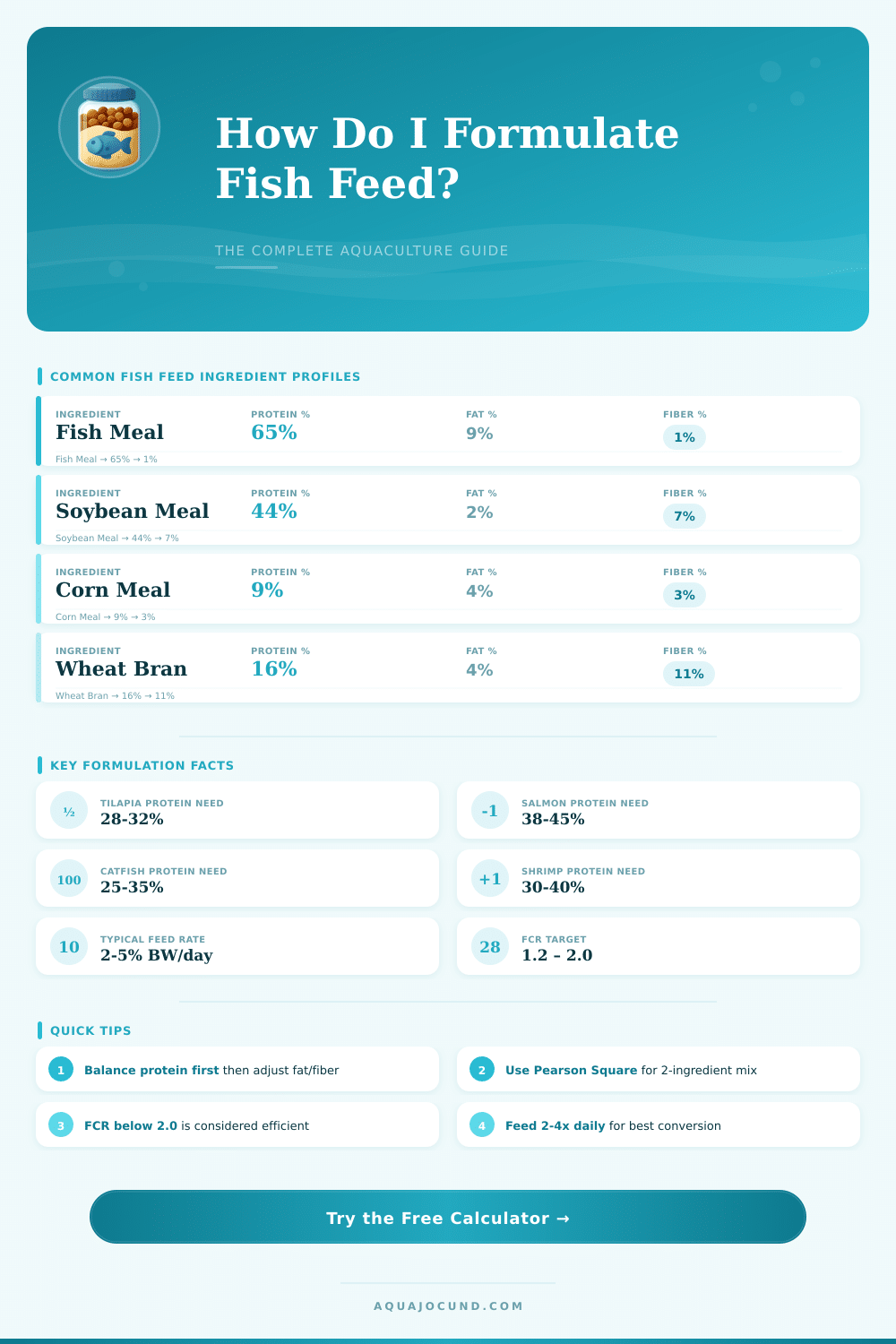
| Fish Meal (65%) | 65 | 9 | 1 | 10 | 2,770 |
| Soybean Meal (44%) | 44 | 2 | 7 | 12 | 2,230 |
| Corn Meal | 9 | 4 | 3 | 12 | 3,381 |
| Wheat Bran | 16 | 4 | 11 | 12 | 1,590 |
| Rice Bran | 13 | 13 | 12 | 12 | 2,890 |
| Blood Meal | 80 | 1 | 1 | 10 | 2,580 |
| Fish Oil | 0 | 99 | 0 | 0 | 8,800 |
| Mineral/Vit Premix | 0 | 0 | 0 | 5 | 0 |
| Cassava / Binder | 3 | 0.5 | 4 | 12 | 3,200 |
| Canola Meal | 36 | 3.5 | 12 | 12 | 1,860 |
| Species | Feed Rate (% BW/day) | Target FCR | Feeding Frequency | Notes |
|---|---|---|---|---|
| Tilapia (Fry) | 8-10% | 1.5-2.0 | 4-6x/day | Fine particle size |
| Tilapia (Grow-out) | 2-4% | 1.6-2.0 | 2-3x/day | Pellet size 3-5mm |
| Catfish | 2-5% | 1.5-2.5 | 2-3x/day | Sinking pellets preferred |
| Salmon / Trout | 1-3% | 1.1-1.5 | 2-4x/day | High protein/fat needed |
| Shrimp | 3-5% | 1.5-2.0 | 2-4x/day | Slow-sinking pellets |
| Carp | 2-4% | 2.0-3.0 | 2-3x/day | Omnivore, low protein ok |
In the base of everything Formulation of Fish Feed simply applies nutrition in practice. One gathers various ingredients, mix them so that fishes reach their targets about production, everything must taste good, stay stable and give balanced nutrition. Technical spots come in when one checks different nutrients and figures, that nutrients fishes truly require.
Protein usually is the first thing that folks consider. Fishes require between two and three times more protein than land creatures. Here the key: fishes do not well use carbs, so they end using protein for energy instead.
How to Make Good Fish Feed
Hence the cost of Fish Feed depends this much on the protein amount, when one prepares a formula, crude protein becomes the first step. Other things matter more: reach right balance between digestible protein and amino acids. Only the number of crude protein does not describe everything.
Sources of energy have quite a big role also. In commercial Fish Feed for catfishes appear all sorts of options… Corn, corn glutens, wheat, wheat middlings, rice bran, soy, animal fat and fish oil all are common.
Mixes of vitamins and minerals add themselves, and although they seem a small part, they are needed to escape diseases and strengthen the immune system. Also there are binders, that keep the pellets of Fish Feed together so that they do not break apart. Corn meal and wheat flour do that task, but they should not be the main part; they are only less important then others.
While one builds a formula, quality of ingredients is the most important. Using poorly made Fish Feed lowers the output and causes environmental troubles by means of waste of pellets, that builds up everywhere. The main challenge consists in reaching that right spot: cheap diet, that still uses the best nutritious ingredients available.
In many regions, growers of fishes and millers of Fish Feed struggle, because prime ingredients are hard to find and there lacks knowledge about Formulation and making of Fish Feed.
A good list of items must cover three main fields: protein, energy and binders. Proteins from plants include bean, peanut, mustard, sunflower, palm, coconut, sesame, poppy and cotton. By-products of land creatures, birds or sea sources work also.
Good Formulation gives fishes the right nutrients that they require. The second good idea helps them well digest cheaper ingredients. When one combines both, here happens the miracle, one finds balance between price and high quality, that truly works.
There are special kinds of Fish Feed that deserve a mention. Custom diets prepare for fancy African cichlid fish in research places or for small output. Diets based on gelatin well serve for giving medicines or other extras directly to fishes.
Looking ahead, sea fishes and saltwater farming will require protein and oil from sources beyond what fishmeal and fishoil products can now provide. Some labs already offer non-marine diets, even forthe most difficult meat-eating species.