🐟 Fish Pond Stocking Calculator
Calculate exactly how many fish your pond can safely support based on volume, fish type, and filtration
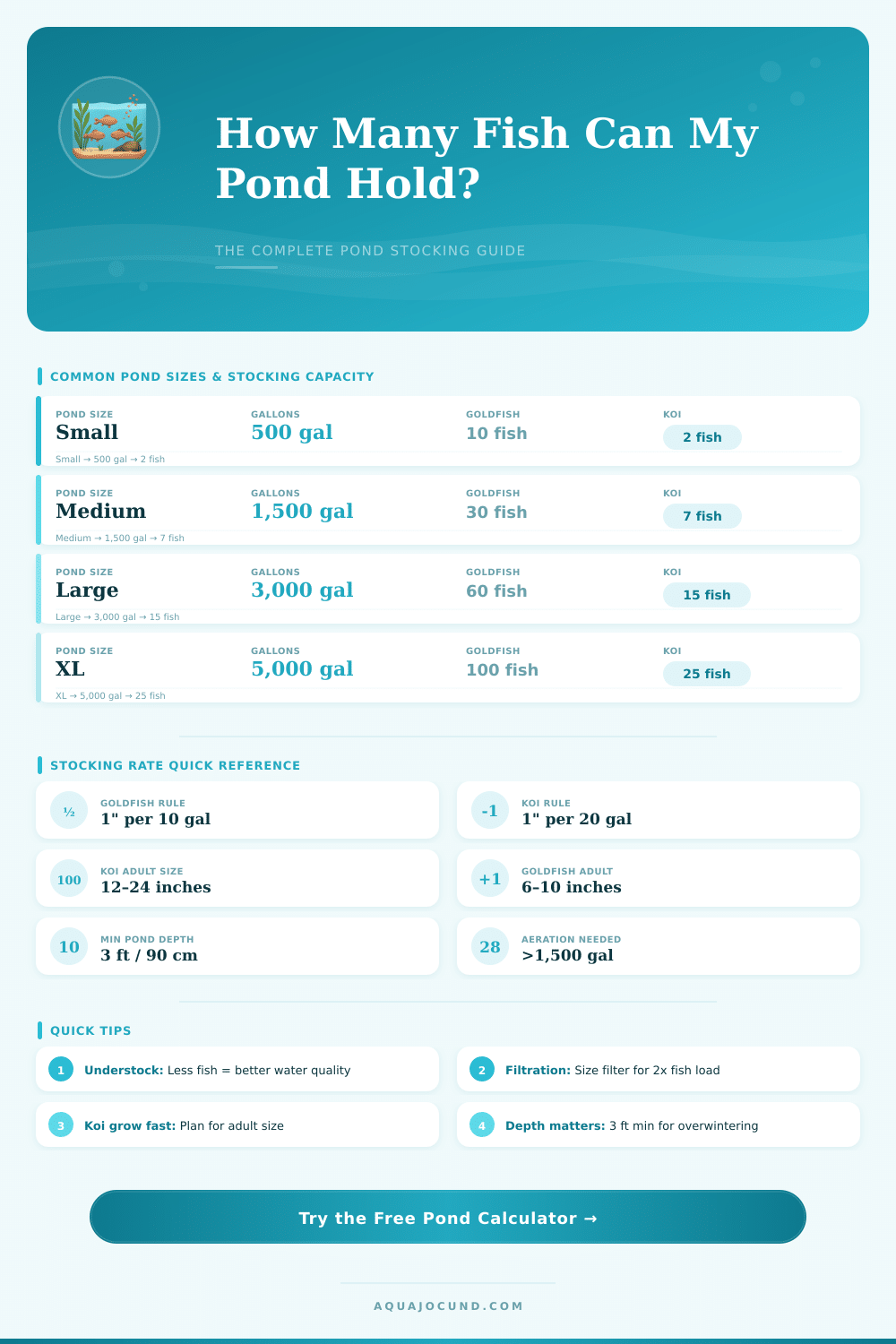
| Pond Type | Dimensions (ft) | Volume (gal) | Volume (L) | Max Goldfish | Max Koi |
|---|---|---|---|---|---|
| Tub / Mini | 4 x 3 x 1.5 | 135 | 511 | 2 | 0 |
| Small Garden | 6 x 4 x 2 | 359 | 1,360 | 6 | 1 |
| Medium Garden | 8 x 6 x 2.5 | 898 | 3,400 | 15 | 4 |
| Standard Koi | 10 x 6 x 3 | 1,348 | 5,105 | 22 | 7 |
| Large Koi | 15 x 10 x 4 | 4,493 | 17,011 | 75 | 18 |
| Show Pond | 20 x 12 x 5 | 8,987 | 34,022 | 150 | 37 |
| Round 8ft dia | 8 dia x 2.5 | 940 | 3,559 | 15 | 4 |
| Round 12ft dia | 12 dia x 3 | 2,543 | 9,628 | 42 | 10 |
| Factor | Condition | Stocking Multiplier | Notes |
|---|---|---|---|
| Filtration | None | 0.40x | Very limited; natural balance only |
| Filtration | Basic pump + foam | 0.70x | Suitable for goldfish only |
| Filtration | Bio-filter + UV | 1.00x | Standard benchmark |
| Filtration | Pressurized bead filter | 1.30x | Best for koi ponds |
| Aeration | None | 0.80x | O2 limits bio activity |
| Aeration | Fountain/Waterfall | 1.05x | Moderate improvement |
| Aeration | Air pump/diffuser | 1.10x | Good baseline |
| Aeration | Both waterfall + air | 1.20x | Maximum natural aeration |
| Plants | None | 0.90x | No natural nitrate uptake |
| Plants | Light coverage | 1.00x | Minimal benefit |
| Plants | Moderate coverage | 1.10x | Good natural filtration |
| Plants | Heavy coverage | 1.20x | Excellent for goldfish ponds |
| Climate | Warm / Tropical | 0.85x | Higher metabolism, more waste |
| Climate | Temperate | 1.00x | Standard baseline |
| Climate | Cold / Northern | 1.10x | Slower metabolism in winter |
| Shape | Formula (Imperial) | Formula (Metric) | Conversion Factor |
|---|---|---|---|
| Rectangle | L x W x D x 7.481 = gal | L x W x D = cubic meters x 1,000 = L | 1 ft³ = 7.481 gal |
| Circular (round) | π x r² x D x 7.481 = gal | π x r² x D x 1,000 = L | π = 3.14159 |
| Kidney/Irregular | L x W x D x 7.481 x 0.80 | L x W x D x 1,000 x 0.80 | 80% of bounding rectangle |
| Custom | Enter volume directly | Enter volume in liters | 1 gal = 3.78541 L |
The success of Stocking Fish in a Pond depends on the close choice of species and their cleanup. If one overstocks that can cause unbalanced populations and failed fishing, that requires years of work to fix. A planned method requires patience, because sport Fish like largemouth bass maybe requires up to three years to be ready for capture.
Even so, the prize comes to those, that have patience.
How to Stock Fish in a Pond
For a well balanced Pond, one should provide three prey for every predator. Species like bluegill or sunfish provide food for predators like basses. When the balance tips too far to one side, problems appear soon.
Overpopulation forces the Fish to stay small and underdeveloped. Small Fish also live more in a group than those in not overstocked Ponds. Big basses eat little, so if the whole population stays small, the big ones hardly die.
Ponds with fewer Fish allow them to grow bigger, because enough food and life lasts more long.
Fathead minnows are commonly chosen as base for food. They can breed three to five times yearly, if they have good cover. That ensures food during the whole year.
On the other hand, depending on the number of predators in teh area, one maybe must restock minnows yearly. Around thousand fathead minnows per acre create a solid base for feeding. One should first set up the minnows before adding predators.
Interesting things happened with folk, that first added goldfish in a fresh Pond and later wanted to replace them with fathead minnows, shining minnows or shad minnows. A year after the draining of the Pond, one added twenty quarter-sized channel catfish. Those catfish grew past two feet, bred and provided thrilling fishing.
Fresh Ponds require at least five feet of water before Stocking. It stops the whole Pond from freezing hard during winter. For older Ponds with already added Fish, one should check them before adding more.
The size of the Pond, the habitat and the quality of water all affect the plan of Stocking. Some Fish farms suggest largemouth bass, bluegill, hybrid bluegill, redear sunfish, channel catfish, black crappie, grass carp, koi, tilapia, golden shiners and fathead minnows. Species like grass carp require a permit from a state agency and usually one stores them in five to ten per acre.
They work well against water plants like hydrilla and dense pondweed, but they do not eat lily pads, primrose ore cattails.
Small Fish need protection when one first adds them. One folk stocked a Pond with small basses, and inside some months local birds ate all. The goals also matter.
Some want big trophy basses, others favor many small Fish for children to catch. Having a clear plan beforestarting the Stocking makes all the difference.