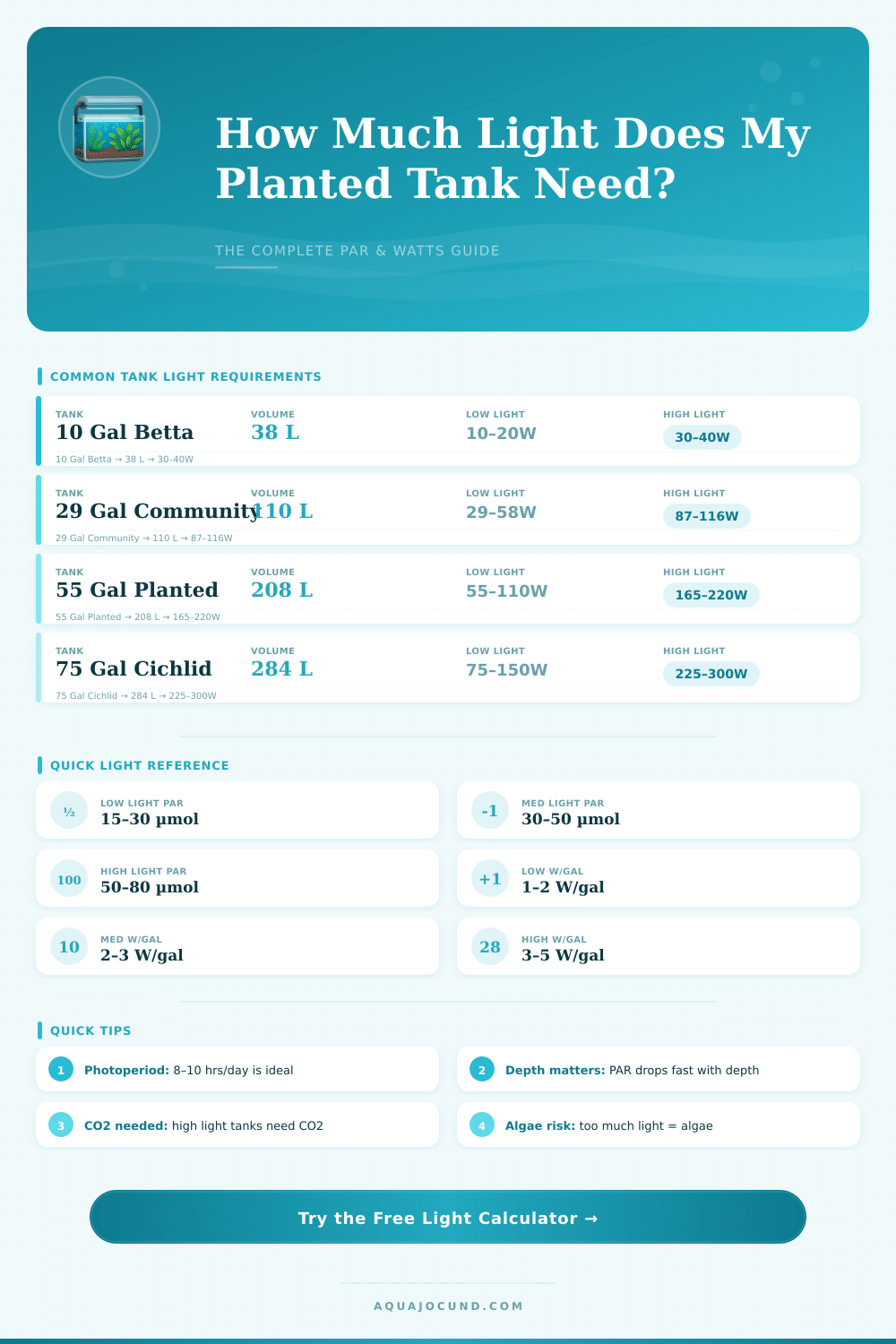
🌱 Planted Aquarium Light Calculator
Calculate PAR, watts per gallon & daily light needs for your planted tank
| Plant Category | PAR at Substrate (µmol) | W/Gal (LED) | CO2 Needed | Photoperiod |
|---|---|---|---|---|
| Java Fern, Anubias, Moss | 10–25 | 0.5–1.5 | Not required | 6–8 hrs |
| Crypts, Val, Amazon Sword | 20–40 | 1–2 | Optional | 8 hrs |
| Stem Plants (Bacopa, Rotala) | 40–60 | 2–3 | Recommended | 8–9 hrs |
| Carpeting (HC, Glosso, Dwarf Baby Tears) | 50–80 | 3–4 | Required | 8 hrs |
| Dutch / Heavy Stem Jungle | 60–80 | 3–5 | Required | 8–9 hrs |
| Iwagumi / Aquascape | 60–100 | 3–5 | Required | 8 hrs |
| Tank Name | Dimensions (in) | Volume (gal) | Volume (L) | Footprint (in²) | Rec. Low Light (W) | Rec. High Light (W) |
|---|---|---|---|---|---|---|
| 2.5 Gallon Pico | 12 x 6 x 8 | 2.5 | 9.5 | 72 | 3–5 | 8–13 |
| 5 Gallon Nano | 16 x 8 x 10 | 5 | 19 | 128 | 5–10 | 15–25 |
| 10 Gallon Standard | 20 x 10 x 12 | 10 | 38 | 200 | 10–20 | 30–50 |
| 20 Gallon Long | 30 x 12 x 12 | 20 | 76 | 360 | 20–40 | 60–100 |
| 29 Gallon Standard | 30 x 12 x 18 | 29 | 110 | 360 | 29–58 | 87–145 |
| 40 Gallon Breeder | 36 x 18 x 16 | 40 | 151 | 648 | 40–80 | 120–200 |
| 55 Gallon Standard | 48 x 13 x 21 | 55 | 208 | 624 | 55–110 | 165–275 |
| 75 Gallon Standard | 48 x 18 x 21 | 75 | 284 | 864 | 75–150 | 225–375 |
| 90 Gallon Standard | 48 x 18 x 24 | 90 | 341 | 864 | 90–180 | 270–450 |
| 125 Gallon Standard | 72 x 18 x 22 | 125 | 473 | 1296 | 125–250 | 375–625 |
| Light Type | Efficiency | PAR/Watt | Heat Output | Lifespan | Best For |
|---|---|---|---|---|---|
| Full-Spectrum LED | Very High | 1.5–3.0 µmol/W | Low | 30,000+ hrs | All planted tanks |
| T5 HO Fluorescent | High | 0.8–1.2 µmol/W | Medium | 10,000–15,000 hrs | Low–High light |
| T8 Fluorescent | Medium | 0.5–0.8 µmol/W | Low–Medium | 8,000–10,000 hrs | Low light only |
| CFL Compact | Medium | 0.6–1.0 µmol/W | Medium | 6,000–8,000 hrs | Small/Nano tanks |
| Metal Halide (MH) | Medium | 0.8–1.5 µmol/W | Very High | 8,000–12,000 hrs | Deep tanks (24 in+) |
| Plasma (LEC) | High | 1.2–2.0 µmol/W | Medium | 30,000+ hrs | Large aquascapes |
| Water Depth | Depth (cm) | Approx. PAR Loss | Surface PAR Needed for 50 µmol Substrate |
|---|---|---|---|
| 6 in (shallow) | 15 cm | ~15% | ~59 µmol |
| 10 in | 25 cm | ~25% | ~67 µmol |
| 12 in (standard) | 30 cm | ~30% | ~71 µmol |
| 16 in | 41 cm | ~40% | ~83 µmol |
| 18 in | 46 cm | ~45% | ~91 µmol |
| 21 in | 53 cm | ~52% | ~104 µmol |
| 24 in (deep) | 61 cm | ~60% | ~125 µmol |
The lighting of your aquarium must be well set, because it is entirely important so that planted tanks stay healthy. Like their relatives on the ground, water plants need light for photosynthesis and for truly growing. The strength of the light, that plants receive is measured by means of micromoles…
This simply shows the amount of light particles, that they can actually use.
How to Light a Planted Aquarium
Plants evolved to absorb red light best in the range of 650 to 680 nanometers. Blue light they also grab quite well, but here the problem: too much blue can cause too much growth of algae. About kelvin values and color temperature, honestly, that matters less than it seems.
Plants are quite flexible regarding the kelvin range, that they accept. One can use warm yellowish light at 2700 K or cool blue-white at 10 000 K, and plants will still work almost equally well. Some systems, that highlight red and blue wavelengths, commonly give pink glow above the whole aquarium, when one switches them.
Choosing the right Planted Aquarium Light, one indeed must balance several factors at once. The size of the aquarium, the kind of light source, the amount of hours daily, the intensity of the light and its colour. Everything affects.
How much light truly is needed, depends on the place, where the plant evolved originally. The clearness of the water, the depth of the aquarium and the positoin of the plant in the water column all add difficulty to the calculation. Something above 40 lumens per liter usually works for plants, that need stronger light.
For the everyday lighting times, around 6 to 8 hours works well for plants, that do not need much. And it helps to control the algae. If you leaf for some days, leaving the lights on is risky, because algae can quickly spread.
Plants still need night, so although short periods of extra light can boost the growth for moments, that is not a lasting solution.
LED lights already lead the market, and you find good options from Fluval, Finnex, Chihiros, Twinstar, Hygger and Nicrew for planted aquariums. Fluval are more expensive, but Beamswork well balance quality and price. Finnex offer nice 24/7 mode, that fakes sun up and down, so the fish have time to adjust before everything becomes too bright.
Many of them come with full timers and dimmers. Fluorescent lamps still are cheap, simple and available in almost every type, that you want. Grow lights were the start for planted aquariums, and average ones work, you only must hang them higher, so that they don’t get wet.
The old rule of watts per gallon offers maximum of around 2.0 watts per gallon without CO2 to grow plants, although at least 1.0 to 1.5 depends on what youcultivate.