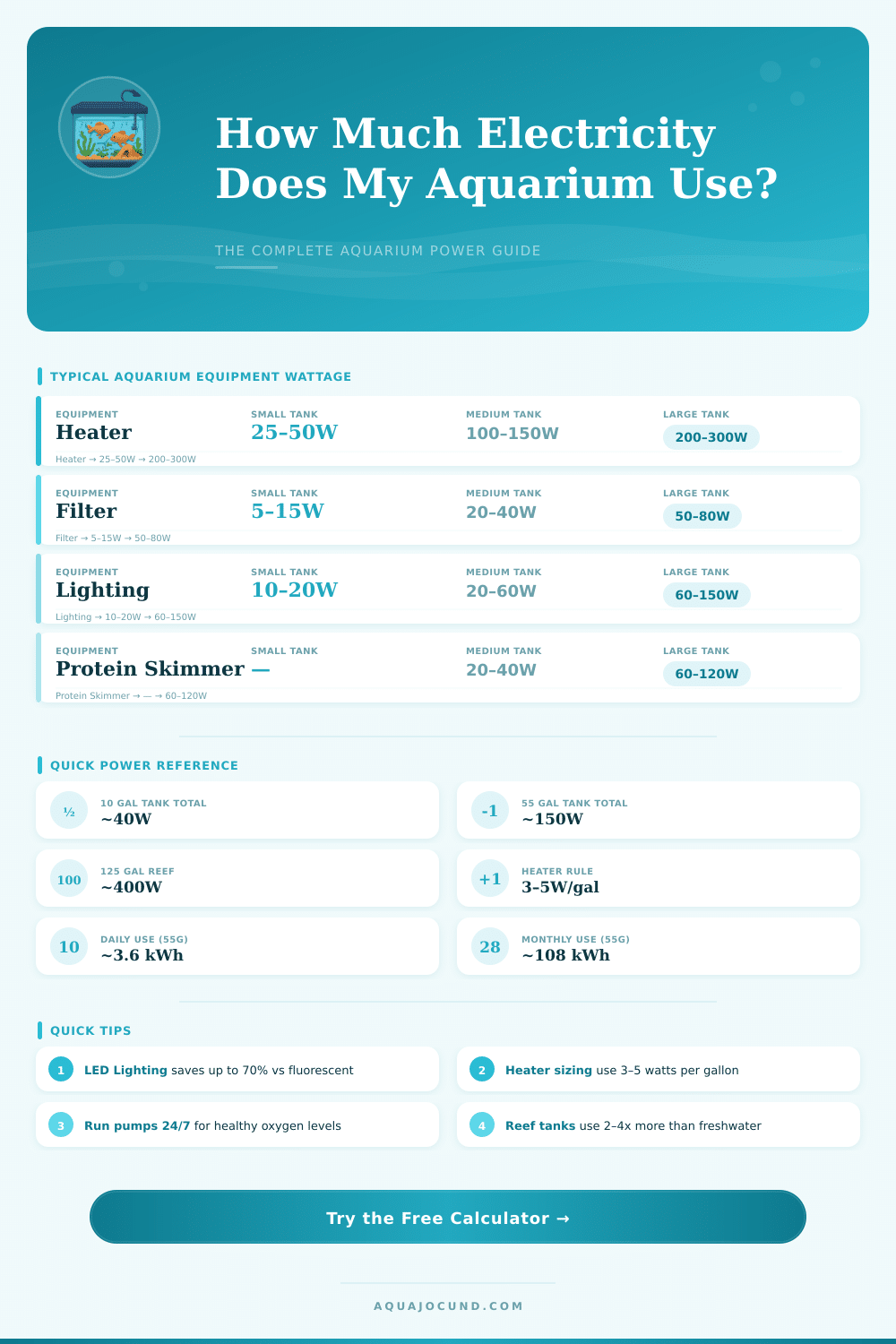
⚡ Aquarium Electricity Usage Calculator
Find out exactly how much power your fish tank consumes daily, monthly, and yearly
💡 Lighting
🔥 Heater
🌀 Filtration
🪨 Additional Equipment
| Equipment Type | Typical Watts | Runs | Notes |
|---|---|---|---|
| LED Light (Basic) | 10–40W | 8–10 hrs/day | Most efficient option |
| LED Light (Planted/Reef) | 30–150W | 8–12 hrs/day | High-output for corals/plants |
| T5 HO Fluorescent | 24–80W per bulb | 8–10 hrs/day | 2–4 bulbs typical |
| Metal Halide | 150–400W | 8–10 hrs/day | Very high output, hot |
| HOB Filter | 5–25W | 24 hrs/day | Most common type |
| Canister Filter | 15–50W | 24 hrs/day | Energy efficient per GPH |
| Sump Return Pump | 25–120W | 24 hrs/day | Size to tank volume x10 |
| Protein Skimmer | 10–80W | 24 hrs/day | Saltwater/reef essential |
| Aquarium Heater | 25–500W | 40–60% duty | 3–5W per gallon rule |
| Powerhead / Wavemaker | 5–30W | 24 hrs/day | Improves circulation |
| CO2 Solenoid | 3–8W | With lights on | Planted tanks |
| UV Sterilizer | 8–40W | 24 hrs/day | Optional disease prevention |
| Aquarium Chiller | 100–350W | 30–70% duty | Reef/coldwater |
| ATO / Dosing Pump | 3–10W | Intermittent | Saltwater top-off |
| Tank Name | Volume | Freshwater Est. | Reef Est. |
|---|---|---|---|
| Nano / Pico | 2.5–5 gal (9–19 L) | 15–40W | 25–80W |
| 10 Gallon (38 L) | 10 gal | 40–75W | 80–150W |
| 20 Gallon Long (76 L) | 20 gal | 60–110W | 120–220W |
| 29 Gallon (110 L) | 29 gal | 80–140W | 160–300W |
| 40 Gallon Breeder (151 L) | 40 gal | 100–175W | 200–375W |
| 55 Gallon (208 L) | 55 gal | 130–225W | 260–500W |
| 75 Gallon (284 L) | 75 gal | 175–300W | 350–650W |
| 90 Gallon (341 L) | 90 gal | 200–350W | 400–750W |
| 125 Gallon (473 L) | 125 gal | 275–475W | 550–1,100W |
| 180 Gallon (681 L) | 180 gal | 375–650W | 750–1,500W |
| Tank Type | Avg Daily Watts | Monthly kWh | Yearly kWh |
|---|---|---|---|
| 5 Gal Betta / Nano | 20–40W | 14–29 kWh | 168–350 kWh |
| 10 Gal Freshwater | 40–75W | 29–54 kWh | 350–648 kWh |
| 20 Gal Planted | 80–130W | 58–94 kWh | 696–1,128 kWh |
| 55 Gal Community | 130–225W | 94–162 kWh | 1,128–1,944 kWh |
| 75 Gal Cichlid | 175–300W | 126–216 kWh | 1,512–2,592 kWh |
| 125 Gal Reef | 400–700W | 288–504 kWh | 3,456–6,048 kWh |
Keeping an Aquarium that runs around the clock always uses energy so it matters to know what it costs and how to care for it without danger. Average Aquarium uses between five and fifty dollars for Electricity monthly (big range), because it depends on the size of the Aquarium, the gear that you use and the prices of your local energy company. Little Aquarium in ten to twenty gallons usually cost around six to eighteen dollars per month.
For bigger setups above seventy-five gallons, the expenses can reach between forty-eight and ninety-six dollars monthly.
Aquarium Electricity Costs and Safety Tips
Most Aquarium gear uses average sixty-three watts, but it adjusts based on the brand and size of your devices. Usually you find the watt rating in the manual or directly on the device itself. For instance, a ten-gallon freshwater Aquarium kept at around seventy-two degrees uses about hundred fifty kilowatt-hours yearly.
If you go to thirty gallons, the use reaches between hundred fifty and two hunderd kilowatt-hours yearly.
Here the main point: the heaters are the real energy eaters. A heater of three hundred watts in a cool home could cost around twenty dollars monthly. Even so, heaters do not work all day.
When the water reaches the wanted heat, the heater runs only sometimes, too keep it stable. Most pumps and filters use under ten watts, which is really little. LED lighting makes the whole Aquarium more cheap than before with those old fluorescent lamps.
Want to count your real expenses? Take your last bill for Electricity and list every piece of gear at the Aquarium. Check the watt power for each of them and guess how many hours daily it runs.
Later, multiply watts by hours per day, for thirty days, divide by thousand, and then multiply by your Electricity price, like this you find the monthly amount. Websites with calculators do all that math right away and show what gear uses themost energy.
Safety is also important as the money side. Touching wet cables with wet hands can send the flow of electrons through your whole body, instead of the normal way. Broken gear could release voltage in the water without warning, until something closes the circle to ground.
At two hundred forty volts, even ten milliamps through your body cause strong pain, and fifty milliamps or more can be deadly. Test the water in your Aquarium regularly with a volt meter. Add a GFCI outlet on every cable, so that water does not flow in the socket.
Use a separate circuit only for Aquarium gear, so that you do not blow fuses when you connect other devices nearby. A UPS device keeps the gear running during short outages and protects against high voltage. There is also the chance to go without Electricity, plants, sunshine and thick soil can be enough, just like in natural pools and lakes.