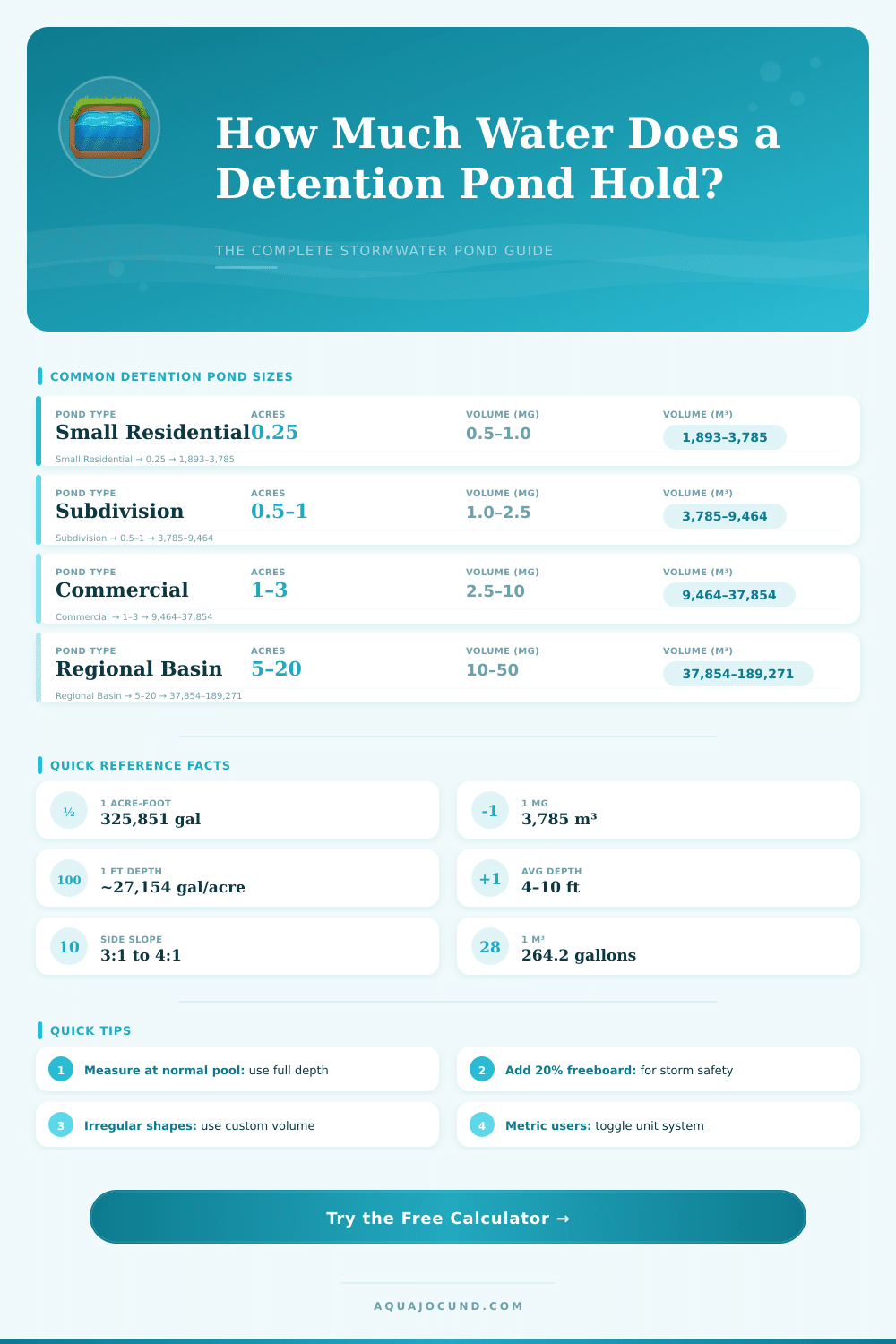
🌊 Detention Pond Volume Calculator
Calculate exactly how much water your detention or retention pond holds — in gallons, liters, and acre-feet
| Pond Type | Approx. Area | Avg Depth | Volume (Gallons) | Volume (Liters) | Volume (Acre-ft) |
|---|---|---|---|---|---|
| Small Residential | 0.25 acres | 4 ft | ~326,000 | ~1,234,000 | ~1.0 |
| Subdivision Basin | 0.5 acres | 6 ft | ~978,000 | ~3,701,000 | ~3.0 |
| Commercial Lot | 1.0 acre | 8 ft | ~2,607,000 | ~9,870,000 | ~8.0 |
| Bioretention Cell | 0.1 acres | 3 ft | ~97,800 | ~370,200 | ~0.3 |
| Extended Detention | 2.0 acres | 7 ft | ~4,562,000 | ~17,266,000 | ~14.0 |
| Regional Basin | 10.0 acres | 10 ft | ~32,585,000 | ~123,344,000 | ~100.0 |
| Highway Roadside | 0.3 acres | 4 ft | ~391,000 | ~1,480,000 | ~1.2 |
| Constructed Wetland | 3.0 acres | 2 ft | ~1,955,000 | ~7,401,000 | ~6.0 |
| Pond Type | Typical Depth | Side Slope | Detention Time | Primary Use |
|---|---|---|---|---|
| Dry Detention Pond | 3–8 ft | 3:1 to 4:1 | 12–48 hrs | Peak flow control |
| Wet Retention Pond | 6–12 ft | 4:1 to 6:1 | Permanent pool | Water quality + volume |
| Bioretention Cell | 1–4 ft | 3:1 | 12–24 hrs | Pollutant removal |
| Extended Detention | 4–10 ft | 3:1 to 4:1 | 24–72 hrs | Sediment settling |
| Infiltration Basin | 2–5 ft | 3:1 | 24–72 hrs | Groundwater recharge |
| Constructed Wetland | 1–3 ft | 5:1 to 10:1 | 7–14 days | Nutrient removal |
| Regional Basin | 8–15 ft | 3:1 to 5:1 | Varies | Large watershed control |
| Highway Roadside | 2–6 ft | 4:1 to 6:1 | 24–48 hrs | Runoff capture |
| From Unit | To Gallons | To Liters | To Acre-Feet | To m³ |
|---|---|---|---|---|
| 1 Cubic Foot (ft³) | 7.481 | 28.317 | 0.0000230 | 0.02832 |
| 1 Cubic Meter (m³) | 264.17 | 1,000 | 0.000811 | 1.0 |
| 1 Acre-Foot | 325,851 | 1,233,480 | 1.0 | 1,233.48 |
| 1,000 Gallons | 1,000 | 3,785.4 | 0.003069 | 3.785 |
| 1 Million Gallons | 1,000,000 | 3,785,412 | 3.069 | 3,785.4 |
| 1 Cubic Yard | 201.97 | 764.55 | 0.000619 | 0.7646 |
For a rectangular pond with sloped sides, volume = Depth × (Bottom Area + Top Area + 4 × Mid Area) ÷ 6 (prismatoid formula). The side slopes (H:V ratio) significantly reduce actual storage compared to a simple L × W × D calculation. This calculator applies the trapezoidal correction automatically when you enter a slope value.
Design standards typically require 1–2 ft of freeboard (dry space above normal pool). A 20% volume buffer is recommended to account for sediment accumulation over time, which can reduce effective storage by 15–30% over 10–20 years. Measure pond volume at the design water surface elevation, not at the top of the embankment.
Count the volume of a pool seems simple, until you truly try to do it. Then everything becomes tricky. Tools for counting pond volume help you estimate gallons, find sizes and estimate the need for storage outside.
Many of those tools also give the surface area, needs for filters and how big a pump you truly need.
How to Measure Pool and Pond Volume
Simple square pool? Here the math stays easy to handle. Take your flexible tape to get the length width and depth in metres, then multiply all three values to have cubic metres.
Here the good part: cubic metres of fresh Water match directly to tons or liters. For liters, simply multiply length × width × depth in metres and add zeros. If you work with feet and inches, one cubic foot matches 1 728 cubic inches.
Because one cubic foot stores around 6,23 gallons (or 7,48 for more exact), the conversion is easy, multiply your cubic foot by 7,48.
Round pools add another problem. The formula is something like 0,8 times length × width × depth. For the surface area of a round pool, multiply 3,142 by the sqaure of the radius, then multiply that result by depth.
With circles, you must consider radius, diameter and circumference. In volume calculations, the depth is the main element.
Bigger pools, measured in acres, have there own way. Take the area of the pool in acres, multiply by average depth in feet, and you get acres-feet. One acre-foot matches about 325 851 gallons.
So, for half acre pool with average depth of 4 feet, that makes 2 acres-feet, which gives around 651 702 gallons.
Odd pools with sloping sides truly bother. The best way is to estimate the average depth and split the area into simpler rectangles. Measure width and length at the surface, repeat at the bottom, then average those two sets of numbers.
Finding those wrong values truly causes headache. Some did a calculation, that shows, that their 9-by-5-by-3-foot pool carries 505 gallons. Two different calculators however pointed it more near above 1000.
Such mistakes matter, when you buy gear. For a 1000-gallon pool you need a pump, that moves around 1000 gallons in an hour. Double that to 2000 gallons, and suddenly you need a pump, that handles double the flow.
There is also a method based on salt to measure volume exactly. Multiply 120 by pounds of added salt, then split by the difference between your salty readings before and after, in parts per thousand. For pools with brooks, add the volume of the brook to the pond volume for the whole.
The average depth of a brook is around 0,17 feet, so around 2 inches, take or leave.
Getting exact volume values for storage of fish is also important. The general rule is 1000 gallons for your first koi, then another 300 to 500 gallons forevery extra fish.