🧪 Aquarium pH Calculator
Calculate how much pH adjuster your tank needs to reach your target pH safely
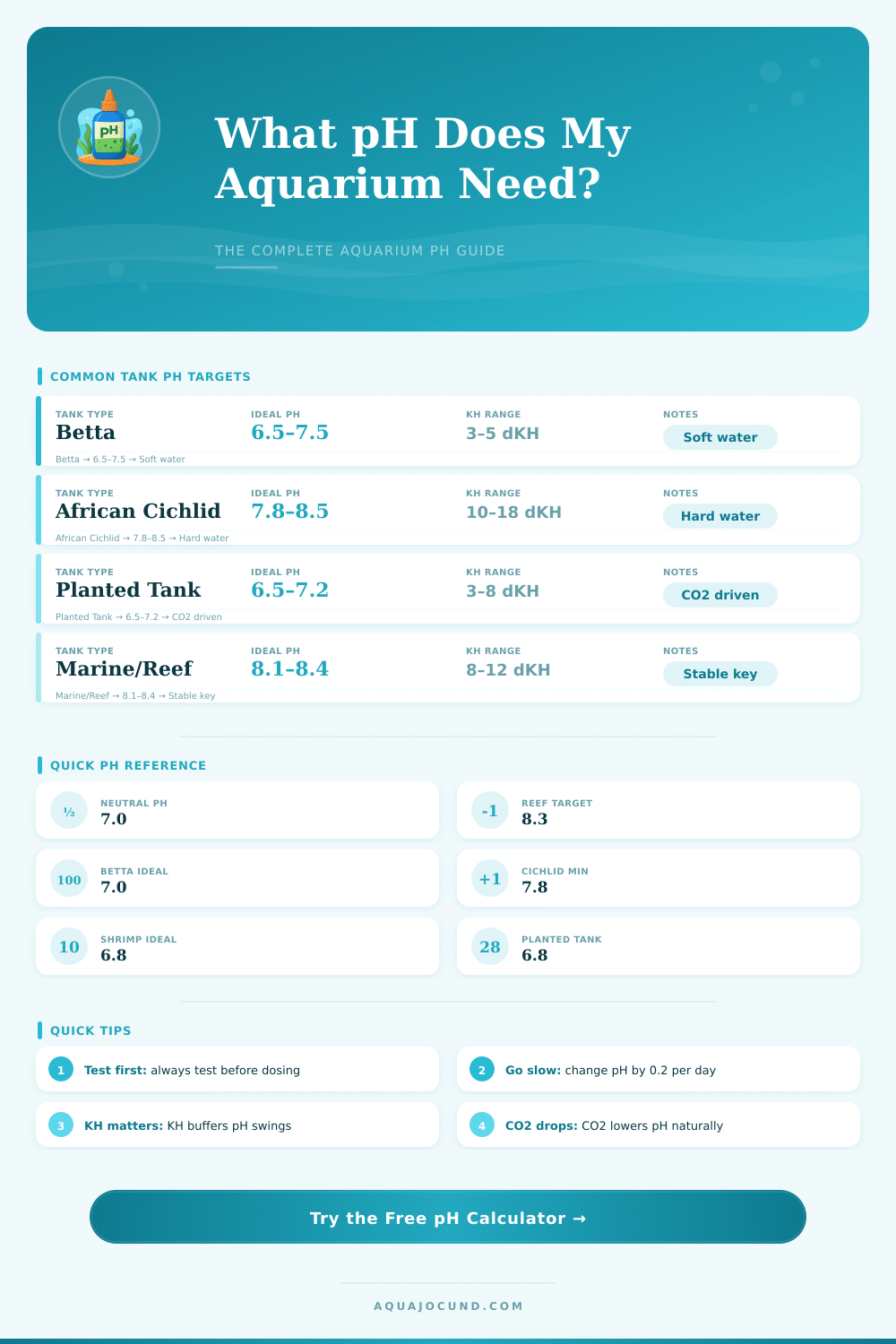
| Tank / Fish Type | Ideal pH Range | Ideal KH (dKH) | GH Range (dGH) | Adjuster to Use |
|---|---|---|---|---|
| Betta Fish | 6.5 – 7.5 | 3 – 5 | 5 – 20 | pH Down / Peat |
| Community Tropical | 6.8 – 7.6 | 4 – 8 | 4 – 12 | Neutral / Minor adjust |
| Planted Tank | 6.5 – 7.2 | 3 – 8 | 3 – 8 | CO2 / pH Down |
| African Cichlid | 7.8 – 8.5 | 10 – 18 | 10 – 20 | pH Up / Crushed Coral |
| Discus | 6.0 – 7.0 | 1 – 4 | 1 – 8 | RO Water / Peat Moss |
| Goldfish | 7.0 – 8.0 | 6 – 12 | 6 – 16 | Baking Soda / Crushed Coral |
| Neocaridina Shrimp | 6.5 – 7.5 | 3 – 8 | 4 – 8 | pH Down / Peat |
| Caridina Shrimp | 5.8 – 6.8 | 0 – 4 | 0 – 6 | RO Water / Peat |
| Marine / FOWLR | 8.0 – 8.3 | 8 – 12 | 8 – 12 | Marine Buffer |
| Reef / SPS Coral | 8.2 – 8.4 | 8 – 12 | 8 – 12 | Marine Buffer / Kalk |
| Tank Name | Dimensions (L x W x H in) | Volume (gal) | Volume (L) | Water Volume (80%) |
|---|---|---|---|---|
| 5 Gal Nano | 16 x 8 x 10 | 5.5 | 20.8 | 4.4 gal / 16.7 L |
| 10 Gal Standard | 20 x 10 x 12 | 10.4 | 39.3 | 8.3 gal / 31.4 L |
| 20 Gal Long | 30 x 12 x 12 | 18.7 | 70.8 | 15 gal / 56.7 L |
| 29 Gal Standard | 30 x 12 x 18 | 28.1 | 106.4 | 22.5 gal / 85.1 L |
| 40 Gal Breeder | 36 x 18 x 16 | 37.8 | 143.1 | 30.2 gal / 114.4 L |
| 55 Gal Standard | 48 x 13 x 20 | 55.0 | 208.2 | 44 gal / 166.5 L |
| 75 Gal Standard | 48 x 18 x 20 | 75.0 | 283.9 | 60 gal / 227.1 L |
| 90 Gal Standard | 48 x 18 x 24 | 90.0 | 340.7 | 72 gal / 272.5 L |
| 125 Gal Standard | 72 x 18 x 22 | 125.0 | 473.2 | 100 gal / 378.5 L |
| 180 Gal Standard | 72 x 24 x 25 | 187.5 | 709.8 | 150 gal / 567.8 L |
| Adjuster Type | Effect | Dose / 10 gal | Dose / 40 L | Speed | KH Impact |
|---|---|---|---|---|---|
| pH Down (Phosphoric Acid) | Lowers pH | 1 mL / 0.2 drop | 2.6 mL / 0.2 drop | Fast (hours) | Slight decrease |
| pH Up (NaHCO3) | Raises pH | 1 tsp / 0.2 rise | 4.9 mL / 0.2 rise | Moderate (hours) | Increase |
| Marine Buffer | Raises pH | 1 tsp / 0.1 rise | 4.9 mL / 0.1 rise | Moderate | Significant increase |
| CO2 Injection | Lowers pH | 1 BPS / 0.5 drop | — | Gradual (hours) | Decreases slightly |
| Peat Moss | Lowers pH | 1 cup / 0.5 drop | 240 mL / 0.5 drop | Very slow (days) | Decreases |
| Crushed Coral | Raises pH | 1 lb / slow rise | 450 g / slow rise | Very slow (days) | Increases |
| Baking Soda | Raises pH | 1 tsp / 0.2 rise | 4.9 mL / 0.2 rise | Fast (hours) | Significant increase |
| RO Water Dilution | Lowers pH | 50% swap / ~0.3 drop | 50% swap / ~0.3 drop | Immediate | Decreases |
The ph of water in an aquarium shows whether it is acidic or basic. One measures it on a scale of 0 to 14. Values between 0 and 7 are acidic while between 7 and 14 it is basic or alkaline.
At 7 it stays neutral. The word ph relates to the amount of hydrogen ions and hydroxide ions in the water. The more hydrogen ions, the more acidic the water becomes.
Aquarium pH and How It Affects Fish
The fewer hydrogen ions, the more basic or alkaline it becomes.
Here comes the hard part. The scale of ph is logarithmic. So a change of one unit, for example from 7 to 6, makes the water tenfold more acidic.
That is a huge difference, although it seems tiny on paper.
Most freshwater aquarium tanks have an average ph around 7.0. Many fishes tolerate a range of 6.5 to 7.5, but everything depends on the species. Some fishes require very precise levels of ph.
Cichlids and discus are more sensitive, while goldifsh last through harder conditions. The best ph varies from species to species. Between 6 and 8.5 is well tolerated for most fishes, if the level stays stable.
Aquarium tanks for fishes try to copy their natural habitat. They are in effect small copies of natural water environments. Choosing the write species of fish for a particular ph is an important first step.
Tap water usually tends to be alkaline thanks to the minerals in it. In the aquarium, acids build up from metabolic processes, which lowers the ph over time. Organic substances, like driftwood or peat, release tannins, which naturally lower the ph.
Using water from reverse osmosis or distilled water is another option. RO-water is available at local stores for fishes or even at machines in the supermarket. Chemicals to adjust ph also exist, but one should use them with very big care, to escape sudden dangerous changes of ph.
Always adjusting the ph is not a good idea. Fishes benefit most in water, where the ph stays the same, instead of in water that always changes because of attempts to push it up or down. Sudden changes of ph can even kill fish.
Gradual changes are the safer way.
KH, or carbonate hardness, also matters. Freshwater aquarium tanks usually should have between 4 and 8 dKH, which matches 70 to 140 ppm. Low KH can cause the ph to drop and becomeunstable.
Testing ph and other parameters of the water should happen often. Most plants also benefit in a slightly acidic range of 6 to 7 ph, although they can adapt to slightly alkaline conditions also.