🐠 Aquarium Sump Filter Size Calculator
Calculate the ideal sump volume, return pump flow rate, refugium size, and media capacity for your tank
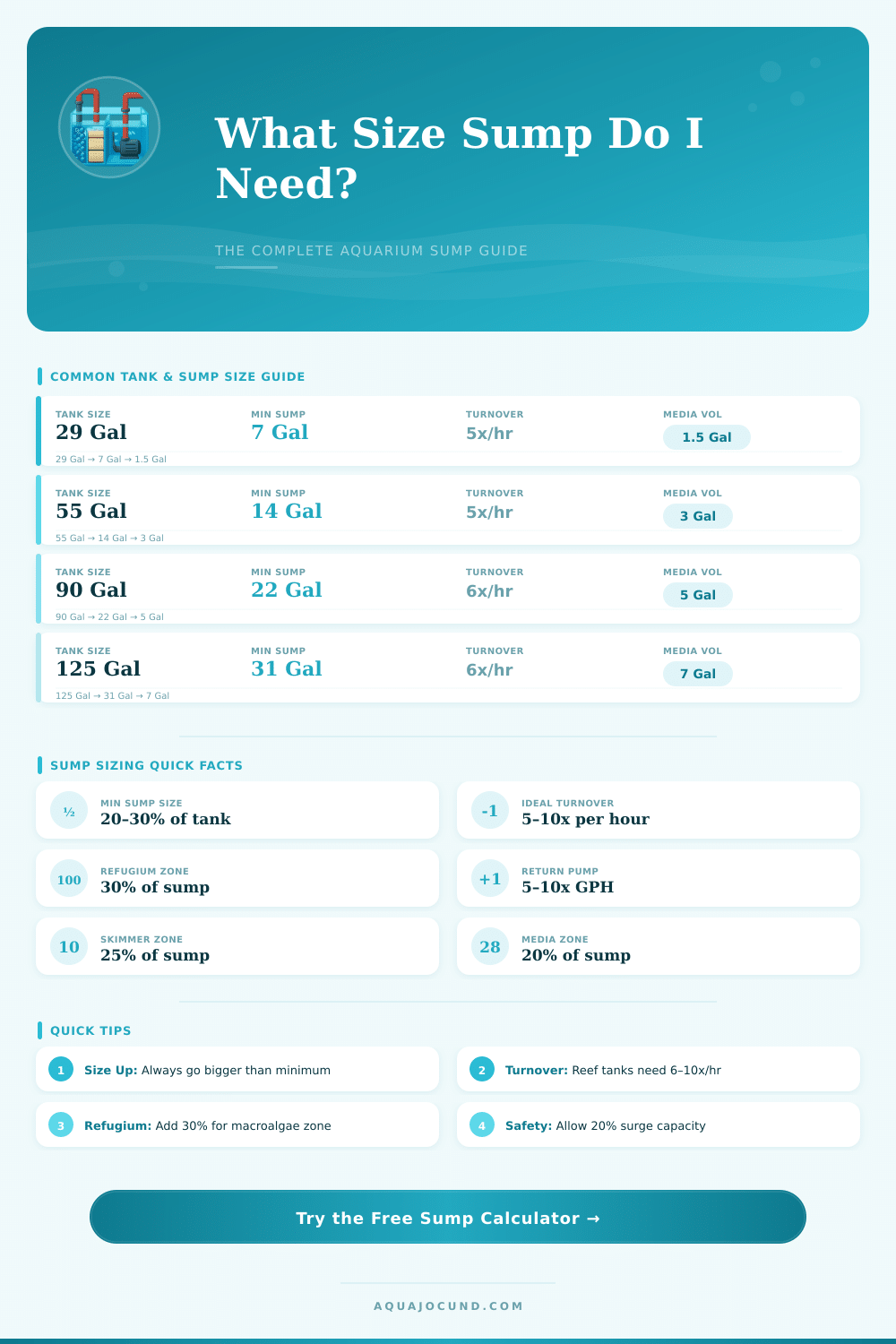
| Tank Type | Min Sump % | Turnover Rate | Refugium | Skimmer Zone | Notes |
|---|---|---|---|---|---|
| Freshwater Community | 15–20% | 5–7x/hr | Optional | Not required | Canister filter often preferred |
| Planted Freshwater | 15–20% | 4–6x/hr | Not needed | Not required | Lower turnover preserves CO2 |
| FOWLR | 20–25% | 5–8x/hr | Beneficial | Recommended | Generous bio-media needed |
| Reef / Mixed | 25–30% | 7–10x/hr | Recommended | Required | Include skimmer and refugium zones |
| SPS Dominant | 30–40% | 8–12x/hr | Strongly Rec. | Required | Pristine water quality critical |
| LPS / Soft Coral | 25–30% | 6–8x/hr | Recommended | Required | Moderate flow acceptable |
| Predator | 25–35% | 6–8x/hr | Optional | Recommended | High bio-load demands larger sump |
| Brackish | 20–25% | 5–7x/hr | Optional | Optional | Similar to FOWLR requirements |
| Tank Name | Dimensions (L x W x H in) | Volume (US Gal) | Volume (Liters) | Min Sump (Gal) | Ideal Sump (Gal) |
|---|---|---|---|---|---|
| Nano / Pico 5 Gal | 16 x 8 x 10 | 5 | 18.9 | 1–1.5 | 1.5–2 |
| 10 Gallon Standard | 20 x 10 x 12 | 10 | 37.9 | 2 | 2.5–3 |
| 20 Gallon Long | 30 x 12 x 12 | 20 | 75.7 | 4 | 5–6 |
| 29 Gallon | 30 x 12 x 18 | 29 | 109.8 | 6 | 7–8 |
| 40 Gallon Breeder | 36 x 18 x 16 | 40 | 151.4 | 8 | 10–12 |
| 55 Gallon | 48 x 13 x 21 | 55 | 208.2 | 11 | 14–17 |
| 75 Gallon | 48 x 18 x 21 | 75 | 283.9 | 15 | 19–22 |
| 90 Gallon | 48 x 18 x 24 | 90 | 340.7 | 18 | 22–27 |
| 125 Gallon | 72 x 18 x 22 | 125 | 473.2 | 25 | 31–37 |
| 180 Gallon | 72 x 24 x 24 | 180 | 681.4 | 36 | 45–54 |
| Tank Volume | Freshwater GPH | Reef GPH | SPS GPH | Head Loss Factor | Pump Size Tip |
|---|---|---|---|---|---|
| 10–20 gal | 50–140 GPH | 80–200 GPH | 100–200 GPH | 1.2–1.4x | Rate pump 20–40% higher than needed |
| 29–40 gal | 145–280 GPH | 200–400 GPH | 280–400 GPH | 1.2–1.5x | Account for head pressure from height |
| 55–75 gal | 275–525 GPH | 385–750 GPH | 550–750 GPH | 1.3–1.5x | Use variable-speed DC pumps |
| 90–125 gal | 450–875 GPH | 630–1250 GPH | 900–1250 GPH | 1.3–1.6x | Redundant pumps recommended |
| 150–180 gal | 750–1260 GPH | 1050–1800 GPH | 1500–1800 GPH | 1.4–1.6x | Consider dual-return setup |
The Sump Filter sits below or beside your main Aquarium and holds all the heavy gear for filtering and cleaning, which helps to keep the water clear and pure. From the main Aquarium water flows down into the Sump Filter by means of an overflow later it passes through various filtering steps. Here happens mechanical filtering by means of filter socks, chemical cleaning in reactors and biological filtering in refuge spaces then the pump sends everything back up to the display.
The main advantage? Everything hides itself. Heaters, protein skimmers, reactors, pumps, they all sit in the Sump Filter, where no one notices them.
How a Sump Filter Helps Your Aquarium
Your main Aquarium stays natural and without mess. This works well for reef tanks and saltwater systems, although freshwater setups also benefit a lot from it.
In a Sump Filter the water first hits a rough sponge, which removes big dirt from it before it reaches the whole filtering area. A Sump Filter of 40 gallons does what three filters in a FX6 can do. If you try to add extras like refuges or protein skimmers to a setup in a tin?
You find yourself very crmaped. With a Sump Filter you freely place whatever you want. Because corals need more care than average fish, reef hobbyists turn to Sump Filters only for that reason.
In a Sump Filter water usually hits first a rough sponge, then a fine sponge. Between them you can place activated carbon or Purigen, if you want a bit of chemical filtering. Then come ceramic bio media.
This is the same filtering method as in other systems, only cut or shaped to fit the space that you work with.
The disadvantage? Evaporation becomes a constant problem. If you use a Sump Filter, you must regularly add water.
Noise can also matter, especially in wet/dry systems, wear water splashes over loose parts. Some folks place soft foam in their Sump Filter to lower the sound. For planted Aquariums with CO2, a tight lid on the Sump Filter stops loss of CO2 into the open air.
Wet/dry filters got their fame as the best way to handle ammonia and nitrite, both bad poisonous things. Water that flows over bio balls gets well oxygenated, which lets you drop the air stone entirely.
Building a homemade Sump Filter is easy for DIY folks. An old Aquarium or even a bucket with an overflow works well. The overflow pulls water from the main Aquarium down to the Sump Filter by means of gravity, then the pump sends it back up.
The real risk? If something clogs the overflow, your pump keeps working and noticeably empties the Sump Filter. Some store-bought Sump Filters use high-density plastic without glued seams or welds, so you avoid leaks, warping and yellowing after years of use.
That said, Sump Filters are not needed for every system. Aquariums under 100 gallons usually dowell without one. But when you start to go bigger, that extra water volume and filtering truly helps to keep your whole setup stable.