🐟 Cylinder Aquarium Volume Calculator
Calculate the exact water volume, weight, and fill capacity of any round or cylinder fish tank
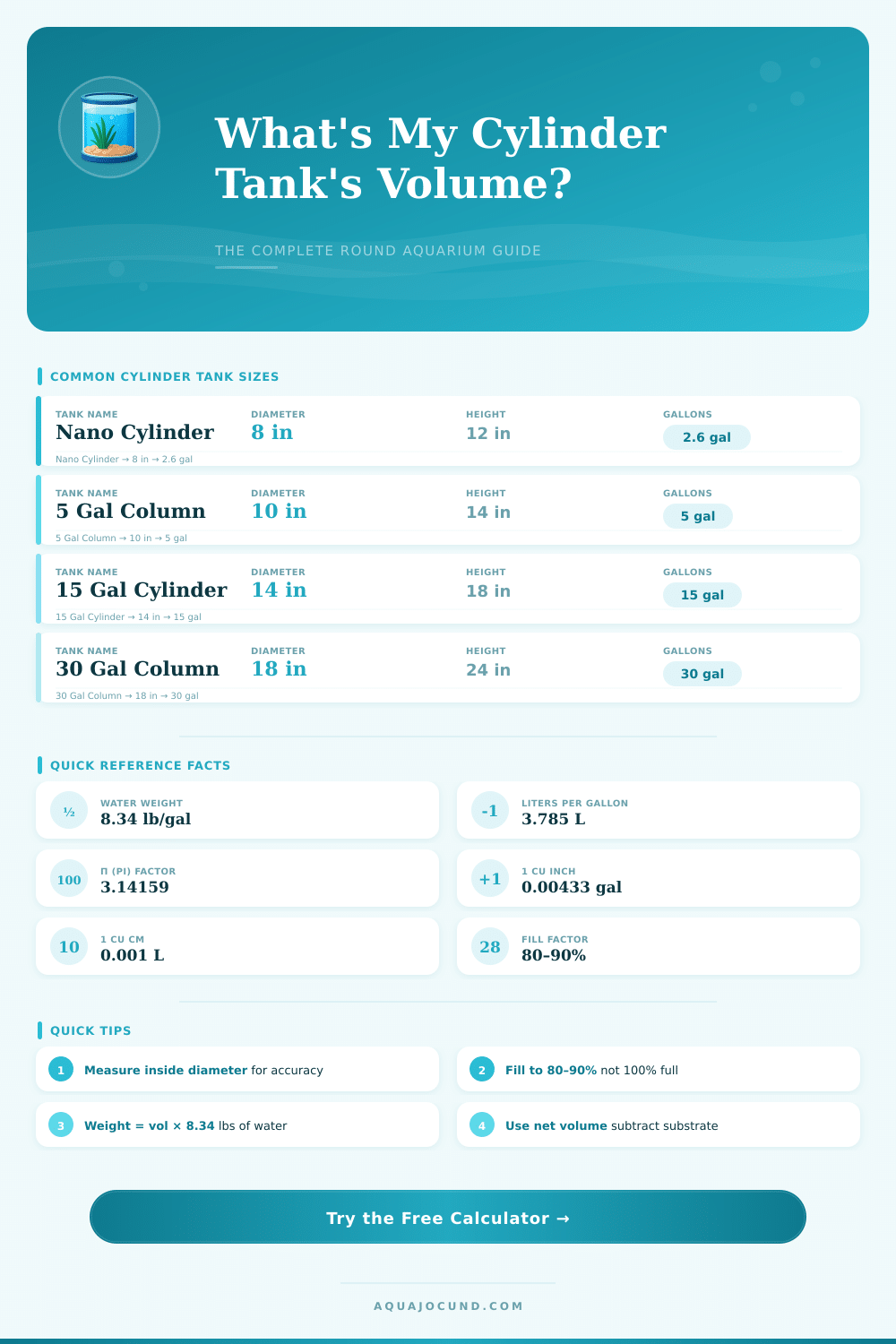
| Tank Name | Diameter | Height | Gross Volume (Gal) | Gross Volume (L) | At 90% Fill (Gal) |
|---|---|---|---|---|---|
| Nano Cylinder | 8 in / 20 cm | 12 in / 30 cm | 2.6 gal | 9.8 L | 2.3 gal |
| 5 Gal Column | 10 in / 25 cm | 14 in / 36 cm | 4.7 gal | 17.8 L | 4.3 gal |
| 10 Gal Round | 12 in / 30 cm | 18 in / 46 cm | 8.8 gal | 33.3 L | 7.9 gal |
| 15 Gal Cylinder | 14 in / 36 cm | 20 in / 51 cm | 13.4 gal | 50.7 L | 12.1 gal |
| 20 Gal Round | 16 in / 41 cm | 22 in / 56 cm | 19.4 gal | 73.4 L | 17.5 gal |
| 30 Gal Column | 18 in / 46 cm | 24 in / 61 cm | 26.5 gal | 100.3 L | 23.9 gal |
| 50 Gal Cylinder | 20 in / 51 cm | 30 in / 76 cm | 40.8 gal | 154.4 L | 36.7 gal |
| 75 Gal Tower | 24 in / 61 cm | 36 in / 91 cm | 73.2 gal | 277.0 L | 65.9 gal |
| 100 Gal Column | 28 in / 71 cm | 40 in / 102 cm | 107.5 gal | 406.9 L | 96.8 gal |
| 125 Gal Display | 30 in / 76 cm | 48 in / 122 cm | 147.3 gal | 557.5 L | 132.6 gal |
| Tank Volume | Volume (L) | Heater Wattage | For Cold Rooms (+10°F raise) | Circulation Rate (GPH) |
|---|---|---|---|---|
| Under 5 gal | Under 19 L | 25–50 W | 50–75 W | 50–100 GPH |
| 5–10 gal | 19–38 L | 50–100 W | 100 W | 100–200 GPH |
| 10–20 gal | 38–76 L | 100–150 W | 150–200 W | 200–400 GPH |
| 20–30 gal | 76–114 L | 150–200 W | 200–250 W | 300–600 GPH |
| 30–55 gal | 114–208 L | 200–300 W | 300–400 W | 550–1100 GPH |
| 55–75 gal | 208–284 L | 300–400 W | 400–500 W | 750–1500 GPH |
| 75–125 gal | 284–473 L | 400–500 W | 500–600 W | 1000–2500 GPH |
| 125+ gal | 473+ L | 2x 300W | 2x 400W | 2500+ GPH |
| Tank Volume | 2 in Substrate (lbs) | 3 in Substrate (lbs) | 2 in Substrate (kg) | 3 in Substrate (kg) |
|---|---|---|---|---|
| 5 gal / 19 L | ~4 lbs | ~6 lbs | ~1.8 kg | ~2.7 kg |
| 10 gal / 38 L | ~8 lbs | ~12 lbs | ~3.6 kg | ~5.4 kg |
| 15 gal / 57 L | ~11 lbs | ~17 lbs | ~5.0 kg | ~7.7 kg |
| 20 gal / 76 L | ~14 lbs | ~21 lbs | ~6.4 kg | ~9.5 kg |
| 30 gal / 114 L | ~20 lbs | ~30 lbs | ~9.1 kg | ~13.6 kg |
| 50 gal / 189 L | ~32 lbs | ~48 lbs | ~14.5 kg | ~21.8 kg |
| 75 gal / 284 L | ~46 lbs | ~70 lbs | ~20.9 kg | ~31.8 kg |
Count how many water stores your Cylinder Aquarium is not difficult, just know one basic formula. The capacity depends on the area of the round base multiplied by the height of the tank. To find this area one took π and multiply it by the square of the radius.
And what is the radius? Simply, half of the diameter. Like this one measures the diameter of your Aquarium, divide it by two, and already have the radius.
How Much Water Does a Cylinder Aquarium Hold
Of course, not every Aquarium has Cylinder form. For rectangular tanks one uses a whole other method: length multiplied by width and by height. For a cube the task is even easier.
About rolls though? Here one combines diameter and height to get the main numbers. Important to note, two Aquariums with almost the same visible sizes can store really different amounts, depending on their form.
Here the use of the right formula makes the whole difference.
One can easily find the water capacity of a tank, putting its sizes in the formula, made for that particular form. The general method stays same for various types of Aquariums, however the exact math changes according to whether one works with rectangular, bent-front, Cylinder or some other design. Specifically for rolls the math simplfiies to π multiplied by square of radius and by height.
Also half and quarter rolls happen, and they have there own method. The Volume of half-Cylinder tank matches half of π multiplied by square of radius and by height. Quarter-Cylinder use only quarter instead.
Some I know own a quarter-Cylinder Aquarium of around 155 gallons, and a half-Cylinder, that stores almost 105 gallons. If your calculator does not offer a half-Cylinder option, here is a neat trick: double your measures, count as for full roll, later divide the result by two.
Most websites with Aquarium calculators cover not only rolls. They work also for cubes, six-sided and rectangular tanks. The steps are simple: one picks the form, puts in radius and height, picks units (metres, feet, any kind) and everything ends in moments.
The usual conversion is 7.48 American gallons per cubic foot. Recall, that only the water really in the tank affects the final amount.
Knowing the Volume of your Aquarium matters more than simply having some number to guess with. It helps to figure out how much life the tank holds, while the real sizes decide what fish types really can live here. Some Cylinder Aquariums are oversized and huge, we talk about 10 000 gallons for big setups.
Others are small, for instance a 1.5-gallon glass roll, ideal for a salamander. Special stores offer seamless versions, if one wants pure visibility.
Here something useful to recall about Cylinder Aquariums: that curved glass creates some problems. Shy fishes lack the flat walls, where they usually would be able to hide, which matters for nervous species. The form also gives a bad ratio between water surface and whole Volume, something, that no doubt fishesreally mind.
After one found the Volume in cubic units, converting it to gallons or liters is easy. The safest way to estimate the real water capacity of your tank is to measure how much water you use for the first filling.