🌊 Trapezoidal Pond Volume Calculator
Calculate water volume, liner size & fill time for any trapezoidal or irregularly-sloped pond
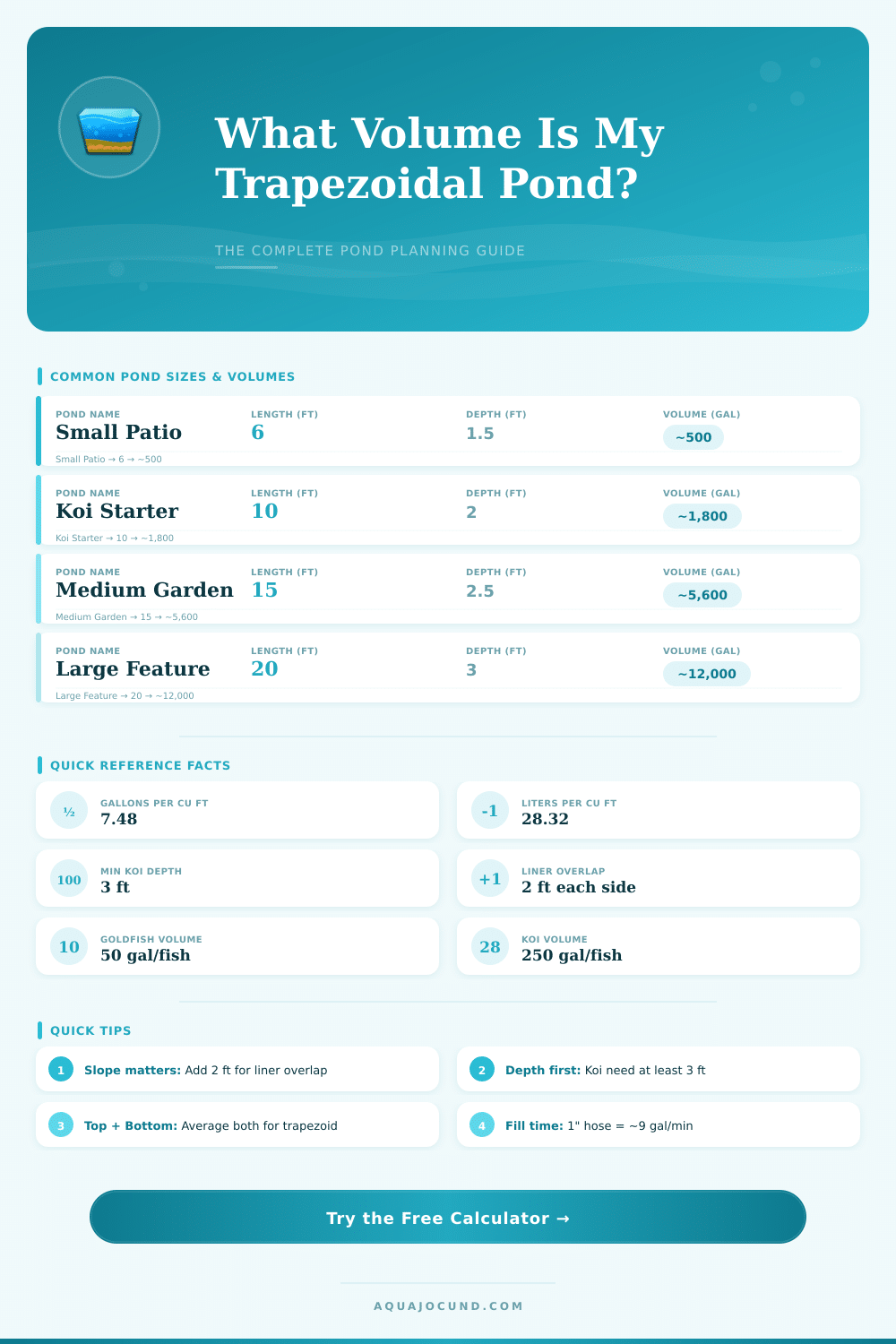
| Pond Type | Top Dims (ft) | Bottom Dims (ft) | Depth (ft) | Volume (gal) | Volume (L) |
|---|---|---|---|---|---|
| Small Patio | 6 x 4 | 4 x 2 | 1.5 | ~500 | ~1,893 |
| Koi Starter | 10 x 6 | 7 x 3 | 2.0 | ~1,800 | ~6,814 |
| Garden Feature | 12 x 8 | 8 x 4 | 2.5 | ~3,600 | ~13,627 |
| Medium Koi | 15 x 10 | 10 x 6 | 3.0 | ~8,100 | ~30,660 |
| Large Koi | 20 x 12 | 14 x 7 | 3.5 | ~16,000 | ~60,567 |
| Wildlife Pond | 14 x 10 | 10 x 6 | 2.0 | ~6,400 | ~24,227 |
| Formal Garden | 16 x 8 | 12 x 5 | 2.5 | ~8,800 | ~33,312 |
| Backyard Feature | 24 x 14 | 18 x 10 | 4.0 | ~36,000 | ~136,275 |
| Application | Recommended Rate | Metric Equivalent | Notes |
|---|---|---|---|
| Pump turnover (koi) | 1x per hour | Liters/hr = vol (L) | Minimum for koi health |
| Pump turnover (goldfish) | 1x per 2 hrs | 0.5x vol/hr | Goldfish are less demanding |
| UV clarifier sizing | 1W per 200 gal | 1W per 757 L | Double for green water issues |
| Waterfall pump | 100 gal/hr per 1in wide | 378 L/hr per 2.5cm | Width of waterfall weir |
| 1" garden hose fill rate | ~9 gal/min | ~34 L/min | Standard residential pressure |
| 3/4" garden hose fill rate | ~6 gal/min | ~23 L/min | Most common hose size |
| Evaporation (summer) | 1/2" – 1" per week | 1.3 – 2.5 cm/wk | Higher in hot, dry climates |
| Minimum koi depth | 3 ft | 0.9 m | Deeper is always better |
| Minimum goldfish depth | 18 in | 0.45 m | Prevents winter freeze-out |
| Wildlife pond shallow zone | 2–6 in | 5–15 cm | For amphibians and birds |
| Shape | Liner Length Formula | Liner Width Formula | Example (10x6x2 ft) |
|---|---|---|---|
| Trapezoid (top dims) | Top Length + (2 x Depth) + (2 x Overlap) | Top Width + (2 x Depth) + (2 x Overlap) | 10+4+4 = 18 ft |
| Rectangle | Length + (2 x Depth) + (2 x Overlap) | Width + (2 x Depth) + (2 x Overlap) | 10+4+4 = 18 ft |
| Round Pond | Diameter + (2 x Depth) + (2 x Overlap) | Same as length | 8+4+4 = 16 ft |
| Irregular | Longest span + (2 x Depth) + (2 x Overlap) | Widest span + (2 x Depth) + (2 x Overlap) | Measure longest axes |
Knowing the exact amount of water in your pool is more important than you might believe. A good calculator for the volume of pools removes the need to guess, you will know exactly how many gallons you have, how big the space actually is and whether you can add more fish without overdoing the density. Many of these tools also show the surface area, the edges of the banks and how big a pump you really need all in the units that suit you.
For a simple rectangular pool the math is fairly easy. Simply measure the length, width and depth in metres then multiply those three values together. Here is the nice part: cubic metres of fresh water almost directly match tons or litres.
How to Calculate Pool Water Volume
So if you want litres, take the length times the width times the depth in metres and then multiply by 1000. Pools with sloped banks or weird shape? Simply estimate the middle depth and split the shape into basic rectangles.
Round pools work a bit differently. The math for the volume of round pools uses 0.8 times length times width times depth. Because it really is round, multiply 3.142 by the square of the radius to get the surface area, then multiply that by the depth.
If you measure in feet and inches instead, recall that cubic feet match 1,728 cubic inches; or about 6.23 gallons. Because 7.48 gallons fill one cubic foot, simply multiply your counted volume in feet by 7.48 to get the gaollns.
For those bigger pools that one measures in acres, average some depth readings to find the middle depth. Multiply that by the area of your pool in feet and you have acre-feet. One acre-foot of water matches around 325,851 gallons.
So if you have a pool of 0.5 acres with a middle depth of 4 feet, that makes 2 acre-feet, or about 651,702 gallons.
When the shape has curves, simply estimate it. Measure the width and length at the top, then the same at the bottom and split the difference between them. Oh, and if you work metric normally but want gallons instead, multiply your cubic metres by 264.172.
There is also a clever method based on salt that works. Add a known amount of salt, measure the level before and after, then use the formula: 120 times the salt in pounds, divided by the difference of parts per thousand. That gives you the volume.
Pools with brooks that flow threw them need to combine both values. The average depth of brooks is around 0.17 feet, about 2 inches or so. For your pump the rule that seems to count is to match it to the volume of the pool, so a pool of 1000 gallons needs flow of 1000 gallons an hour through it, and a pool of 2000 gallonsneeds more.