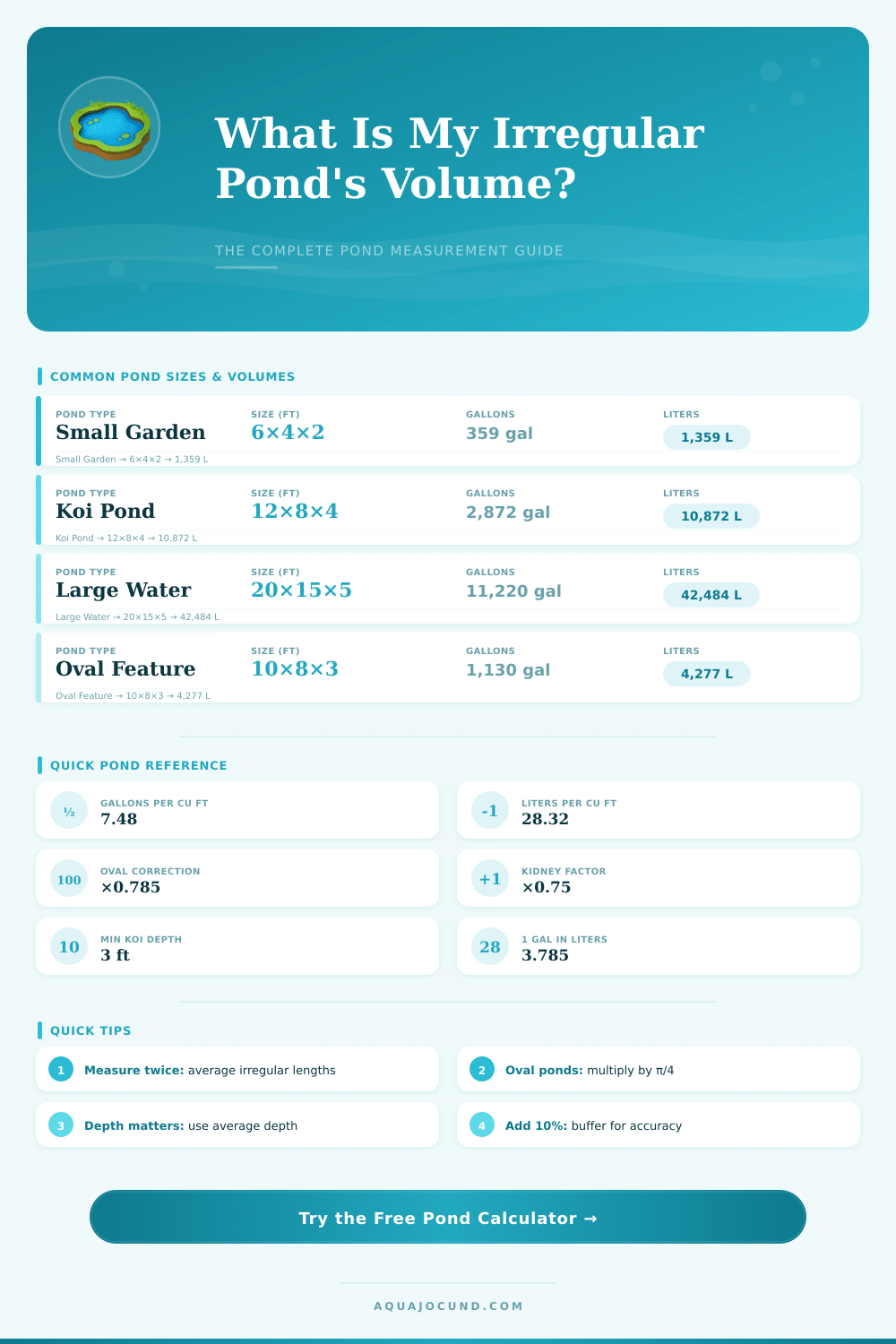
🌊 Irregular Pond Volume Calculator
Calculate the exact water volume of any pond shape — rectangular, oval, kidney, circular & more
| Pond Type | Dimensions (ft) | Shape Factor | Volume (gal) | Volume (L) |
|---|---|---|---|---|
| Patio Mini | 6 × 4 × 1.5 | 1.00 | 269 | 1,018 |
| Small Garden | 8 × 5 × 2 | 1.00 | 599 | 2,268 |
| Oval Feature | 10 × 7 × 2.5 | 0.785 | 1,030 | 3,899 |
| Round Feature | Ø10 × 3 deep | 0.785 | 1,763 | 6,675 |
| Goldfish Pond | 12 × 8 × 3 | 1.00 | 2,154 | 8,155 |
| Koi Starter | 12 × 8 × 3 | 0.785 | 1,691 | 6,401 |
| Kidney Koi | 15 × 10 × 3.5 | 0.75 | 2,956 | 11,189 |
| Large Koi | 20 × 12 × 4 | 1.00 | 7,181 | 27,183 |
| Show Pond | 25 × 16 × 4 | 0.75 | 8,976 | 33,984 |
| Competition Koi | 30 × 20 × 5 | 1.00 | 22,440 | 84,952 |
| Pond Volume | Pond Volume (L) | Min Pump Flow (GPH) | Min Pump Flow (LPH) | Recommended for |
|---|---|---|---|---|
| Up to 500 gal | 1,893 L | 500 GPH | 1,893 LPH | Wildlife / Plants |
| 500–1,000 gal | 3,785 L | 1,000 GPH | 3,785 LPH | Goldfish |
| 1,000–2,000 gal | 7,571 L | 2,000 GPH | 7,571 LPH | Mixed Fish |
| 2,000–5,000 gal | 18,927 L | 5,000 GPH | 18,927 LPH | Koi (lightly stocked) |
| 5,000–10,000 gal | 37,854 L | 10,000 GPH | 37,854 LPH | Koi (fully stocked) |
| 10,000+ gal | 37,854+ L | 20,000+ GPH | 75,708+ LPH | Show / Competition Koi |
| Product / Treatment | Dosing Rate (Imperial) | Dosing Rate (Metric) | Notes |
|---|---|---|---|
| Dechlorinator | 1 tsp per 50 gal | 5 mL per 189 L | Tap water treatment |
| Beneficial Bacteria | 1 oz per 500 gal | 30 mL per 1,893 L | Cycle new ponds |
| Salt (KoiHealth) | 1 lb per 100 gal | 1.2 kg per 379 L | Stress treatment |
| Barley Extract | 1 oz per 1,000 gal | 30 mL per 3,785 L | Algae control |
| Water Clarifier | 1 oz per 250 gal | 30 mL per 946 L | Flocculent |
| Pond Dye | 4 oz per 500,000 gal | 120 mL per 1,893,000 L | Shade / aesthetics |
Knowing how many water enters in your Pond is really important. If you plan to fill it with fishes or buy the right pump, this number about the Volume becomes needed for getting the right result. The good news?
There are several ways to settle this task, and some of them are easier than others.
How to Find the Volume of a Pond
For a rectangular Pond the calculation is simple. Simply multiply the length by the width and by the depth. If you work with metres, you receive cubic metres, and later multiply by thousand to have liters.
When you use feet and inches instead, recall that one cubic foot carries around 6,23 gallons. Everything gets harder when shapes weigh or form is weird, even so commonly you can estimate the middle depth and share the pattern in basic rectangles to ease the task.
Circular Pond follow other rules. Take the radius, square it, and multiply by 3,14 for the surface area. Later, that result multiply by the depth for the whole Volume.
For circular pools there is also a practical shortcut: the Volume one estimate as 0,8 times the diameter times the width times the depth, what spares time.
When the area measures in acres, multiply the surface of the Pond by the middle depth in feet, and you have acre-feet. One acre-foot matches about 325 851 gallons, so take that in mind. For instance, a half-acre Pond with average depth of four feet stores around 651 702 gallons.
To get precise average depth, take measures of some spots around the Pond and average them.
Need to convert cubic metres to gallons? Multiply by 264,172 and done. Online calculators commonly save the day, because they allow you to enter the main length and width, and they automatically give the pattern and the Volume.
More advanced versions even estimate the surface area, the knead about liner and how many capacity has sense for the pump.
Are also clever method using salt, that surprisingly well works if you want to try it. Dissolve a known amount of salt, and measure the focus in front and after. The formula: 120 times the pounds of salt added, divided by the difference in parts for thousand between the readings.
Like this you receive the Volume of the Pond in gallons.
If a brook or fall adds to your Pond, simply add the Volume of the flow to the Pond Volume. According to me, average brook has around 0,17 feet of depth, so around two inches. Because of keeping koi, I noticed that 1000 gallons answer for the first fish, later 300 to 500 extra gallons for every next, assuming that you have good filter that processes three times the whole Volume of the Pond.
Your pump with filter together ideally should push between two and four times thePond Volume, so arrangement of 100 gallons requires pump of 200 to 400 gallons per hour.