💧 Aquarium Filter Flow Rate Calculator
Find the ideal GPH (gallons per hour) or LPH (liters per hour) filter flow rate for your fish tank
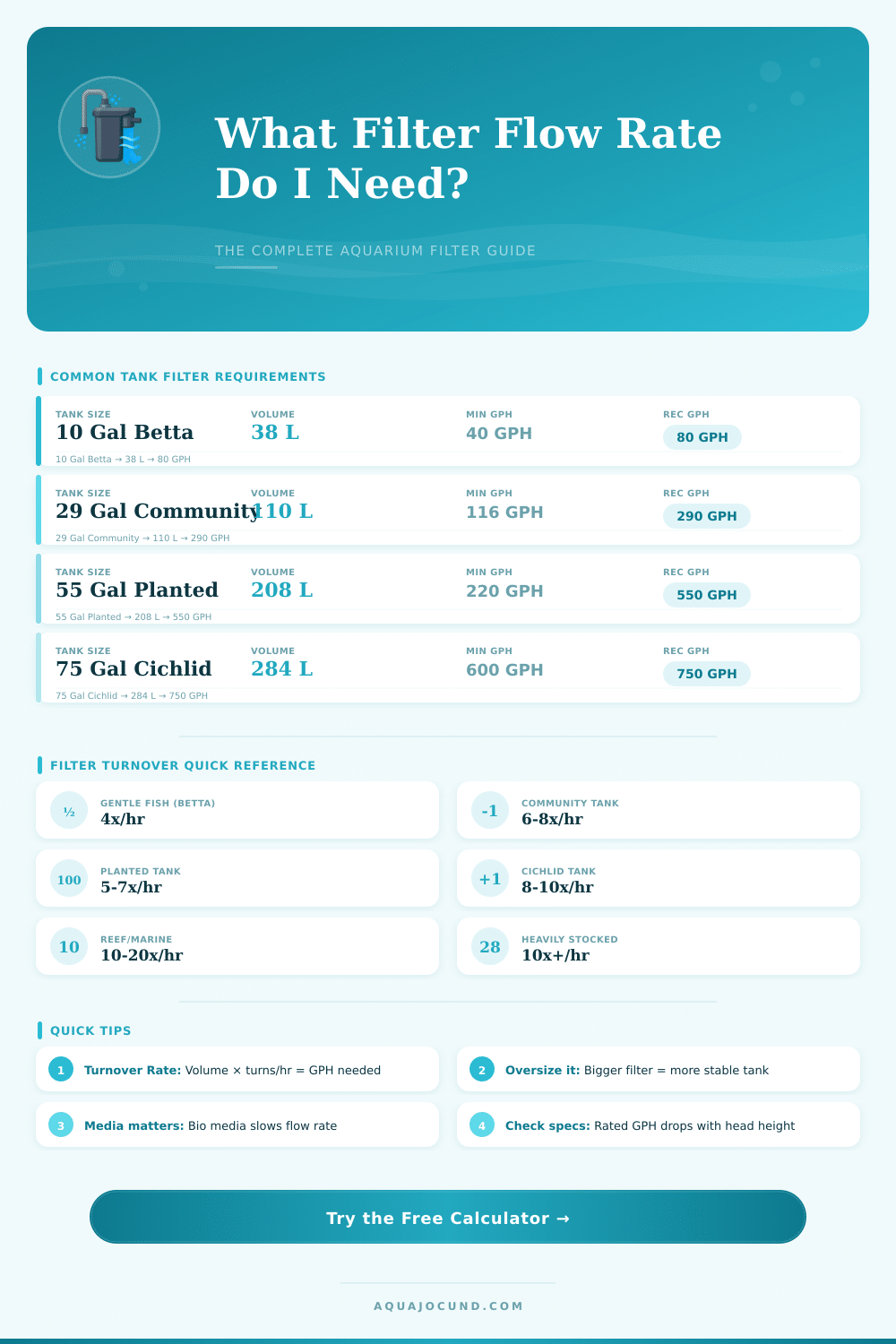
| Tank Type | Min Turnover | Recommended | Max Turnover | Notes |
|---|---|---|---|---|
| Betta Tank | 4x/hr | 4–5x/hr | 5x/hr | Bettas dislike strong current |
| Shrimp / Nano | 4x/hr | 5–6x/hr | 8x/hr | Use pre-filter sponge on intake |
| Planted Tank | 5x/hr | 5–7x/hr | 10x/hr | Gentle flow preserves CO2 |
| Community Fish | 4x/hr | 6–8x/hr | 10x/hr | Most common recommendation |
| Cichlid Tank | 8x/hr | 8–10x/hr | 15x/hr | High waste output needs strong filtration |
| Reef / Marine | 10x/hr | 10–20x/hr | 30x/hr | Powerheads add additional flow |
| Pond / Sump | 2x/hr | 3–5x/hr | 6x/hr | Based on total water volume |
| Tank Name | Dimensions (L×W×H in) | Volume (gal) | Volume (L) | Min GPH | Rec GPH |
|---|---|---|---|---|---|
| Nano 5 Gal | 16×8×10 | 5 | 19 | 20 | 30–40 |
| 10 Gallon | 20×10×12 | 10 | 38 | 40 | 60–80 |
| 20 Gal Long | 30×12×12 | 20 | 76 | 80 | 120–160 |
| 29 Gallon | 30×12×18 | 29 | 110 | 116 | 175–290 |
| 40 Gal Breeder | 36×18×16 | 40 | 151 | 160 | 240–320 |
| 55 Gallon | 48×13×21 | 55 | 208 | 220 | 330–550 |
| 75 Gallon | 48×18×21 | 75 | 284 | 300 | 450–750 |
| 90 Gallon | 48×18×24 | 90 | 341 | 360 | 540–900 |
| 125 Gallon | 72×18×22 | 125 | 473 | 500 | 750–1250 |
| 180 Gallon | 72×24×24 | 180 | 681 | 720 | 1080–1800 |
| Head Height (in) | Head Height (cm) | Approx. Flow Loss | Effective Flow % |
|---|---|---|---|
| 0 in (no lift) | 0 cm | 0% | 100% |
| 6 in | 15 cm | ~5% | ~95% |
| 12 in | 30 cm | ~10% | ~90% |
| 18 in | 46 cm | ~15–20% | ~82% |
| 24 in | 61 cm | ~20–25% | ~77% |
| 36 in | 91 cm | ~30–35% | ~67% |
| 48 in | 122 cm | ~40–50% | ~55% |
Filter manufacturers rate GPH in ideal lab conditions. Real-world use with media loaded, head height, and biological buildup can reduce actual flow by 20–40%. Always select a filter rated at least 20–50% higher than your minimum calculated GPH to ensure stable water quality.
Turnover rate (x/hr) tells you how many times your entire tank volume passes through the filter per hour. A 50-gallon tank with a 6x/hr turnover needs a 300 GPH filter. However, for reef tanks, additional powerheads provide circulation that is separate from filtration flow — always calculate filter GPH and circulation GPH separately.
Get good flow for your Aquarium Filter is one of those tasks that really matters. Good flow helps the Filter do its main role well which means that the Aquarium stays cleaner for more time and that the fish live in healthier surroundings.
One practical tip is pick a Filter with flow at least four times the Aquarium volume. Like this for a 30-gallon Aquarium works well something around 200 gallons per hour. For a 100-liter Aquarium the best Filter flow sits between 200 and 300 liters per hour.
How Much Flow Does Your Aquarium Filter Need
When the Aquarium has high load or aquascape, that value jumps to 400-500 liters per hour. In such a situation the stated capacity of the Filter really should reach 800-1000 liters per hour.
Here comes the hard part. Filters lose their flow over time. The media blocks the ways, and the tubes grow the resistance.
That tends to reduce the flow by 50-60%, what leaves the Aquarium with only double cycle, while it raelly needs four times. Exactly because of that some fish keepers push to buy a Filter rated for 8 to 10 times the Aquarium volume. For typical freshwater Aquariums 10-times flow per hour is a good target value.
For a 10-gallon Aquarium that means a 100 GPH Filter.
A big myth that goes around is that a Filter rated at 600 GPH can handle double the fish load than one at 300 GPH. That does not work like this simply. The capacity of the Filter is just as important as the flow, maybe even moor.
The real flow of a Filter almost always is weaker than the factory statement. The less space between the upper part of the unit and the surface of the Aquarium, the more well it flows and the more closely it gets to the stated number. For instance, the Aqua One Aquas 1250 states a max of 1400 liters per hour, but in real use it reaches only around 900 liters per hour.
Too strong flow can stress the fish. For instance, axolotls and fry of mollies do not well handle strong flows. A little turn down of the setting will not hurt the Filter quality a lot, and the fish probably will feel more comfortable.
A spray bar is another option. It spreads the water through several little holes instead of pushing it through one opening. Some units also come with a built-in valve for controlling the flow.
Using several Filters gives safety through backup. If one of them fails, the others keep working. But five bare Filters without media simply would create flow without real cleaning.
The whole Aquarium volume should go through the Filter many times per hour, but going toofast removes too much water movement, which is not always a good thing.