🐟 Koi Pond Volume Calculator
Calculate your koi pond volume in gallons or liters — includes filter sizing, stocking capacity & liner estimates
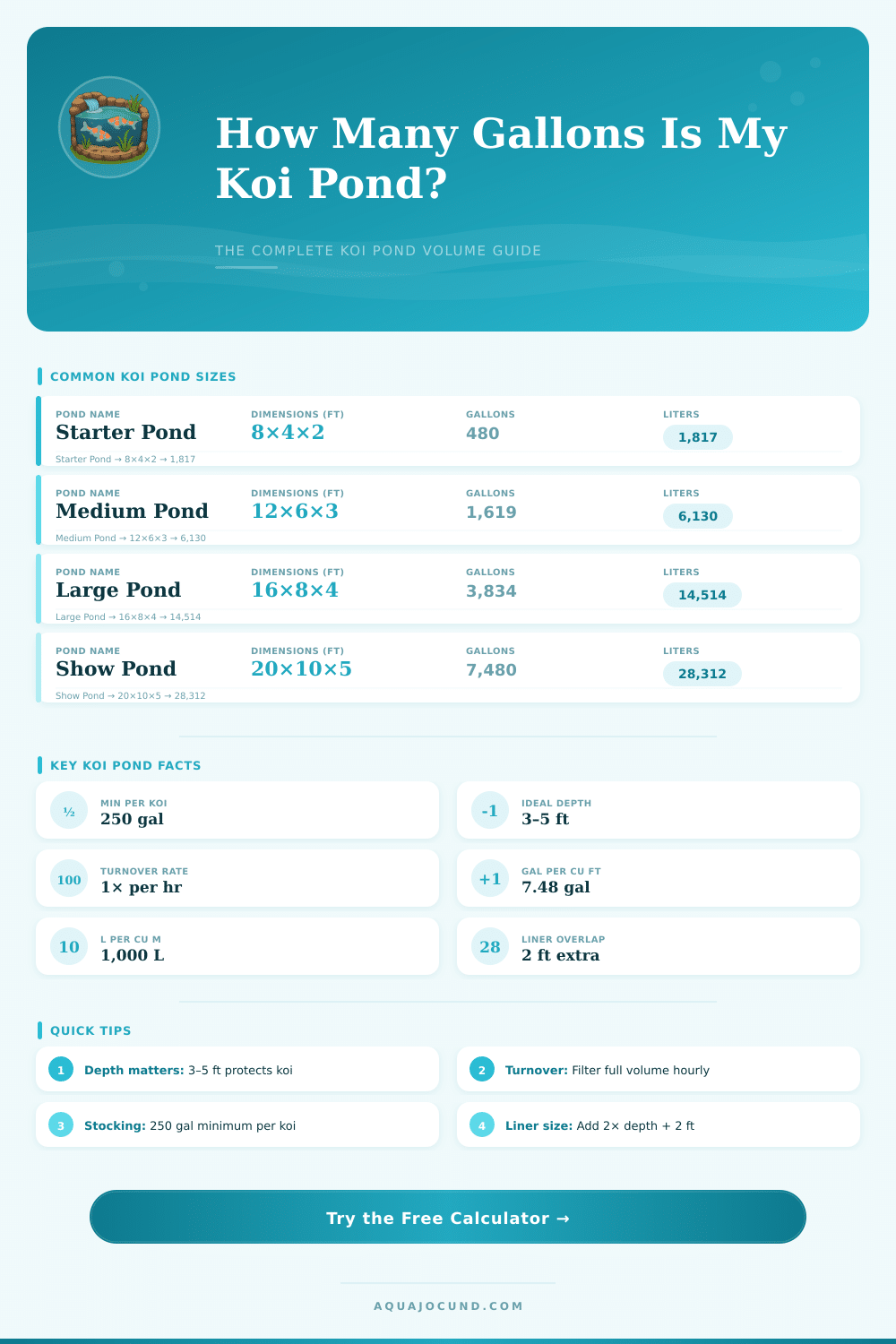
| Pond Name | Dimensions (ft) | Volume (gal) | Volume (L) | Max Koi |
|---|---|---|---|---|
| Starter Pond | 8 × 4 × 2 | 479 | 1,814 | 1–2 |
| Small Garden | 10 × 5 × 2.5 | 936 | 3,543 | 2–3 |
| Medium Pond | 12 × 6 × 3 | 1,619 | 6,130 | 4–6 |
| Large Pond | 16 × 8 × 4 | 3,834 | 14,514 | 8–15 |
| Show Pond | 20 × 10 × 5 | 7,480 | 28,312 | 15–25 |
| Round Small | 8ft dia × 3ft | 1,130 | 4,277 | 3–4 |
| Round Large | 12ft dia × 4ft | 3,393 | 12,842 | 7–12 |
| Raised Planter | 6 × 4 × 2 | 359 | 1,360 | 0–1 |
| Pond Volume (gal) | Min Pump GPH | Filter Size | UV Wattage | Koi Capacity |
|---|---|---|---|---|
| 250–500 | 250–500 | Small Pressure | 5W | 1–2 |
| 500–1,000 | 500–1,000 | Medium Pressure | 9–13W | 2–4 |
| 1,000–2,000 | 1,000–2,000 | Large Pressure | 18–25W | 4–8 |
| 2,000–5,000 | 2,000–5,000 | Gravity / Bead | 40–55W | 8–20 |
| 5,000–10,000 | 5,000–10,000 | Bead / Drum | 80–110W | 20–40 |
| 10,000+ | 10,000+ | Drum / Multi-chamber | 120W+ | 40+ |
| Pond L × W × D (ft) | Liner Length (ft) | Liner Width (ft) | Approx Area (sq ft) |
|---|---|---|---|
| 8 × 4 × 2 | 14 | 10 | 140 |
| 10 × 5 × 2.5 | 17 | 12 | 204 |
| 12 × 6 × 3 | 20 | 14 | 280 |
| 16 × 8 × 4 | 26 | 18 | 468 |
| 20 × 10 × 5 | 32 | 22 | 704 |
Figuring out the volume of a pool matters a lot. A calculator for pond volume helps to estimate how many gallons of water it can store, what is its size and even how many fish one can keep. Some such tools also show the surface area, size of the surface and minimal size of recommended pumps in various units.
For basic rectangular or square pools the calculation is easy. One multiplies the length by the width and depth. When one measures in metres, one multiplies them to get cubic metres.
How to Calculate Pool Volume
Those cubic metres match also to tons or liters of fresh water. To get liters, one multiplies the length in metres by width in metres by depth in metres then multiplies by 1000. For feet and inches, one cubic foot matches 1 728 cubic inches or around 6.23 gallons.
Round pools need a bit different formula. Volume of a round pool one counts by 0.8 times the length times the width times the depth. One can use also the radius.
One multiplies teh radius by itself, then by 3.14 to get the surface area. In round pools, 3.142 times the square of the radius gives the surface area, which one then multiplies by the depth.
For pools with sloping sides or odd forms, one estimates the average depth. One splits the area into simple rectangles to ease the task. One measures the depth in several spots and averages them.
Volume in acre-feet simply is the area of the pool in acres multiplied by the average depth in feet. One acre-foot of water matches 325 851 gallons. Like this, a pool of 0.5 acres with average depth of 4 feet would have 2 acre-feet ore 651 702 gallons.
To convert cubic metres to gallons, one multiplies the volume by 264.172. Like this a pool with 1.884 cubic metres would store around 498 gallons.
Pools with flowing waters and streams need a bit more attention. Volume of the stream plus volume of the basin matches the whole number of gallons. Average depth of most streams is around 0.17 feet, which describes roughly 2 inches.
During measurement of a pool, if the sides are straight without shelves, the dimensions give quite a precise number. But when one adds rocks and grit, the real water volume shrinks a bit.
There is even a clever way using salt. One adds a known amount of salt in pounds, measures the salt level before and after, then puts the difference in a formula. The formula is 120 times the added salt in pounds, divided by the difference between after and before salinity in parts per thousand.
It gives a trulyprecise reading of the volume.