
Platies are an “easy” beginner fish species. Unfortunatly, if you don’t know much about platy biology, they can drive you crazy when trying to breed them. You might end up putting several white and/or orange platies in a tank, feed them bloodworms and flakes, and question why you aren’t seeing more of them.
It’s almost always because you don’t know male versus female platies. Unlike guppies, whose tails makes their gender easy to see, platies look the same at first. Look carefuly.
For those of you who likes to keep your fish together or breed them, knowing sex of your fish can help. Platys are livebearing species, females retain sperm for up to several months, then release free swimming fry. You may end up breeding more fish then your tank can hold.
You might also pair up incompatible genders if you don’t know the sex of your platy. Once you know where to look, sexes is quite easy to distinguish. It is biology, not magic.
How To Tell Male And Female Platies Apart
Why Platies Are Hard to Breed
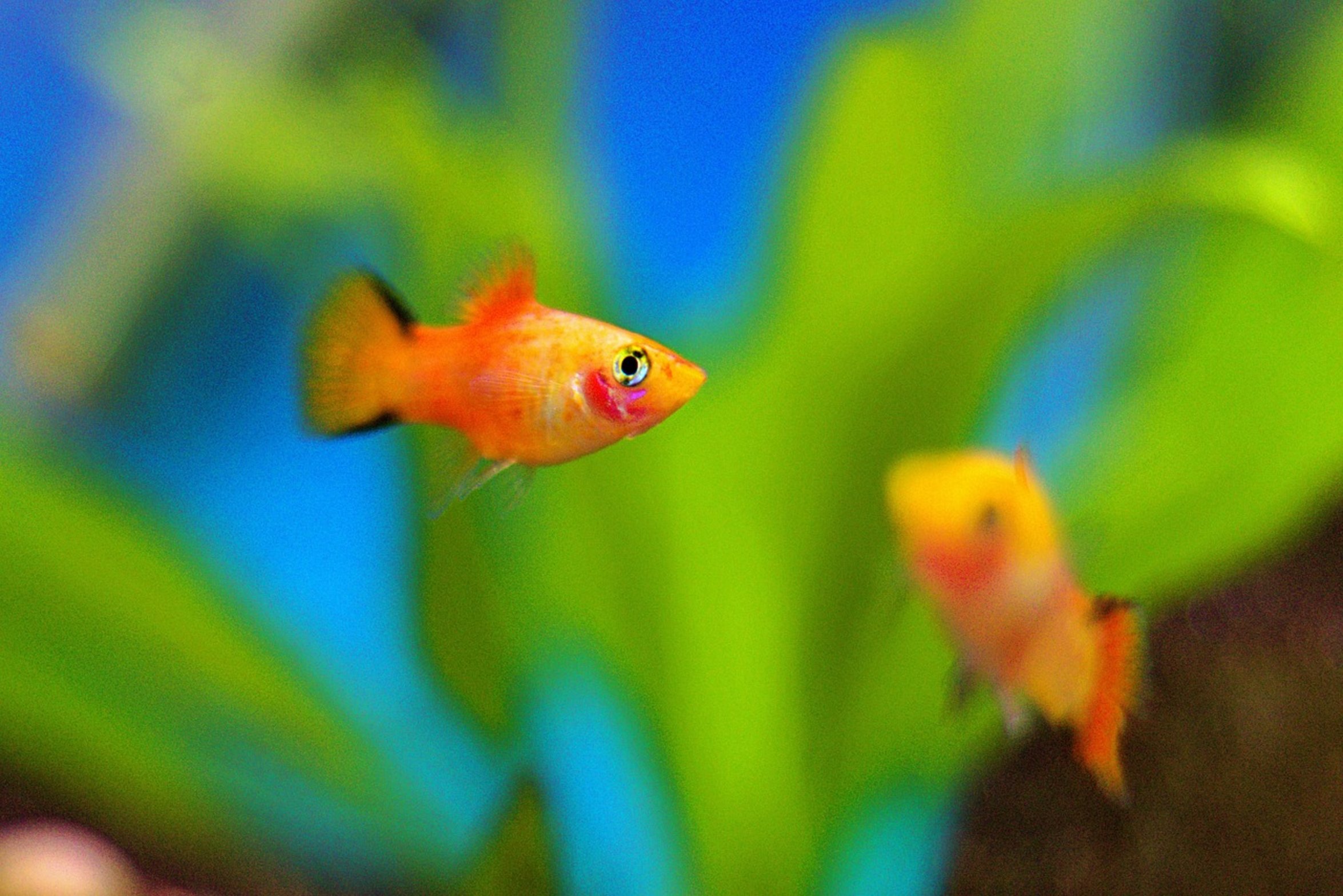
One of the quickest tells are the anal fin. The anal fin is right below the fish (behind the abdomen). In males, the anal fin become what is known as a gonopodium, which is a long, thin, spear-like structure.
Picture a ray coming out back of the fish. That’s the gonopodium. It’s used by male to deposit his sperm onto the female during mating time.
It’s quite unlike typical fan-shape anal fin in females. They retain their large, wide, triangular anal fin. For example, even though there is many different species or varieties of platy, Red Wagtail has a similar anal fin shape.
So does Sun Moon Platy. Basically, if it resemble a needle, its a male. If it look more like a fan, its a female.
Identifying the Anal Fin
Another method are to identify the sex by body shape. Females have wider bodies than do males. Since they will carry fry around in their body, they must has room for that, so they has more body width.
Also, if she’s with fry, she’ll be carrying it in her belly, which make her abdomen puffy. So behind the gill area, there will be this boxiness. Males are sleek and narrow (to chase mates better).
It’s a pretty significant size disparity between males and females. An adult male might be only half the length or even less than an adult female, and much lighter. So if you’re seeing a rounded up fish that’s plump, chances is good it’s a female.
Checking Body Shape
A third check are the tail fins. This one isn’t quite as reliable as body shape or anal fin. Generally speaking, females will has less elaborate tail fins than males.
That’s all dependent off what strain it is and how long it has been inbred. Some selectively bred females can have huge, show-quality tails that rival or exceed the males in size. So, don’t rely solely on tail shape.
Use it as a secondary clue, something to support what you already know. The tail can be misleading based off lineage. The anal fin doesn’t lie.
Evaluating Tail Fins
If you want to determine sex of your juvenile fish, age makes that difficult. Fingerling platies (very small fry) is indistinguishable by gender. They don’t possess different shaped anal fins yet.
Their bodies also hasn’t grown to be distinctly male/female either. This doesn’t happen until after three to four months. So again, be patient.
Don’t try to determine the sex of a newborn. Let them grow a couple of centimeters first. At this point, they’ll start to get their body shape.
Determining Sex of Juveniles
They will also starts growing the gonopodium. These characteristics explain away what was before a mystery. Do not guess by color, which can differs among members of the same species.
It’s about anatomy. And it’s all pretty straightforward: body contour, tail fin shape, degree of sexual maturity. Seeing those cues, you can begin to read your tank with greater clarity.
And you’ll understand more about how that big female and that little male fits into the system.
