Ambient Room Temperature Offset Calculator
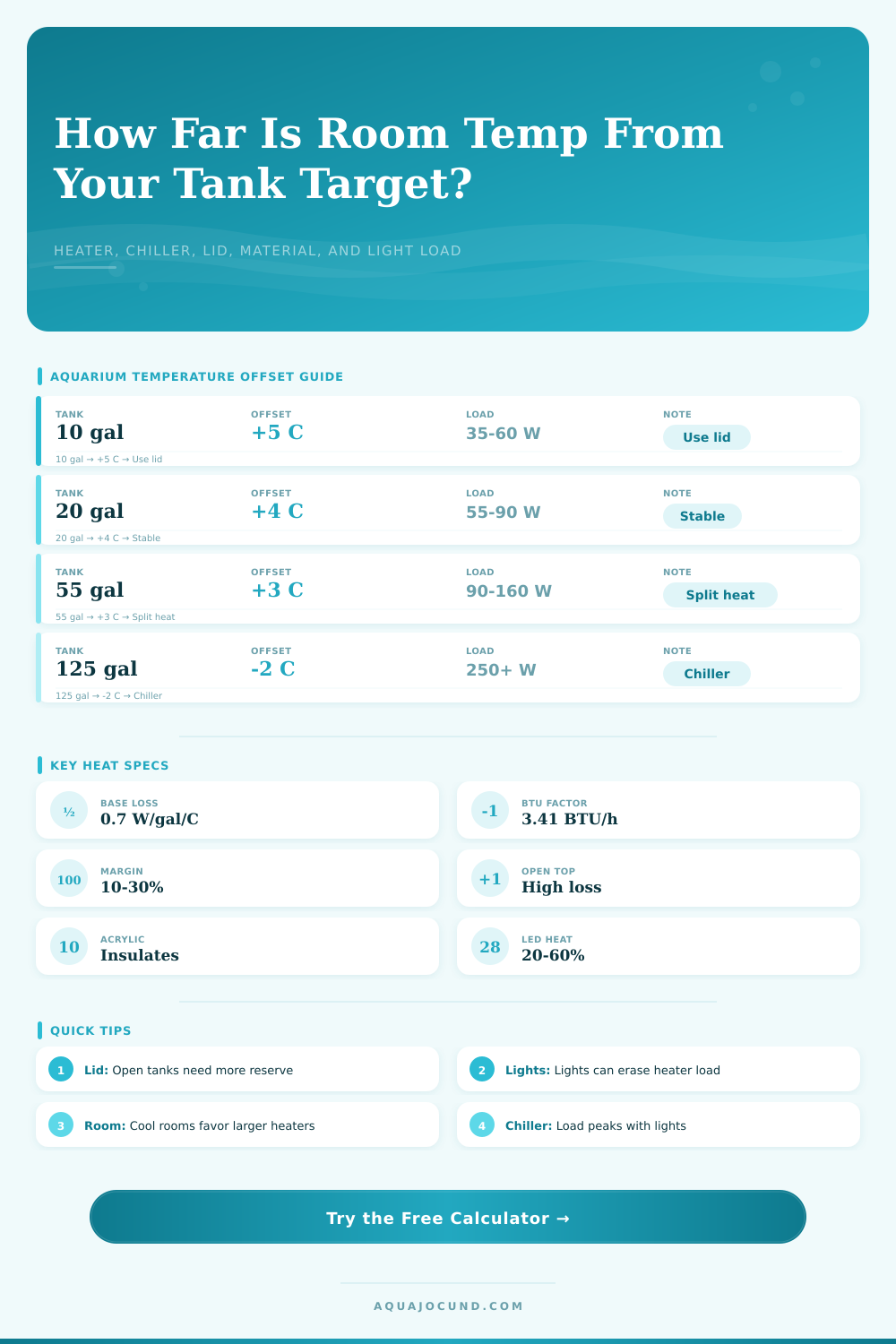
Estimate the aquarium heater or chiller load created by room temperature, tank volume, cover type, material, and light heat.
Temperature Offset Results
| Material / Setup | Loss Factor | Best Use | Offset Note |
|---|---|---|---|
| Rimless or thin glass | 1.12 | Nanos and shallow tanks | Fastest room coupling |
| Standard glass aquarium | 1.00 | Most freshwater displays | Baseline estimate |
| Thick glass display | 0.94 | Large framed aquariums | Slightly slower swings |
| Acrylic aquarium | 0.82 | Large warm or cool systems | Better insulation than glass |
| Back and sides insulated | 0.70 | Fish room racks | Less heater cycling |
| Cabinet sump system | 1.18 | Reef tanks with sump gear | Extra exposed water and plumbing |
| Top Condition | Loss Factor | Evaporation Effect | When It Matters |
|---|---|---|---|
| Open top | 1.35 | High cooling and water loss | Warm reef, rimless planted tanks |
| Mesh screen lid | 1.18 | Moderate evaporation | Jump-prone fish and reef tanks |
| Glass or polycarbonate lid | 0.90 | Reduced evaporation | Heated freshwater tanks |
| Enclosed canopy | 0.98 | Lower evap, trapped light heat | Strong lights over displays |
| Insulated night cover | 0.68 | Lowest overnight loss | Basement tanks and outdoor rooms |
| Scenario | Volume | Room vs Target | Usual Equipment Range |
|---|---|---|---|
| Betta or hospital nano | 5-10 gal / 19-38 L | +4 to +8°C | 25-75 W heater |
| Planted community tank | 20-40 gal / 76-151 L | +2 to +5°C | 75-150 W heater |
| Large acrylic display | 75-125 gal / 284-473 L | +1 to +4°C | 150-300 W heater |
| Warm reef under strong LED | 40-125 gal / 151-473 L | -1 to +3°C | Fan or chiller check |
| Summer room cooler tank | 10-55 gal / 38-208 L | -2 to -5°C | 100-500 W cooling load |
If you’re fighting physics, you might think that seventy-eight degree water feels cool because the room temperature is at seventy degrees; then you go over to the thermometer and realize… It’s realy seventy-eight.
That gap between the water and the air (ambient) is what I call the ambient offset and it determine what equipment you need. When weather conditions change, most hobbyist only heat their tanks based off volume and thus fail miserably. Once you know your specific situation, the calculator do all the math and removes the guesswork of whether you need to heat or cool.
How to Choose the Right Heater or Cooler
Glass isn’t an impenetrable barrier, and water doesn’t retain heat as well than air. If your room temperature is different from your target temperature then energy moves between them. Your tank will gain or lose heat depending in whether the room is warmer or cooler than your target temperature. How quickly this occurs depend on how your tank was built.
Tanks made out of acrylic hold their temperature more stubbornely better than thin glass. They insulate better. A thinner glass tank lose heat more easy and also gains it more easily. It needs a heater that cycle more often to help it stay in balance. That’s important for keeping fry healthy or corals stable.
Heat loss is greatly affected by the lid. Evaporation cause rapid loss of heat from an open top. Bare-top planted tanks frequently require more watts compared to covered tanks. A glass lid or enclosed canopy slow down heat exchange and traps moisture inside the tank.
But that’s a two-edged sword. In winter, that’s going to save you some energy. And in summer, depending on how powerful your lighting is, that same canopy can make the tank into an oven. According to reference table, a mesh screen puts you right in the middle while an insulated cover lower the amount lost. Depending on your species and season, you’ve got to pick between ventilation vs. Stability.
Many overlook complication of lighting. LED lights produce heat (waste). That heat get radiated into the tank. In a cold room, this free heat may make up for a big heater. In a warm room, it’s the reason you have a chiller running all the time. Not only do you have to consider the draw on the wall, but also actual wattage near the water. The remote driver helps, but still that light will hit the surface and move energy. The tool factor in your photoperiod, which will smooth out the heat load with peaks and valleys, then calculates the daily average.
You also have to consider amount of heat being generated by equipment. Protein skimmers, siphons, and submerged pumps converts electricity to warmth. Even a small nano tank with a single power head could of generate five watts of continuous heat. In a large reef system, all that furnitures can be surprising. Enter this number of watts into the calculator to tell it how much additional warmth to add to the chiller burden (or remove from the heater load). It’s all about net balance.
Finally, always have a cushion. It’s never going to be the same. Temperature changes overnight. Sun in the day drives it up. Keeping things running at one hundred percent capacity all the time kill the equipment. Have a reserve of maybe ten to thirty percent. Large systems should also have redundancy. If you’ve got two smaller heaters, they’ll fail more gracefully than one big unit.
Sizing correctly mean understanding the offset. The only way to verify that is to let a thermometer run through a full day cycle. The difference between tank and room shows your aquarium’s climate. Don’t guess, close it preciseley.