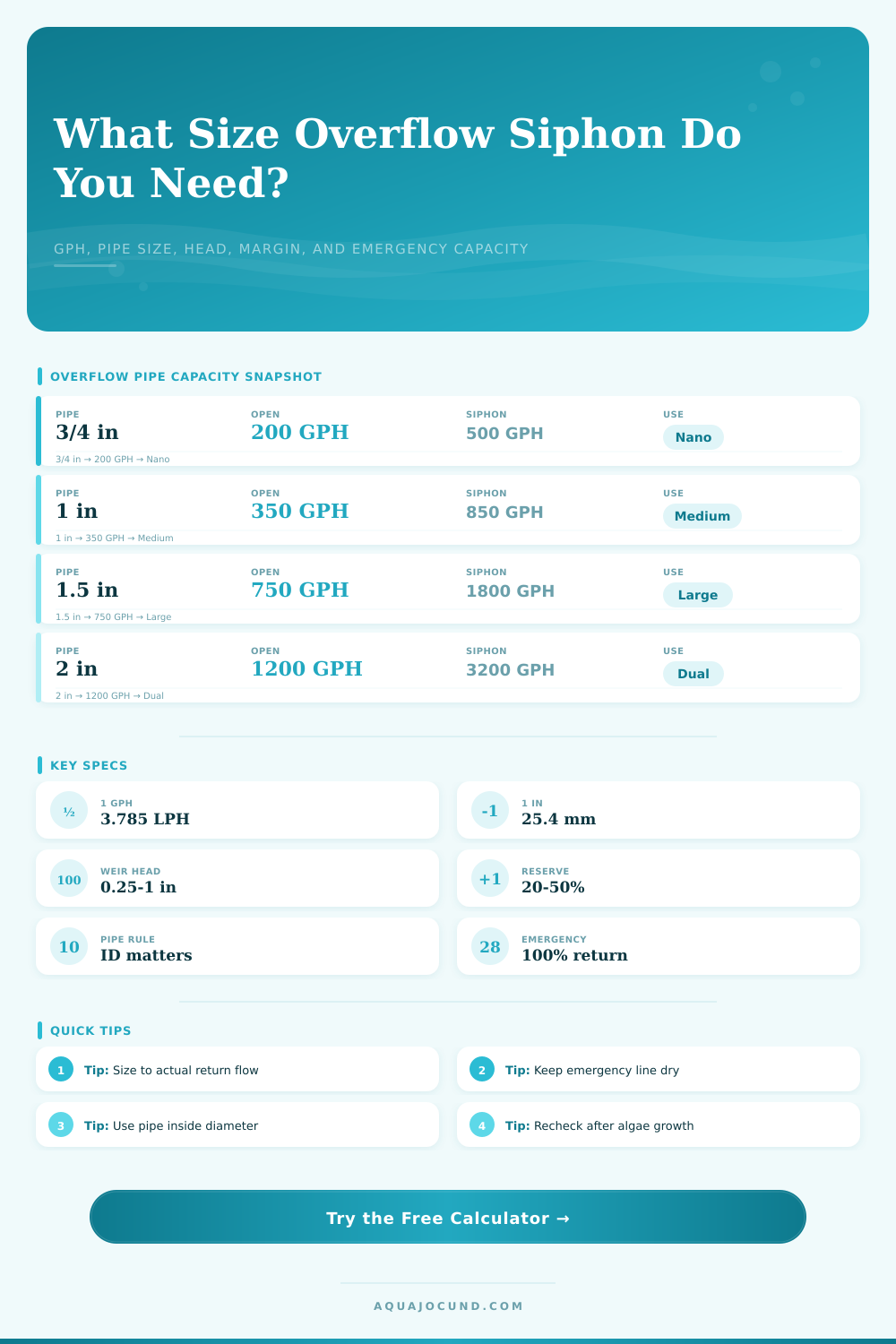
🌊 Overflow Box Siphon Size Calculator
Estimate overflow GPH, pipe diameter capacity, weir limit, head height effect, sump return flow margin, and emergency drain capacity.
✅ Overflow Sizing Breakdown
| Drain Style | Normal Operating Channel | Emergency Expectation | Calculator Treatment |
|---|---|---|---|
| Hang-on-back U-tube siphon | U-tube siphon through a box | Limited unless a second tube or standpipe exists | Siphon capacity derated for trapped air and box restriction |
| Single open standpipe | Air and water share one drain | No independent emergency unless entered separately | Open-channel flow is treated as a partial pipe capacity |
| Herbie full siphon | One tuned full siphon | One open emergency drain should pass all return flow | Main line uses siphon flow; emergency uses open-channel flow |
| BeanAnimal system | Full siphon plus open channel | Separate dry emergency drain | Usable flow includes a small open-channel assist |
| Dual overflow system | Two boxes or two main drains | Emergency capacity should still cover return flow | Main and emergency counts multiply pipe capacity |
| Pipe Size | Inside Diameter | Typical Open Channel | Typical Full Siphon |
|---|---|---|---|
| 1/2 in PVC | 0.622 in / 15.8 mm | 90-140 GPH | 220-380 GPH |
| 3/4 in PVC | 0.824 in / 20.9 mm | 160-260 GPH | 420-700 GPH |
| 1 in PVC | 1.049 in / 26.6 mm | 300-450 GPH | 750-1150 GPH |
| 1-1/4 in PVC | 1.380 in / 35.1 mm | 470-700 GPH | 1250-1900 GPH |
| 1-1/2 in PVC | 1.610 in / 40.9 mm | 650-950 GPH | 1700-2600 GPH |
| 2 in PVC | 2.067 in / 52.5 mm | 1100-1600 GPH | 3000-4600 GPH |
| Common Tank | Dimensions | Display Volume | Typical Return Flow |
|---|---|---|---|
| 20 Long | 30 × 12 × 12 in / 76 × 30 × 30 cm | 18-20 gal / 68-76 L | 120-220 GPH / 450-830 LPH |
| 40 Breeder | 36 × 18 × 16 in / 91 × 46 × 41 cm | 38-40 gal / 144-151 L | 250-450 GPH / 950-1700 LPH |
| 75 Gallon | 48 × 18 × 21 in / 122 × 46 × 53 cm | 70-75 gal / 265-284 L | 350-750 GPH / 1325-2840 LPH |
| 125 Gallon | 72 × 18 × 21 in / 183 × 46 × 53 cm | 118-125 gal / 447-473 L | 600-1100 GPH / 2270-4160 LPH |
| 180 Gallon | 72 × 24 × 24 in / 183 × 61 × 61 cm | 170-180 gal / 644-681 L | 900-1600 GPH / 3410-6060 LPH |
| Overflow Limit | What Controls It | Calculation Signal | Practical Check |
|---|---|---|---|
| Pipe bore | Inside diameter and head height | Area × square root of head | Upsize when margin is below 20% |
| Air entrainment | Drain style and standpipe tuning | Open-channel derate factor | Listen for flushing or surging |
| Overflow weir | Linear tooth length and water rise | Rectangular weir equation | Keep normal rise under about 1 in |
| Tooth slots | Total open area through the comb | Velocity through open slots | Clean algae before it halves area |
| Emergency line | Dry drain count and diameter | Emergency flow divided by return flow | Test with main siphon blocked |
I’m sure you’ve experienced the panic of a slow leak. It is not the sudden and dramatic crack in a glass panel. I’m talking about when you look into your display tank and notice water level has dropped below height of your return pump. It isn’t keeping pace with the siphon churning and bubbling away. You’re waiting for it to catch back up, but it’s just not happening.
That overflow box. Which is meant to be the protector of your aquarium… Are frequently the weakest link in the plumbing chain. When most people have their tanks built, they use whatever PVC comes out of bucket first, because plumbing is seen as an afterthought. Don’t be like that.
## How to Stop Water Leaks in Your Fish Tank
The problem with all this is that your pump box rating doesn’t mean a thing in terms of water. Sure, maybe manufacturer rates it for ten hundred gallons per hour, but before it gets into the pipe there is friction killing the flow. Dirty filter media, every inch of vertical lift, every elbow, they will all reduces it. That’s what this page’s calculator does: it allows you to close that gap between what your return flow actualy is vs what the physics of your drain line can support. Most folks lose their water because they don’t realize they has to consider both the pipe diameter and head height combined. A siphon is only as strong as its diameter and gravity pulling it down.
Now let’s look at the weir. The weir is the lip that water spills over and into the drain. And in most designs, the weir is the bottleneck, not the pipe. What happens is, as long as the water never gets higher than teeth on the weir, more water will go through but only up to a point. It’s an unforgiving bit of math. As the water get higher over the weir teeth, the flow goes up, but much more quickly. This continues until the pipe can’t take anymore. Then, it just keeps getting higher and higher until it spills over top of the overflow box. And that’s when you start praying.
The tool above checks if the water rise and weir length can actualy handle the amount of water your pump is trying to move.
Another easy pitfall is pipe size. What’s that? Nominal size lies. You know what I’m talking about, a one-inch PVC pipe isn’t actualy an inch in diameter. It is more like one inch and five thirty-seconds. And that’s important if you’re trying to push thousands of gallons through it. The capacity calculation in this calculator are based off the real inside diameter.
And it also considers your plumbing profile. A nice smooth sweep in PVC moves water much more quickly than a tangle of sharp ninety-degree elbows in corrugated hose. Flexible tubing for returns? Expect to see a dramatic reduction in efficiency.
A Herbie or a BeanAnimal system relies on a main siphon to carry ninety percent of the flow. That’s because a Herbie or a BeanAnimal depends on their main siphon to carry the bulk of water flow. And when the main siphon fails, all that flow has to move through the emergency line. This typically happens if there is a power failure or an air bubble gets trapped in the siphon tube. Can it do so? Does it have enough diameter to hold full GPH of your return pump? Because if not, your main drain can’t help it out. Your emergency pipe has to take care of everything by itself. The calculator specifically test for this. If your emergency pipe can’t hold the full GPH of your return pump, then your tank isn’t safe.
The overflow capacity will decrease because the algae-choke slot reduces the amount of water that can pass through. What used to be a nice big opening becomes more like a narrow straw. Why is this such a big deal? Because you’re not just planning for this moment in time. You’re planning for six months from now… when the pumps loses their prime and the combs gets slimy. Having a twenty to thirty percent reserve isn’t optional… it’s insurance against the eventual wearing down of your furnitures.
An overflow is more physics than plumbing. The water will take the route of least resistance. But it will also flow through if there is no other path, unless the resistance is too high. Design your overflow so that the three variables, the pipe size, the weir length, and the head height, is all part of one system.
An overflow doesn’t have to be loud or fail. It’s a little thing. But it matters. If you lose power, you don’t want to listen for bubbles. You would of wanted to know that the water has somewhere else to flow. And that peace of mind makes every minute spent figuring it out worthwhile.