🧽 Sponge Filter Count Per Tank Calculator
Estimate how many sponge filters a tank needs from water volume, stocking load, sponge rating, turnover flow, air pump capacity, foam size, and bio surface.
✅ Sponge Filter Count Results
| Sponge profile | Conservative rating | Air per sponge | Loaded flow guide | Foam volume | Use in calculator |
|---|---|---|---|---|---|
| Nano single | 5 gal / 19 L | 0.4 L/min | 10-18 gph | 0.15 L | Betta, shrimp, and hospital tanks |
| Small single | 15 gal / 57 L | 1.0 L/min | 30-45 gph | 0.45 L | 10-20 gallon community tanks |
| Medium single | 30 gal / 114 L | 1.6 L/min | 55-80 gph | 0.90 L | 20-40 gallon displays and racks |
| Large single | 55 gal / 208 L | 2.2 L/min | 90-130 gph | 1.70 L | Messy community or breeder tanks |
| Jumbo single | 75 gal / 284 L | 3.0 L/min | 120-180 gph | 2.80 L | Goldfish, cichlid, and high-feed setups |
| Dual cylinder | 60 gal / 227 L | 2.4 L/min | 100-150 gph | 2.00 L | Redundant biological sponge pair |
| Corner block | 40 gal / 151 L | 1.8 L/min | 70-105 gph | 1.20 L | Corner placement with larger foam body |
| Custom sponge | User entered | User entered | User entered | User entered | Use measured foam and pump data |
| Tank example | Dimensions imperial | Dimensions metric | Volume | Typical sponge count |
|---|---|---|---|---|
| 5.5 gallon nano | 16 x 8 x 10 in | 41 x 20 x 25 cm | 5.5 gal / 21 L | 1 nano or small sponge |
| 10 gallon shrimp | 20 x 10 x 12 in | 51 x 25 x 30 cm | 10 gal / 38 L | 1 small sponge |
| 20 long community | 30 x 12 x 12 in | 76 x 30 x 30 cm | 20 gal / 76 L | 1 medium or 2 small sponges |
| 40 breeder fry tank | 36 x 18 x 16 in | 91 x 46 x 41 cm | 40 gal / 151 L | 2 medium sponges |
| 55 gallon goldfish | 48 x 13 x 21 in | 122 x 33 x 53 cm | 55 gal / 208 L | 2 large or jumbo sponges |
| 75 gallon cichlid | 48 x 18 x 21 in | 122 x 46 x 53 cm | 75 gal / 284 L | 2-3 large sponges |
| 125 gallon rack tank | 72 x 18 x 21 in | 183 x 46 x 53 cm | 125 gal / 473 L | 3-4 jumbo or dual sponges |
| Delivered air | CFM equivalent | Nano sponges | Small sponges | Medium sponges | Large sponges |
|---|---|---|---|---|---|
| 1 L/min | 0.04 CFM | 2 | 1 | 0-1 | 0 |
| 3 L/min | 0.11 CFM | 7 | 3 | 1-2 | 1 |
| 6 L/min | 0.21 CFM | 15 | 6 | 3 | 2 |
| 10 L/min | 0.35 CFM | 25 | 10 | 6 | 4 |
| 20 L/min | 0.71 CFM | 50 | 20 | 12 | 9 |
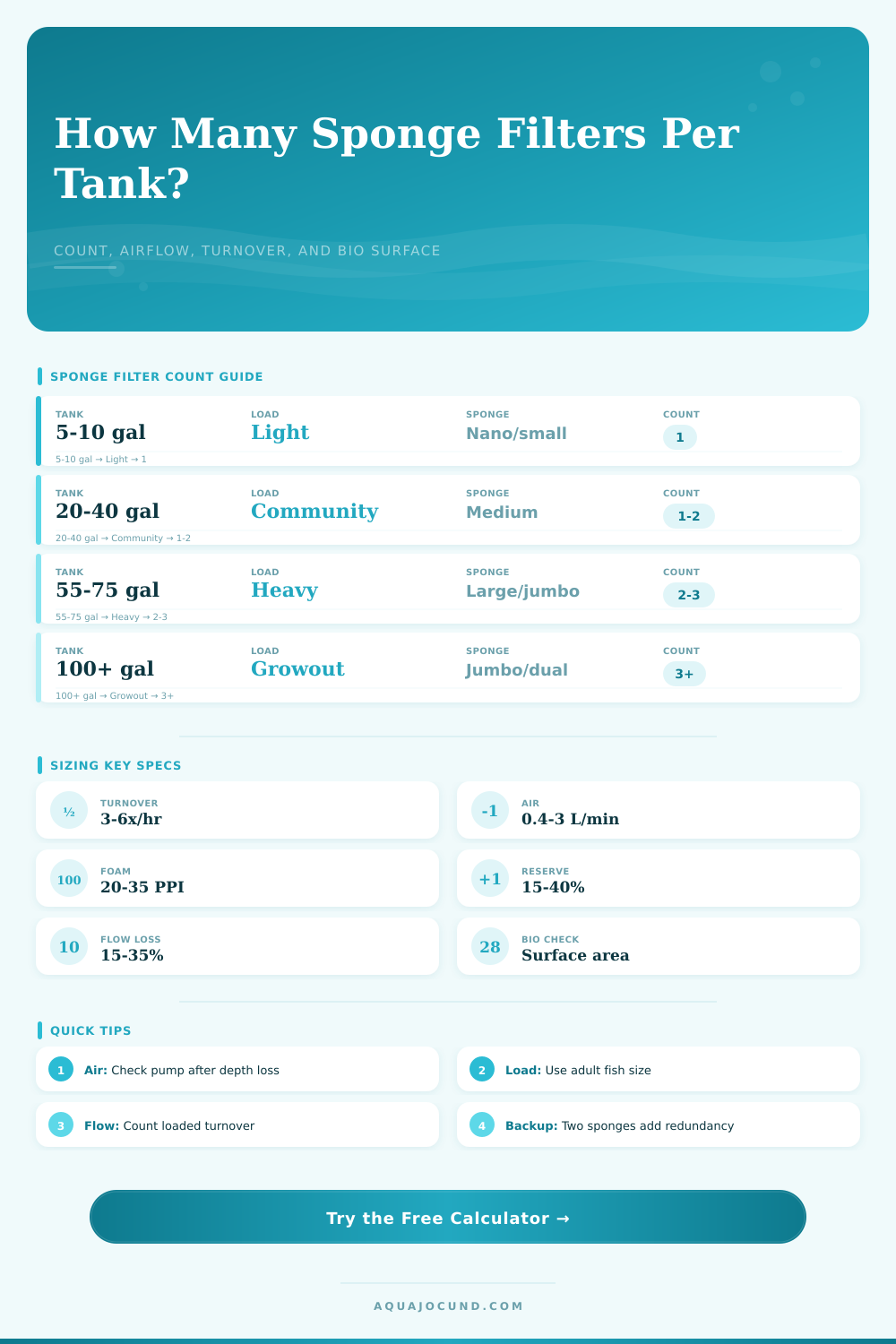
As freshwater hobbyists, we’re used to buying a new sponge filter, hooking up the tubing, and watching it sputter due to an insufficient air pump. Sponge filters look simple, but they’re actualy complex biological reactors that require a combination of surface area, water volume, and airflow. Once you input your tank size and stocking level into the calculator above, it do the math so you don’t have to guess about whether to use one medium filter or two.
Because there’s no mechanical force moving water through a sponge filter, it relies on bubbles to rise, pulling water into and up the foam structure. The more air that reaches bottom of the sponge in your tank, the stronger the filtration are. And contrary to intuition, depth is an important variable. Because of water pressure, deeper water compresses bubbles, decreasing there efficiency as a lifting mechanism. What works well running a sponge vigorously in a shallow nano tank won’t work as well than a deep five-five gallon aquarium. To account for this, the tool let you input depth loss and airline length so the recommended number of sponges takes into account real world physics instead of just theoretical capacity.
Why You Need the Right Air Pump for Your Sponge Filter
Keepers get fixated on the sponge’s size, while overlooking the air pump. Using a weak pump with a big sponge produces a stagnant zone where detritus accumulate. Pairing a big pump with a small sponge rapidly turns over water volume, but provides insufficient surface area for beneficial bacteria to attach. What you want is both sufficient sponge structure along with adequate water turnover.
The page contains a reference table that shows common air demand and pump flow rate matched with sponge profile. Use this to help determine if you’re balanced in terms of equipment.
Not so much “clean” as it is “maintain”, because you want to maintain the biological ecosystem that maintains your fish health. That’s why stocking density matter. A lot. A couple of messy, waste producing fish like cichlids will produce more waste in a 20g long than a group of timid tetras will in the same sized tank. Your answer to “what are you keeping” determines the appropriate stocking load profile. The calculator then use that profile to adjust the turnover rate. If you have heavy feeders, you’ll want increased flow because you don’t want rotting, uneaten food collecting on substrate. If you keep shrimp tanks, you know that gentle flows is preferred, you don’t want to tear your shrimp from their perches. Selecting the correct profile results in mathematics aligned with your bioload.
It is not just water volume. Sponges decrease over time. Efficiency decreases as biofilm builds up on them. A fresh sponge allows air to pass through easily. Biofilm forms inside sponge within a matter of months. This is good; it acts as a filter because it holds all those beneficial nitrifying bacteria that digest ammonia. But it also blocks the air passage. The tool factors in a flow loss percentage to account for this decline. That’s why users often ask, “Why does my filter get weaker over time?” Including an airflow loss percentage accounts for this sponge decline. This give a more realistic projection of how long it will last.
It prepares you for redundancy. When you need a filter, you could of just depend on one that will eventually become clogged. There is no better insurance policy than redundancy. Instead of a big sponge, you use two little ones. One gets rinsed in tank water periodically (every couple weeks). The other keep working. That way the bio load stay stable. No nasty spikes in waste. A simple change in operation. Huge impact on long term tank health. You want that tank nice and stable.
How many sponge filters do you need? It depends. It depends on what you have set up. It depends on the tank size. It depends on amount of livestock and their waste output. Take the calculator and get an idea of where you start from. Adjust according to what you see happening. If it’s all nice and clear, your parameters are good. You’re in the sweet spot. The bubbles is working hard for you. A well sized air pump can be a powerful thing. Don’t underestimate it.