Fish Bag Count Per Cooler Calculator
Estimate how many filled fish bags fit inside a cooler from bag dimensions, water and oxygen split, fish count, internal cooler dimensions, packed weight, and reserved heat pack space.
Cooler Bag Capacity Estimate
| Bag style | Shape factor | Tare basis | Measurement note |
|---|---|---|---|
| 2 mil single poly bag | 0.93 | 0.25 oz / 7 g | Light bag, less tare in weight math |
| 3 mil single poly bag | 0.91 | 0.35 oz / 10 g | Common aquarium fish bag reference |
| Double 3 mil poly bag | 0.88 | 0.70 oz / 20 g | Extra plastic slightly reduces packed volume |
| 4 mil single poly bag | 0.90 | 0.55 oz / 16 g | Thicker plastic, moderate tare |
| Square-bottom gusset bag | 0.96 | 0.60 oz / 17 g | Closer to rectangular volume when filled |
| Long koi transport bag | 0.89 | 1.20 oz / 34 g | Long footprint often limits layer count |
| Round-bottom fish bag | 0.86 | 0.50 oz / 14 g | Rounded corners reduce rectangular fit |
| Cooler label | Internal dimensions | Approx volume | Example bag count |
|---|---|---|---|
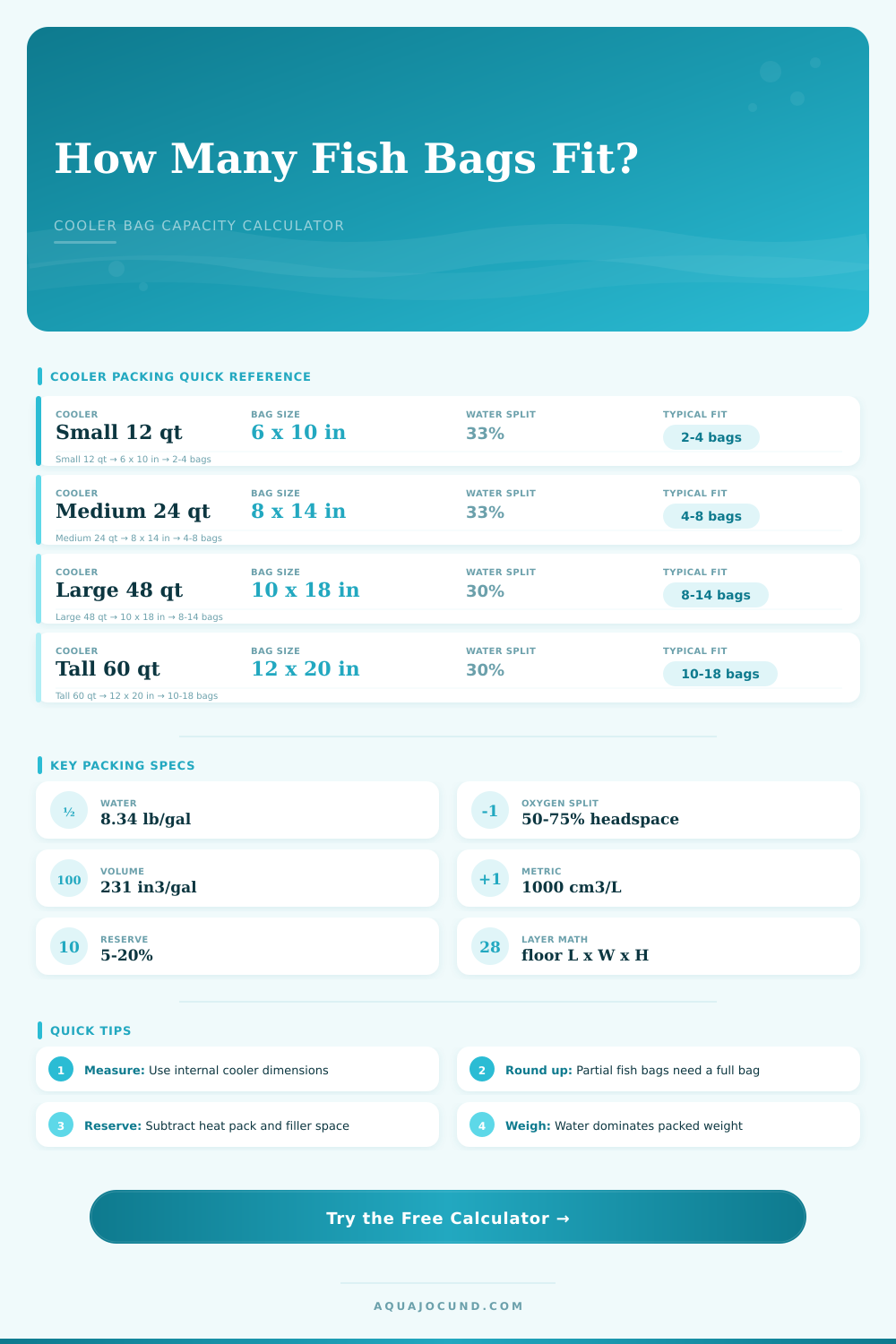
| Small hand cooler | 12 x 8 x 8 in / 30 x 20 x 20 cm | 3.3 gal / 12.6 L | 2 to 4 small bags |
| Medium shop cooler | 18 x 12 x 10 in / 46 x 30 x 25 cm | 9.4 gal / 35.4 L | 4 to 8 mixed bags |
| Large rectangular cooler | 24 x 14 x 13 in / 61 x 36 x 33 cm | 18.9 gal / 71.6 L | 8 to 14 standard bags |
| Tall bulk cooler | 27 x 16 x 15 in / 69 x 41 x 38 cm | 28.1 gal / 106.5 L | 10 to 18 stacked bags |
| Long tote cooler | 30 x 15 x 12 in / 76 x 38 x 30 cm | 23.4 gal / 88.5 L | 8 to 16 long bags |
| Filled bag basis | Approx filled volume | Water at 33% | Oxygen or air at 67% |
|---|---|---|---|
| 6 x 10 x 5 in pillow | 1.18 gal / 4.5 L | 50 fl oz / 1.5 L | 101 fl oz / 3.0 L |
| 8 x 14 x 6 in pillow | 2.62 gal / 9.9 L | 111 fl oz / 3.3 L | 224 fl oz / 6.6 L |
| 10 x 18 x 7 in pillow | 4.96 gal / 18.8 L | 210 fl oz / 6.2 L | 425 fl oz / 12.6 L |
| 6 in diameter x 10 in round | 1.22 gal / 4.6 L | 51 fl oz / 1.5 L | 105 fl oz / 3.1 L |
| 12 x 24 x 8 in long bag | 8.97 gal / 34.0 L | 379 fl oz / 11.2 L | 769 fl oz / 22.8 L |
| Limit checked | Formula used | Input affected | Result meaning |
|---|---|---|---|
| Floor grid | floor(L / bag L) x floor(W / bag W) | Cooler length and width | Bags per horizontal layer |
| Stacking layers | floor(usable height / bag height) | Cooler height and top reserve | Vertical bag layers |
| Volume capacity | usable cooler volume / filled bag volume | Reserve and heat pack volume | Bag count by displacement |
| Weight capacity | payload left / packed bag weight | Water split and fish weight | Bag count by lifting limit |
| Fish split | fish count / target fish per bag | Fish count profile | Bags required before cooler fit |
But now you’ve got forty pounds of water, plastic and living things in a cooler to carry up two flights of stairs. And water’s heavy. It’s unstable. You’re not packing bags; you’re packing liquid. A gallon of water weigh eight and a third pounds. Each cup of extra water makes your load noticeably heavier.
That’s where the calculator come into play. That’s where it checks your assumptions. It takes care of all geometry for you. You specify the internal dimensions of your cooler. You specify size of the full bags. How many will fit?
How the Calculator Helps You Pack Safely
The cool part is the constraints. Maybe you can only fit so many bag in volume, but maybe you cannot actualy lift that much. The calculator tests both constraints. It determines how many bags fits on the floor side by side. Then it figures out how many stack up vertically. Next it calculates how much room is left for loose filler and heat pack. Finally it looks at total weight. If the weight is more then you are willing to lift, the tool pulls back until there is less.
It keeps you from over packing. It keeps handle from snapping. And it keeps you back from going out.
More than folks think bag shape makes a difference. On label a pillow bag appears rectangular. Filled and tied they forms a rounded shape. Those are all wasted corners. Check out the shape factors by bag style on the page’s reference table. This compensate for wasted space.
Gusseted bags stands upright. They use their space better. Round bottom bags has air gaps at the corner. So if your koi transports come on long bags, you lose vertical space where you stack them. The footprint is too big to stack multiples of them. The calculator compensates. No need to count theoretical bag that won’t fit.
Another crucial factor is the water percentage. “You’re thinking about giving these fish more space; they’ll be more comfortable,” you say. That is a good instinct. However, adding more water add weight. It is not much volume, but it adds significant mass if you change from a thirty-thirty water-land split to a fifty-fifty water-land split. Oxygen headspace doesn’t change at all. Liquid load increases.
Toggle the water percentage with the tool and check out the tradeoff. Perhaps you end up fitting the same number of bags. But now you’ve reached your weight limit. That forces a decision: reduce the amount of water per fish or reduce the number of bag? There is no wrong answer. It is only a physical limit.
Water Weight and Heat Pack Volume
Heat packs are necessary for keeping water temperature stable so they need to be stashed in your cooler. That takes up room and adds weight. They’re not free either. A typical heat pack insert doesn’t take up much space. Depending on how many you use, three or four can easly take up the space of a bag or two in your cooler.
There is a place on the calculator that allows for inputting the weight and dimensions of the heat packs. So you know exactly how much it will knock out of your cooler capacity. Many people forget about this until last minute. When you don’t account for space, the bags won’t close correctly.
It spits out the weight of the packed cooler. It spits out an estimate of what bag capacity that is. It spits out how many bags you should of had based off your number of fish. The three should match up. Use a bigger cooler if the required amount is greater than the capacity. Take fewer fish on each trip if the required amount is greater than the capacity. Too heavy? Lighten up.
That’s all math. But it protects you from driving home with a disaster in your hands.
Want some wiggle room? Adjust the safety margin so you can overshoot a bit. Smart move. Transporting fish is stressful enough without having to add the extra stress of a full-to-bursting cooler.
Ultimately though, it’s a matter of control. Outside the truck, you have no control over the temperature or the traffic. Inside the truck, you do. How you pack the cooler is something you can control. This takes out the guessing game and allows you to know just how many bag will fit. What was once a chaotic loading process becomes a planned operation. You no longer have to guess whether it will fit.
Gone. Knowing? Here. That confidence matters when you have forty pounds of potential disaster in your hands. Getting them home safely is the goal. A little math goes a long way towards helping that.