💧 Submersible Pump Drain Rate Calculator
Estimate delivered drain flow, head and hose losses, runtime, removed volume, and residual water for a tank, sump, tub, or pond pump-out.
Drain Rate Breakdown
| Pump Curve Profile | Approx. Shutoff Head | Loss Character | Best Calculator Use |
|---|---|---|---|
| Compact utility pump | 7 ft per 1000 GPH | Flow falls quickly with lift | Short aquarium drains |
| Aquarium drain pump | 10 ft per 1000 GPH | Moderate head capability | Tank to sink or bucket |
| Pond pump | 13 ft per 1000 GPH | Better flow at medium head | Outdoor pond drawdown |
| Solids utility pump | 11 ft per 1000 GPH | Handles debris but loses flow | Stock tubs and basins |
| High-head transfer pump | 18 ft per 1000 GPH | Maintains lift better | Long vertical discharge |
| DC controllable pump | 9 ft per 1000 GPH | Depends on speed setting | Controlled service drains |
| Hose ID | Practical Flow Range | Typical Drain Use | Loss Warning |
|---|---|---|---|
| 1/2 in | 100-300 GPH | Nano tank or slow siphon assist | Restrictive above 300 GPH |
| 5/8 in | 200-500 GPH | Garden hose to nearby drain | Long runs cut flow hard |
| 3/4 in | 350-800 GPH | Common aquarium pump-out | Watch head above 5 ft |
| 1 in | 600-1500 GPH | Fast sump, tub, and vat drain | Good balance for home use |
| 1-1/4 in | 1000-2400 GPH | Sump pump discharge hose | Use smooth adapters where possible |
| 1-1/2 in | 1500-3600 GPH | Small pond or large holding tub | Keep kinks out of lay-flat hose |
| 2 in | 2500-6500 GPH | Pond drawdown and utility basins | Needs matching pump outlet size |
| Water Body | Dimensions or Volume | Target Drain | Typical Pump and Hose |
|---|---|---|---|
| 10 gal nano | 20 x 10 x 12 in | 30% water change | 200-400 GPH, 1/2 to 5/8 in hose |
| 20 long aquarium | 30 x 12 x 12 in | 50% reset | 400-800 GPH, 5/8 to 3/4 in hose |
| 40 breeder | 36 x 18 x 16 in | 75% drain | 800-1200 GPH, 3/4 to 1 in hose |
| 75 gal display | 48 x 18 x 21 in | 80% move prep | 1200-1800 GPH, 1 in hose |
| 100 gal stock tub | Known volume | 90% pump-out | 1600-2400 GPH, 1 to 1-1/4 in hose |
| 600 gal patio pond | Known volume | 85% service drawdown | 2400-3600 GPH, 1-1/2 in hose |
| Drain Factor | How to Measure | Calculator Role | Common Mistake |
|---|---|---|---|
| Rated GPH | Pump label at zero head | Starting flow before losses | Expecting label flow at sink height |
| Static lift | Water surface to outlet | Main head loss input | Measuring from tank bottom |
| Hose diameter | Inside diameter, not outer size | Sets friction and practical capacity | Using small hose on large pumps |
| Hose run | Full path to drain point | Adds friction head | Ignoring coils or extra length |
| Target percent | Percent of current volume | Sets removed volume and runtime | Forgetting residual intake water |
It’s frustrating to see a pump fighting physics. You purchase a pump with an advertised high flow rate so you can empty your pond or tank in record time, but then you find yourself looking at a slow trickle as water dribbles out like a snail. The box says the rated capacity and we want to believe it, but it’s a lie. Well, sorta. It is at least the kind of lie that you’re hoping for.
What it says on the box is the amount the pump can move if its sitting there doing absolutely nothing, no resistance, no gravity. In the real world, however, you’re battling some form of gravity or resistance all the time. Once you input your exact dimensions, calculator does all the complicated math about friction and head loss. This removes the guesswork for you and hopefully saves you from rushing your next water change and potentially spilling your livestock.
How to Predict Pump Time Correctly
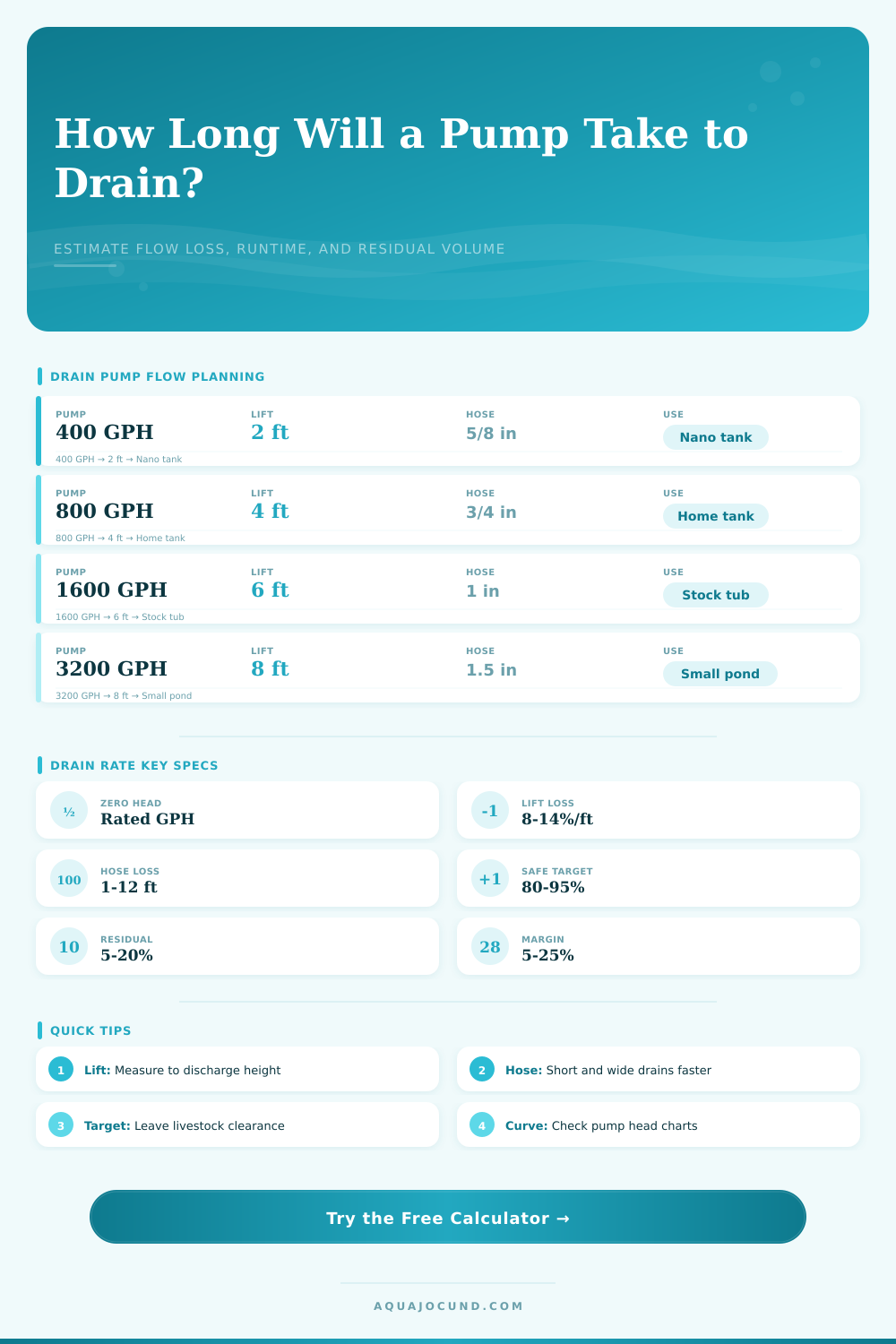
One reason for this failure is static lift, which is vertical distance from surface of the water to the point where the hose exits. The pumps is rated at no head…aka: zero head. They will pump X number of gallons per hour on level ground with zero head. You put one foot of water behind them and it drops dramaticly. Not a straight line drop off, but it’s steep enough to get most people by surprise. A pump that pushes a thousand gallons per hour on your table may only push four hundred when asked to lift the same water 5 feet. If you don’t know about the drop-off, a ten-minute job becomes an hour-long chore.
The pump also isn’t everything, it’s just as important what kind of hose you use. Just like traffic going through a small street becomes choked up, so does water flowing through a narrow hose. This means that using a large aquarium pump with a half inch garden hose create too much resistance for the pump to overcome. The tool comes with reference tables that describe practical flow ranges and will help you match size of the hose to how big of a pump it should be.
If you have a high pressure system, you don’t want a hose that causes clogs due to the high pressure. You want free flow. Smooth vinyl tubing works better different than corrugated hose because the ridges add friction and slow things down overall.
It also factors in residual volume; the water that’s left standing because your pump intake won’t reach all the way to the bottom. That’s not a design defect; it’s a safety mechanism. Running a pump dry can causes you to burn out the motor. It can also suck in debris which can damage the impeller. Having a few inches of residual ensures safe operation while still reducing the volume significanty. By factoring in the amount of residual volume, the calculator will estimate how much water you’ll be able to remove. In other words, it will give you an idea of what the actual water level will be after you’re done, so you’ll have a realistic expectation. Knowing there’s still a gallon in there is better then thinking you’re empty and reaching into it with a bucket.
The wild card in every drainage situation is some combination of debris and screen clogging. A clean screen will maximize flow, but once a screen starts accumulating sludge, plant matter, or pond fines, that’s less intake area. The calculator includes an allowance factor to handle heavy debris or dirty water. Make sure to increase this margin if you are draining a pond after a storm. This is a small thing, but it matters when you have a tight schedule. You don’t want to be caught off guard by a sudden slowdown.
The whole point is to accurately predict the run time, so you can plan your day. So ultimately, pumping down a tank is really an exercise in managing time and expectations. How big does it need to be? What size hose do I have? What’s my pump curve? These are all questions that will make you think deeply about your system and the outputs required. Consider them all together and don’t fall victim to common mistakes of overestimating one or two things and underestimating another.
Next time you’re trying to drain a tank, understand that that rated flow rate is only the beginning. It’s the hose. It’s the lift. It’s the crap in there. Understand those things and they’ll let you control the process instead of having the process control you. Give it time and give it the right path and the water will go where you want it to.