🧽 Matten Filter Surface Area Calculator
Size submerged foam face area, through-foam velocity, pore density, thickness volume, turnover flow, and estimated biofilm surface.
| Foam Type | PPI | Open Area | Surface Estimate | Velocity Guide |
|---|---|---|---|---|
| Coarse Reticulated Foam | 10 | 95% | 250 m²/m³ | 8-12 cm/min |
| Open Cell 15 PPI | 15 | 94% | 375 m²/m³ | 7-10 cm/min |
| Matten Foam 20 PPI | 20 | 93% | 600 m²/m³ | 5-8 cm/min |
| Medium Foam 30 PPI | 30 | 91% | 820 m²/m³ | 3-6 cm/min |
| Fine Foam 45 PPI | 45 | 88% | 1120 m²/m³ | 2-4 cm/min |
| Dual Layer 20/30 PPI | 25 | 91% | 700 m²/m³ | 4-7 cm/min |
| Pond Block 20 PPI | 20 | 94% | 520 m²/m³ | 6-9 cm/min |
| Custom Foam Data | editable | editable | editable | editable |
| Tank | Dimensions | Volume | End-Wall Foam | 4x Flow Velocity |
|---|---|---|---|---|
| 10 Gallon | 20 x 10 x 12 in / 51 x 25 x 30 cm | 10 gal / 38 L | about 92 sq in / 594 cm² | about 4.2 cm/min |
| 20 Long | 30 x 12 x 12 in / 76 x 30 x 30 cm | 20 gal / 76 L | about 110 sq in / 710 cm² | about 7.1 cm/min |
| 29 Gallon | 30 x 12 x 18 in / 76 x 30 x 46 cm | 29 gal / 110 L | about 166 sq in / 1070 cm² | about 6.9 cm/min |
| 40 Breeder | 36 x 18 x 16 in / 91 x 46 x 41 cm | 40 gal / 151 L | about 265 sq in / 1710 cm² | about 5.9 cm/min |
| 55 Gallon | 48 x 13 x 21 in / 122 x 33 x 53 cm | 55 gal / 208 L | about 250 sq in / 1613 cm² | about 8.6 cm/min |
| 75 Gallon | 48 x 18 x 21 in / 122 x 46 x 53 cm | 75 gal / 284 L | about 348 sq in / 2245 cm² | about 8.4 cm/min |
| 125 Gallon | 72 x 18 x 22 in / 183 x 46 x 56 cm | 125 gal / 473 L | about 364 sq in / 2348 cm² | about 13.4 cm/min |
| Status | Velocity vs Target | Meaning | Calculation Response |
|---|---|---|---|
| Gentle | Under 70% | Low pressure across the mat | Area has flow reserve |
| Balanced | 70-100% | Within the selected foam guide | Use calculated layout |
| High | 100-130% | Foam may pull harder as it loads | Add face area or reduce turnover |
| Too Fast | Over 130% | Velocity exceeds the planning target | Use larger or coarser foam |
| Item | Formula | Imperial Factor | Metric Factor |
|---|---|---|---|
| Tank volume | length x width x height | 231 cu in = 1 gal | 1000 cm³ = 1 L |
| Target flow | tank volume x turnover | gal/hr to L/hr x 3.78541 | L/hr to gal/hr x 0.264172 |
| Foam velocity | flow per minute / effective face area | 1 sq in = 6.4516 cm² | direct cm² |
| Foam volume | face area x thickness | 1 cu in = 0.0163871 L | 1000 cm³ = 1 L |
| Bio surface | foam m³ x SSA x usable factor | 1 m² = 10.7639 sq ft | direct m² |
Use the wet face: subtract dry top margin, lift tube slots, frames, and side gaps before judging velocity through the foam.
Check the loaded case: the clogging allowance shows velocity after biofilm and trapped solids reduce open face area.
What does filtration look like? If you’ve ever put a sponge under running water, you know, it doesn’t look much like filtration. It looks like chaos.
And that’s what it can be in a matten filter if the sponge’s surface area are not enough for the pump’s output. Instead of being pressed up against the sponge, the water just rips through it. Your helpful biofiltration bacteria starve while your detritus float back into your tank.
How to Use Foam for Better Filtration
Getting the face area right is less about geometry and more about patience. You want the face area to create just enough gentle resistance to force the water to hang around just long enough to do its job mechanically and biologically.
Once you enter your tank dimensions and foam specifications into the above calculator, it does all the math for you so you don’t have to guess if you have too much or too little foam.
What about the wetted surface? How much does that really matter? Yes, maybe you’ve got a sheet of foam that’s a dozen inches on each side but maybe the water comes up only an inch from the top. What do you have then? Eleven inches. And that makes all the difference in how fast the water moves over the whole surface area. It’s velocity that matters here.
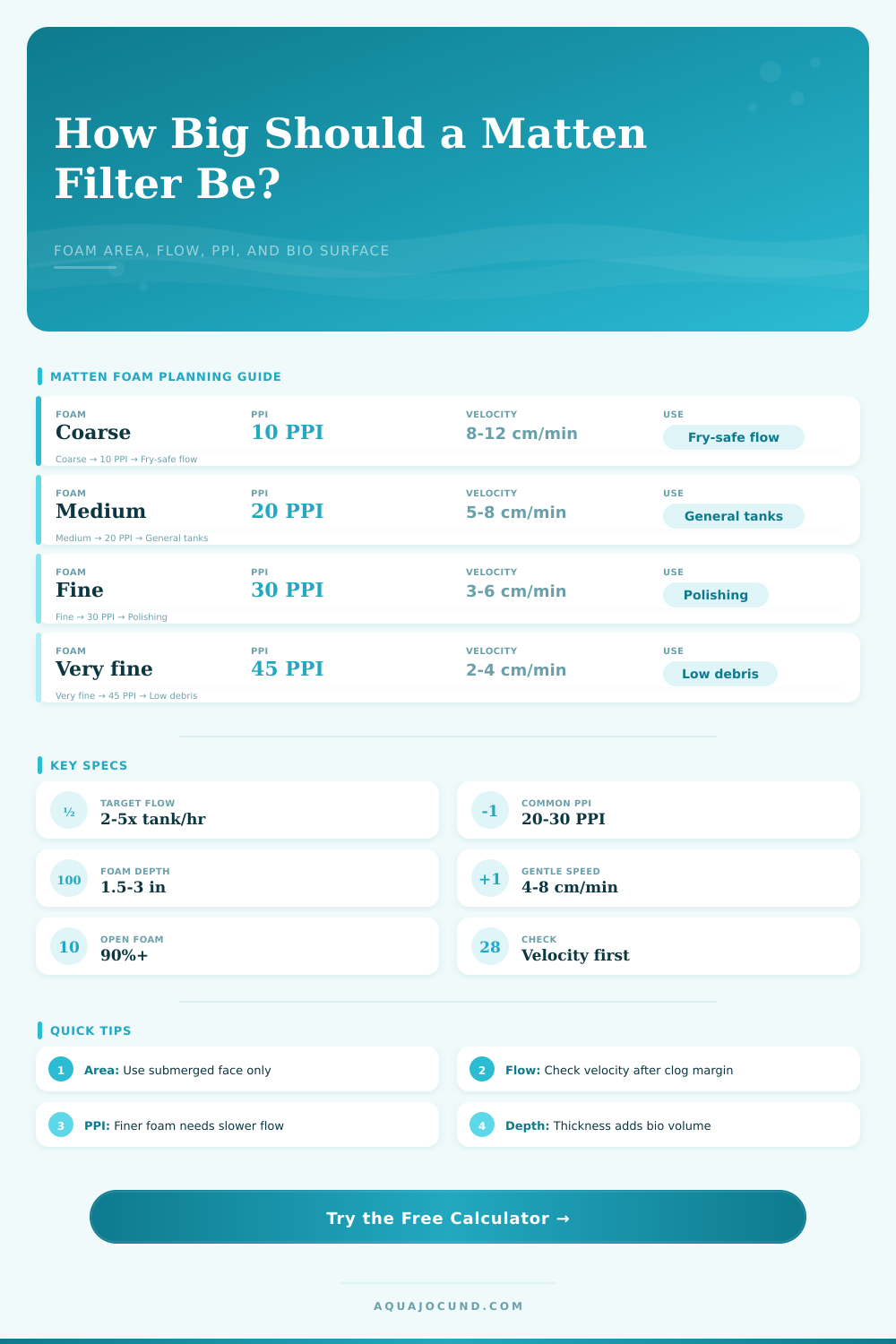
Do you want the water moving slowly so that debris gets trapped, or do you want it moving quickly enough to shoot right through at 12 centimeters per minute? Obviously, most people is looking to maintain their flow around 5, 8 centimeters per minute for general stock. At that rate, it doesn’t feel like much to you but it’s great for growing biofilm.
The calculator helps you see this because it includes the clogging allowance. A new filter runs faster then a used filter. You might be surprised to find that your filter’s lifespan has decreased by two weeks and it is not performing as well. A twenty-five percent clogging buffer takes into account the biofilm layer that’s going to form in the pores eventually. This is a little change, but it helps it last longer.
This friction has to do with pore density. A rough foam (ten pores per inch) will capture big chunks of uneaten food while not choking off flow. Think of it as a coarse sieve. A fine foam (forty-five pores per inch) will catch tiny particulates and dust but will work more like a polishing stage.
The issue? The finer the foam, the more it will restrict flow. Run a high-output pump through very fine foam, especially if there isn’t enough surface area, and you’ll create a vacuum effect. The water rips the foam apart or simply bypasses it altogether.
With the calculator, you have the option of mixing those variables. Want a sheet of foam that’s medium-thick? No problem. How about a thin layer of really fine stuff? See how it changes your biological surface area.
Total surface area: This is a technical term called specific surface area, which refers to all of the internal wall space available inside the foam for bacteria to colonize. More surface area mean more biological filtration capacity. Catching junk isn’t the only deal; it’s creating the microbes that eat the ammonia.
Another source of confusion surrounds tank turn over. Common advice is that “you should turn your tank 5X per hour.” That may be true, but it also may be too much for a matten filter. Because the water moves slowly and has resistance to flow in a Matten filter, two; four times might be all that’s needed. Remember: Volume = Good; Speed = Bad. Watch the bio surface estimate when looking at output. This provides an idea of what sort of biological load you can put on the system. Even if a tank is large and the foam panel is small, a low calculated velocity doesn’t always mean a low actual velocity upon contact. In other words, insufficient bio surface means water quality will still crash during feedings.
The page has a reference table that shows how various foam materials trade off density against open area.
Lastly, don’t skimp on foam thickness. A half-inch of foam isn’t going to provide much in the way of space for bacteria to colonize. A couple inches of foam will give you depth as well as backup. If the front side gets clogged up, there are other ways for the water to get through the remaining layers. This gives you time before you’ll need to clean it again. It takes what was just a strainer and turns it into a livig organ.
That is what you have been doing all along. You are slowing the water down. You are giving it someplace to go. Making the foam work harder than the pump does. Once the flow equals the surface area, the filter becomes invisible to you. You no longer have it at the forefront of your mind. The water remains clear. The bacteria multiply. Everything hums along quietly and efficiently because you paid respect to the physics of foam from the beginning.