Coral Acclimation Light Schedule Calculator
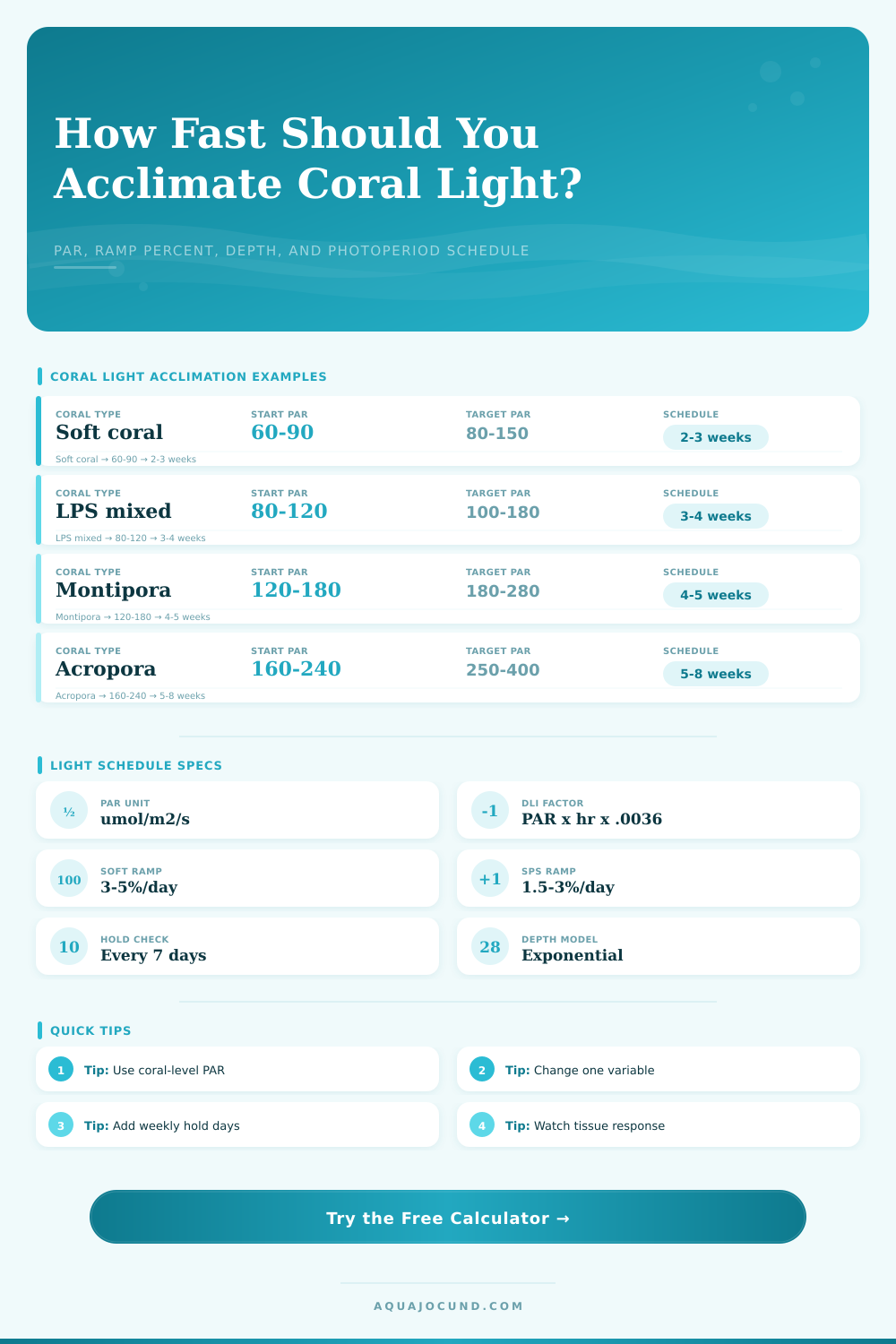
Plan gradual reef light changes from current PAR to target PAR using ramp percent, photoperiod, depth attenuation, and weekly hold days.
Calculation breakdown
| Day | Ramp | Peak PAR | Photoperiod | DLI | Action |
|---|
| Week | Ramp range | PAR range | Photoperiod range | Weekly check |
|---|
| Profile | Typical PAR band | Default target | Daily PAR step | Photoperiod step | Schedule note |
|---|---|---|---|---|---|
| Soft coral | 60 to 150 | 110 | 4.5% | 0.35 hr | Usually tolerates steady ramping when flow is stable. |
| Zoanthid or palythoa | 80 to 180 | 135 | 4.0% | 0.30 hr | Open polyps are a useful weekly response check. |
| Mushroom or ricordea | 40 to 120 | 80 | 3.0% | 0.25 hr | Use lower targets if tissue stretches away from light. |
| Low light LPS | 70 to 140 | 105 | 3.0% | 0.25 hr | Fleshy tissue benefits from slower peak increases. |
| Euphyllia branching LPS | 90 to 180 | 135 | 2.7% | 0.25 hr | Hold the week if extension shortens noticeably. |
| Montipora SPS | 150 to 300 | 230 | 2.5% | 0.20 hr | Ramp PAR before extending the day too far. |
| Acropora SPS | 200 to 400 | 300 | 2.0% | 0.15 hr | Use smaller changes after shipping or moving colonies. |
| Mixed reef conservative | 80 to 250 | 160 | 2.5% | 0.20 hr | Choose the pace for the most sensitive coral in the zone. |
| Profile | Attenuation coefficient | 12 in depth | 20 in depth | Use when |
|---|---|---|---|---|
| Clear water, open rockwork | 0.10 per m | 97% remains | 95% remains | Open top, clean water, little shading. |
| Typical reef water | 0.18 per m | 95% remains | 91% remains | Normal aquarium water and rock shadows. |
| Screen top or light diffuser | 0.24 per m plus 8% | 86% remains | 81% remains | Mesh lid, diffuser panel, or splash guard. |
| Tall aquascape shading | 0.28 per m plus 12% | 80% remains | 76% remains | Coral sits under overhangs or shelves. |
| Tinted water or film algae | 0.38 per m plus 10% | 80% remains | 73% remains | Yellowing water, dirty glass, or film algae. |
| Deep blue heavy spectrum | 0.14 per m plus 4% | 92% remains | 90% remains | Blue-heavy output with clean water but some fixture loss. |
| Tank style | Dimensions | Volume | Typical coral depth | Typical schedule use |
|---|---|---|---|---|
| Nano cube | 15 x 15 x 15 in / 38 x 38 x 38 cm | 14.6 gal / 55 L | 6 to 12 in | Small ramp changes because coral is close to the light. |
| 20 long reef | 30 x 12 x 12 in / 76 x 30 x 30 cm | 18.7 gal / 71 L | 6 to 10 in | Short depth but broad footprint; watch edge PAR. |
| 40 breeder reef | 36 x 18 x 16 in / 91 x 46 x 41 cm | 44.9 gal / 170 L | 8 to 14 in | Useful mixed reef baseline for 3 to 5 week ramps. |
| 75 gallon reef | 48 x 18 x 21 in / 122 x 46 x 53 cm | 78.5 gal / 297 L | 10 to 18 in | Depth attenuation matters for sand bed LPS targets. |
| 120 gallon reef | 48 x 24 x 24 in / 122 x 61 x 61 cm | 119.7 gal / 453 L | 12 to 22 in | Use separate schedules for upper rock and lower zones. |
| Frag tank | 48 x 24 x 12 in / 122 x 61 x 30 cm | 59.8 gal / 226 L | 4 to 10 in | Low water height makes ramp percent especially important. |
| Change type | Gentle step | Standard step | Upper planning step | Best use |
|---|---|---|---|---|
| Ramp percent | 0.5 to 1% per day | 1 to 3% per day | 3 to 5% per day | Primary control for peak PAR changes. |
| Peak PAR | 3 to 6 PAR per day | 5 to 12 PAR per day | 10 to 18 PAR per day | Use lower steps for SPS or stressed coral. |
| Photoperiod | 0.10 to 0.20 hr per day | 0.20 to 0.35 hr per day | 0.35 to 0.50 hr per day | Extend after peak PAR is close to target. |
| Weekly hold | 2 to 3 days | 1 day | 0 days | Useful after visible stress or a large PAR jump. |
| DLI increase | 3 to 6% per week | 6 to 12% per week | 12 to 18% per week | Checks combined PAR and photoperiod load. |
And then you install the bracket, and buy the lights. You plug the driver in and the LEDs illuminate. They glow brightly in that blue color of theirs, which casts such a nice glow over your tank. It looks good.
It lasts for about as long as it takes before you look at the Acro in the corner, which has now gone white. Maybe the soft coral in the front right stretch out towards the top where it want to be gone. So what’s going wrong?
Why Slow Light Changes Are Important
A very common mistake for reef keeper is confusing fixture output with coral health. Bright doesn’t equal thriving corals. Shocking them won’t make them thrive.
The idea with light acclimation is not necessarily about getting to a certain number, but making changes at a rate that matches how corals adapts to increased light levels (i.e., manage the rate of change). Coral tissue biology adjusts to the amount of available light (PAR). Energy availability changes pigments and the density of zooxanthellae, and the tissue itself thicken or thins. It doesn’t happen overnight.
When light increases rapidly, the photosynthetic machinery gets overheated. To protect itself from harm, the coral bleaches its algae. That’s a survival mechanism. But it appears to be failing. You don’t want to cause that type of stress response.
You want to make small changes (ones the coral hardly perceives). This means that the calculator figure out the math for you after you input your starting conditions and where you want it to be. You don’t need to guess at what number of days are safe to switch over.
This also guides you toward thinking about ramp percent (i.e., the maximum light level) rather than only thinking about overall hours. Long hours with moderate light won’t cause stress as much as brief hours with a high peak light.
The calculator will break this down into individual day steps. That way, you’re not going from 50 PAR to 200 PAR overnight. This is where folks mess up frequently. They care about the final PAR. However, they neglect the path that leads there.
Consider depth as well. In addition to lighting your tank, how deep is it? You might not think that’s important, but it matters. Light is weakened by water. It travels through it but as it does it will hit things like debris and rock work in its path. That means a piece of coral on top of some high rock gets more light than one sitting on the sand bed below.
To compensate for this, the calculator use attenuation profiles to factor in the fact that algae or film on the water alters the way clear water let in light. Just measuring PAR at the surface and assuming half reaches the bottom is probably an underestimate. The only way to know for sure is to put a meter where the coral sits. Otherwise, you are flying blind.
The other factor that can be adjusted is photoperiod. Usually you don’t want to go from 20% brighter to 25%, but rather extend your days just 15 minutes. You use the calculator to balance the two.
That’s why you hold one constant for several days per week (sometimes a day). A rest is very important because it gives you time to asses the tissue reaction without pushing it further. Stop if the coral is retracting polyps or going pale.
When everything appears stable, then you continue, never pushing again until the coral can handle it. Patience is the key to a vibrant reef or a graveyard of bleached corals.
Not all corals tolerate the same level of light. Generally speaking, soft corals and zoanthids is more forgiving because they can handle a wider range of light and faster changes. On the other end of the range, small polyp stony corals; especially Acropora. Are sensitive. They require a slow increase with precision.
The tool has preset profiles. These profiles adjusts the daily step size to match each one. If you’ve moved your corals into a new tank, or they’re stressed due to shipping, you can still tweak these further.
For example, a sensitive coral may require a ramp change of just one percent per day. It sounds tiny, but that is a big difference over three weeks. It will add up to a significant transition without causing shock.
DLI (daily light integral) measures both duration (how long the lights are on) and intensity (how bright they shine). Think of it as the total energy dose of your light. That’s why it can be a good metric for making comparisons between two schedules.
If the calculator estimates that DLI is 0.5 mol m-2 s-1, for example, then you know what the total energy load is; which in turn helps you know if your schedule provides sufficient light to drive growth without harming corals.
Bright isn’t everything. It’s also about the cumulative dose over time. Reef lighting takes time. Time rewards patience and careful observation.
What are the numbers? They’re your framework. How does it look to your eyes? That’s the final validation.
Do you keep watching your corals? Yes, you do. And you make adjustments accordingly. You don’t rush things; the light won’t be up long enough for that. But you wait. They’ll have time to acclamatize.