💉 Spot Treatment Syringe Volume Calculator
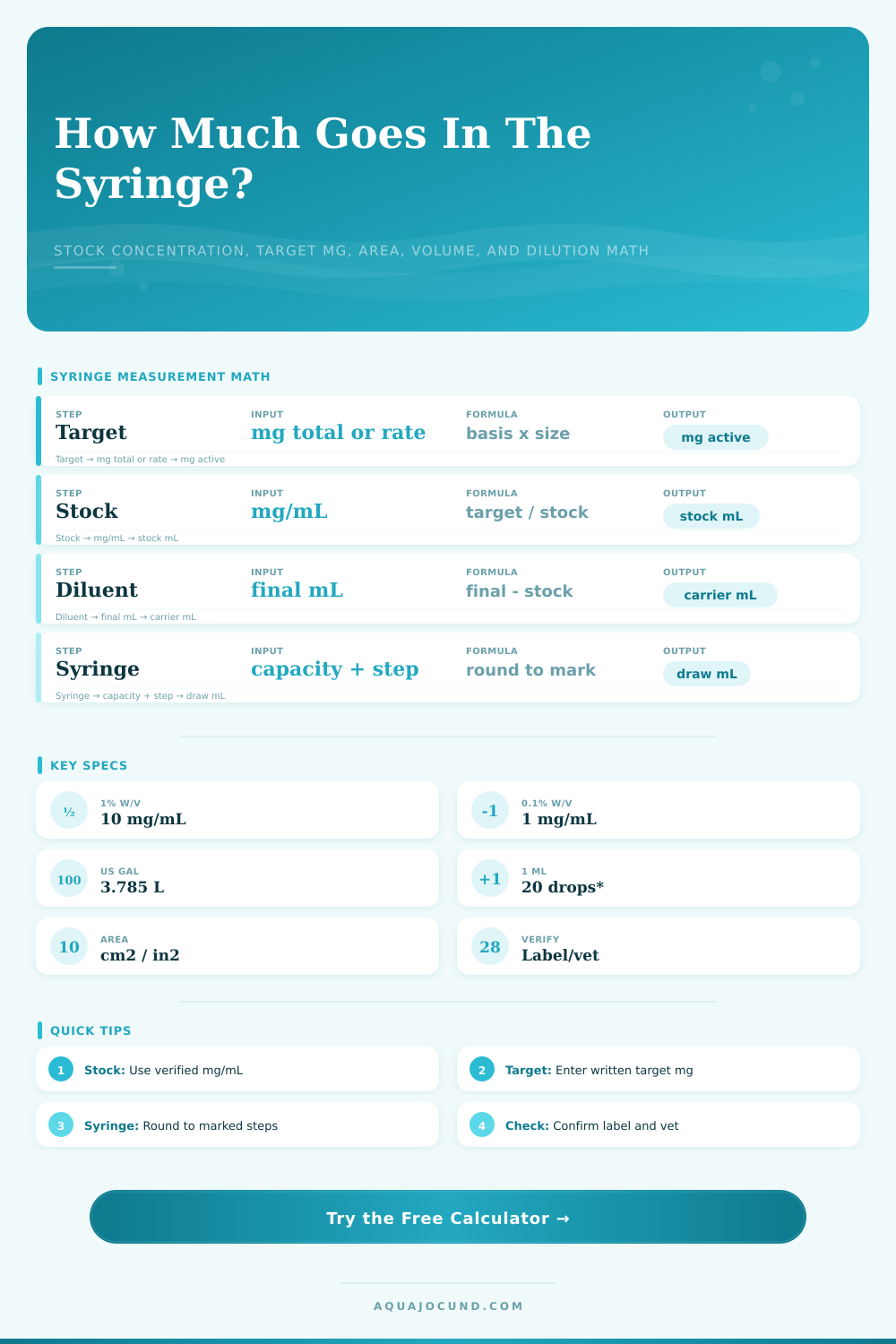
Convert verified stock strength, target active amount, spot area or container volume, dilution carrier, syringe capacity, and plunger markings into mL measurement math.
Syringe measurement worksheet
| Stock format | Entered value | Converted mg/mL | Use in calculator |
|---|---|---|---|
| Liquid stock | mg active per mL | value entered | Direct stock concentration field |
| Percent w/v | grams per 100 mL | percent x 10 | 1% w/v = 10 mg/mL |
| Powder batch | mg dissolved / final mL | mg divided by mL | Preparation-record worksheet |
| Tablet batch | mg per unit / final mL | mg divided by mL | Only if fully dissolved and verified |
| Dropper estimate | mL per drop | stock mg/mL unchanged | Use syringe when possible |
| Syringe profile | Capacity | Typical marked step | Rounding note |
|---|---|---|---|
| Fine 1 mL syringe | 1 mL | 0.01 mL | Best for very small draw volumes |
| Oral 1 mL syringe | 1 mL | 0.05 mL | Common small-volume measuring tool |
| 3 mL syringe | 3 mL | 0.1 mL | Useful for small diluted mixes |
| 5 mL syringe | 5 mL | 0.2 mL | Check mark spacing before using |
| 10 mL syringe | 10 mL | 0.5 mL | Coarser for low-volume stock draws |
| Common size | Imperial dimensions | Metric dimensions | Reference amount |
|---|---|---|---|
| 1 in round spot | 1 in diameter | 2.54 cm diameter | 0.79 in² / 5.07 cm² |
| 2 x 1 in patch | 2 x 1 in | 5.08 x 2.54 cm | 2 in² / 12.9 cm² |
| 6 x 0.25 in strip | 6 x 0.25 in | 15.2 x 0.64 cm | 1.5 in² / 9.68 cm² |
| 250 mL cup | 0.066 US gal | 0.25 L | Container concentration basis |
| 1 L container | 0.264 US gal | 1 L | Container concentration basis |
| Check item | What to verify | Calculator field | Record wording |
|---|---|---|---|
| Target | mg total, mg/cm², or mg/L | Target basis fields | Written label or vet target |
| Stock | mg/mL after any preparation | Stock concentration | Lot, date, concentration |
| Dilution | carrier type and final volume | Final syringe mixture | Stock mL plus diluent mL |
| Syringe | capacity and mark spacing | Syringe profile | Rounded draw amount |
| Boundary | Math only, no diagnosis | Status line | Label/vet verification complete |
Imagine you are staring at a piece of rock that has some sort of algae or decay on it. The syringe is in your hand and you’ve read the label, you know how strong the solution is that’s going into it. It’s arithmetic. It’s the difference between knowing what to dose and not overdosing. It is the difference between what you know and what you do.
The spot treatment syringe volume calculator spans the chasm between your verified stock concentration and the exact milliliter draw you need based off the volume/area you’re treating. I know most folks think they can just wing it, guessing at some arbitrary volume that “looks about right” when applying a liquid treatment. Not so much. Understanding the relationship between the strength of the bottle and the strength of the application is the line between therapeutic dose and toxic shock event for many.
How to Use the Syringe Calculator
Once you input your desired metrics into the calculator, it do all the math for you, saving you from fumbling with dilution ratios and unit conversions on-the-fly while stressed out. It makes you stop and clearly identify what it is you are actualy trying to measure.
So what’s your dose going to be used for? What is the target? Am I dosing a fish in a single cup of water (a dip)? Or am I targeting a specific section of rock face for a patch treatment? You can use volume calculations or area calculations with the tool. Why does that matter? Because surface treatments need to wet a set number of inches or square centimeters. Dipping items into a large amount of liquid require reaching a specific concentration in a certain volume of liquid. Even though both end up at the same place (same result) their starting points are very different. For example, if you treated a flat surface like a volume, you’ll likely have way over applied the chemical. The geometry gets accounted for automatically by the math.
Next comes the stock concentration. This can get a little tricky with labels. Some show it as percentage and some show it in milligrams per milliliter. That’s what the calculator normalizes for. So if you’re starting with a one percent solution of stock, it will recognize that as being equal to ten milligrams per milliliter. No need for you to memorize that conversion. Simply make sure you’re inputting the actual strength of the active ingredient itself. This is more important when diluting your own tablets/powder. In that case you’ll want to know exactly how many milligrams that tablet contains when you dissolve it into, let’s say, fifty milliliters of water. The reference table on the page breaks down those conversions so you can double check your thought process before you begin drawing up the liquid.
There are also some practical constraints, like the type of syringes used. For example, a ten milliliter syringe sucks at measuring small quantities of stock solution. Those gradations is simply too far apart. Trying to draw out point zero five milliliters using a syringe marked in half-milliliter increments is an invitation to fail. To solve this issue, the calculator allows you to specify your syringe size as well as its smallest physically-marked increment. From there, it will round your theoretical draw up to the next physical increment of your specific instrument. This shows you how much you can draw out versus how much the optimal math would suggest drawing out. When the rounded value causes a substantial change from your initial dose, the tool flags it. Time to grab a smaller syringe or dilute your stock again.
It accounts for dilution, Diluting your stock sometimes requires mixing it with a carrier fluid, such as tank water, in order to spread it evenly. It’ll tell you how much diluent to add until you get to your desired final volume. That way, you can be confident that the active ingredient will stay consistent regardless of whether or not you’re spreading it out. It will also help reduce the risk of localized toxicity. If you have a potent concentrate, you can still spread it out over a greater amount of carrier water to get an even spread throughout the target area.
And then there’s proofing. That’s where nothing beats the label. Remember: the calculator doesn’t recommend products, diagnose diseases, or replace reading the label. All it does is convert what you give it into a different form. Your goal numbers need to be verified as coming from a trustworthy source. That safe harbor comes from a trusted manufacturer’s guide or a veterinarian. The calculator gives you accuracy. Combined with this other tool, they avoids errors.
You should of used the calculator before treating anything. Dosage isn’t rocket science; it’s measure twice, dose once. You’ve got the tool, you’ve got the plan. You now know exactly how much to take out. Leave the guesswork behind and treat that spot with confidence.