🧽 Aquarium Maintenance Workload Calculator
Estimate hands-on minutes, travel and setup time, water-change volume, supplies volume, and weekly or monthly workload blocks for aquarium visits.
✅ Aquarium Maintenance Workload Results
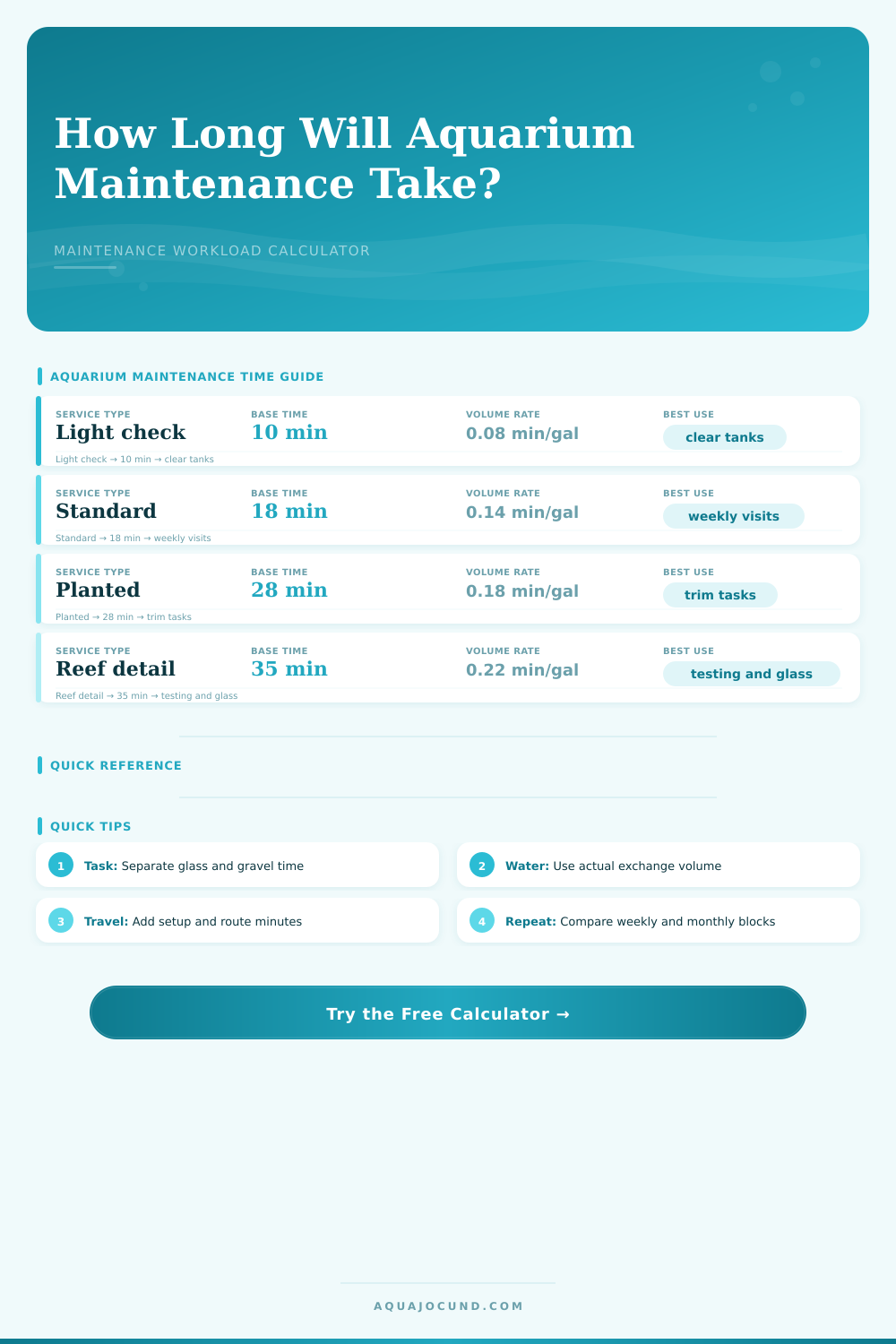
| Profile | Base Minutes | Volume Rate | Task Emphasis |
|---|---|---|---|
| Light check and wipe | 10 min | 0.08 min/gal | Glass wipe, top-off observation, quick notes |
| Standard maintenance | 18 min | 0.14 min/gal | Water change, glass, substrate, media rinse |
| Planted trim visit | 28 min | 0.18 min/gal | Trimming, debris removal, equipment reset |
| Reef detail visit | 35 min | 0.22 min/gal | Testing, algae control, saltwater handling |
| High bio-load gravel visit | 26 min | 0.20 min/gal | Longer substrate work and filter rinse |
| Algae reset visit | 40 min | 0.26 min/gal | Manual removal, repeated glass passes |
| Quarantine tank visit | 14 min | 0.12 min/gal | Small-volume hygiene and careful notes |
| Deep detail visit | 48 min | 0.30 min/gal | Extra teardown, hose work, and reset checks |
| Tank Group | Typical Dimensions | Volume | 25% Exchange |
|---|---|---|---|
| Nano desktop | 16 x 8 x 10 in / 41 x 20 x 25 cm | 5.5 gal / 21 L | 1.4 gal / 5.2 L |
| 10 gallon tank | 20 x 10 x 12 in / 51 x 25 x 30 cm | 10 gal / 38 L | 2.5 gal / 9.5 L |
| 20 long tank | 30 x 12 x 12 in / 76 x 30 x 30 cm | 20 gal / 76 L | 5 gal / 19 L |
| 55 gallon tank | 48 x 13 x 21 in / 122 x 33 x 53 cm | 55 gal / 208 L | 13.8 gal / 52 L |
| 75 gallon tank | 48 x 18 x 21 in / 122 x 46 x 53 cm | 75 gal / 284 L | 18.8 gal / 71 L |
| 125 gallon tank | 72 x 18 x 21 in / 183 x 46 x 53 cm | 125 gal / 473 L | 31.3 gal / 118 L |
| Water Type | Prep Volume Rule | Handling Note | Output Shown |
|---|---|---|---|
| Tap with conditioner | 5 mL conditioner per 10 gal | Round up for measuring spoon or cap accuracy | Conditioner mL and exchange volume |
| RO/DI freshwater | 100% of exchange volume | Reservoir fill and remineralizing time may be separate | Prepared water volume |
| Prepared saltwater | 100% of exchange volume | Mixing and temperature matching should be planned ahead | Prepared saltwater volume |
| Aged freshwater | 100% of exchange volume | Container swaps usually dominate handling count | Reservoir draw volume |
| No treatment counted | 0 mL additive estimate | Use for dry task planning or observation-only visits | Exchange volume only |
The spreadsheet gets in the way because when you sit down to map out this month’s route or give a prospective customer a quote, it start to feel less like a helper and more like a trap. Those tanks are glass boxes, nothing but boxes. But keeping up with them is a logistical issue. And making money is all about knowing exactly what tiny fraction of minutes slip away. You waste seconds when you change more water than you meant to, when you haul a hose upstairs or when you can’t find the nearest sink. And yes: estimating the time is not simply about tank size; it’s about the route water travels from bucket to drain and everything along the way.
Once you go through the steps above and provide your dimensions, the calculator do all the math for you, no more guessing what the coefficient should be. This helps you learn why those numbers matter.
Why This Tool Saves You Time and Money
Setting up a 20g water change on a big tank and a 5g water change on a small tank takes roughly equal amounts of time. It’s not the amount of water that’s heavy work; it’s the ritual. You’re unplugging stuff, scraping glass, mixing additives, rinsing filter, etc. Looking just at the water exchange number makes you underquote yourself. Most estimates don’t separate out the base task time from the amount of volume-dependent work. The tool force you to do that.
What about the type of job? How do you think a quick surface skimming compares to pruning plants in a planted tank? Because your touch on the water is so slight, that seem like a fast job, right? But the calculator makes up for it by assigning certain minutes per gallon based off the nature of the task. A reef tank demand more attention than a cold-water community setup because the stakes are higher and the parameters tighter. Cold-water tanks needs less care. More detailed profiles include buffer time to deal with algae and test parameters. That’s real life. Rushing to clean corals can hurt them. It is another little thing, but it is important to consider when looking at your bottom line.
Another variable is the water source. Do you haul pre-made saltwater or remineralize? Do you have to deal with temperature changes? That take time. Do you use tap water treated with conditioner? Be careful…you must be sure how much you dose. It is on demand but can be quick. Does your system hold enough supply water? The amount of water going in and out will affect how long it takes to refill the volume. Remember all that bucket filling time? All those minutes waiting for salt to dissolve? All those supply volumes you have to account for? This take that into account.
What about access? How easy is it to get to your tank? Is it in a tight cabinet? An open living room? Access impacts how hard it is physically, which we use to adjust our time estimates. You may not realize it until you’re on your knees, but it’s a big part of the work load.
Setup blocks and travel time gets overlooked until they eat all your days. Setting up gear at stops is productive work. Driving around in-between them isnt. You can enter setup time and route minutes into the calculator to see how much work you can do realistically. How many stops will that get you during a normal work week? That takes away stress and overbooking.
Time keeps on slipping…into wrong price You can’t charge for something you didn’t count. Time is money, and if you don’t know how long it takes to do a job you wouldn’ve be able to price it accurately. So when you break it down, the cost of glass, gravel, filters, and travel equals your quote. It’s about planning, not speed. Knowing exactly what each minute and each gallon costs eliminates guesswork. Guessing doesn’t grow a business; knowing does. And knowing is more priceless than a fast quote.